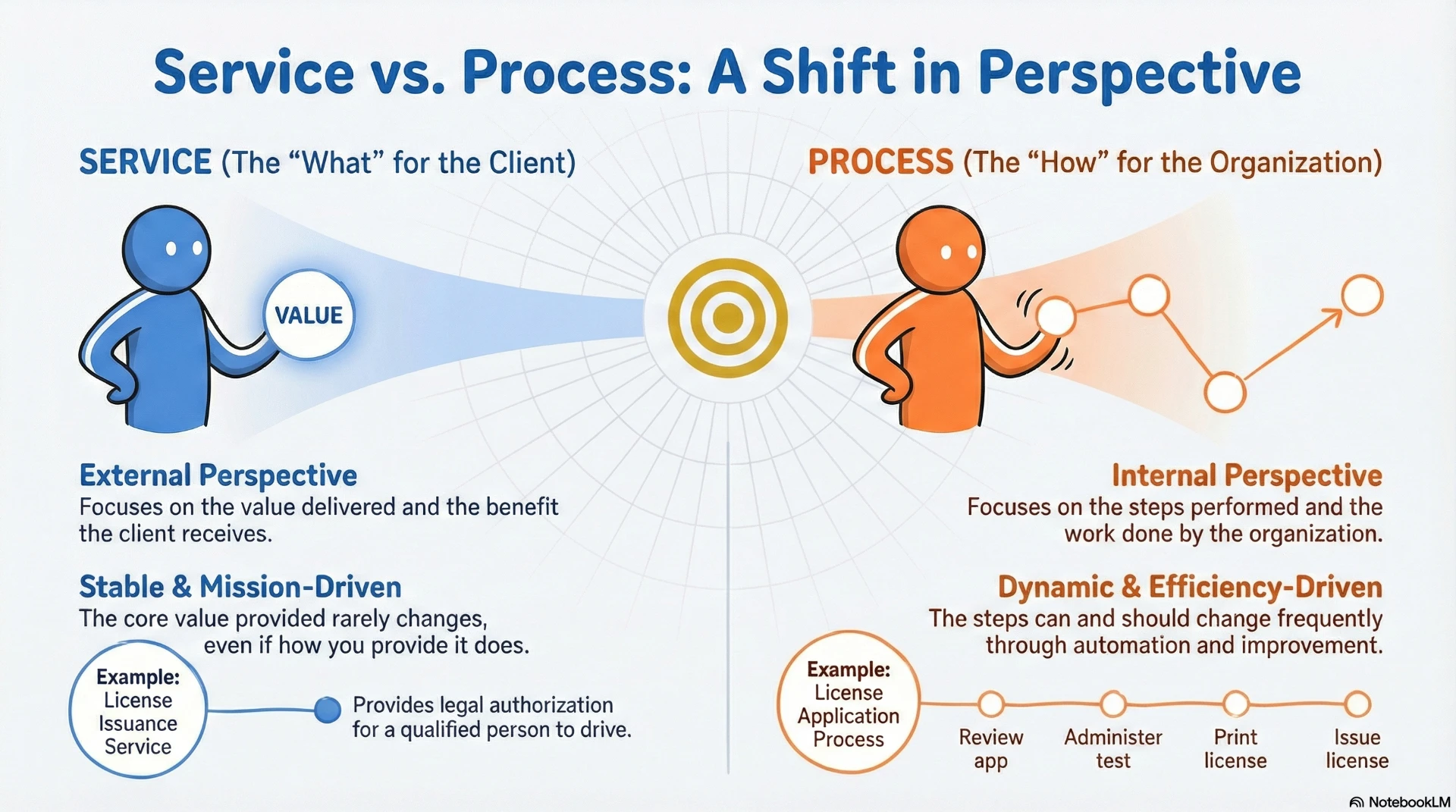
1. **Review your organization's service catalog or inventory. Are services defined by client value or by internal organizational structure?** If a service is named "Division X Processing Service" instead of "Provide [Value] to [Clients]," what does that reveal about service design philosophy?
2. **Analyze the GSRM type distribution across your program's services. Is there heavy concentration in certain types (e.g., many "Provide Periods of Permission" but few "Provide Advisory Encounters")?** Could outcome achievement improve by adding services in underrepresented types?
3. **Think about a recent service improvement initiative that failed or struggled. Was the service defined by its delivery process rather than client value?** When process changes (digitization, automation, reorganization), does it require "creating a new service" or just "changing how we deliver the same client value"?
4. **Map a target group's state transitions for a program you know well. Are services bundled around those transitions, or are they organized by organizational units?** What service gaps exist where transitions occur without supporting bundles?
5. **If you profiled all your program's services, how many would have clear connections to program outcomes in their performance sections?** If service performance measures don't link to outcome achievement, what are you actually measuring?