This chapter details the Program and Service Alignment Model (PSAM), a tool linking service outputs to target group needs via value propositions. It explains how to detect gaps and misalignments at program and enterprise levels to optimize service portfolios and resource allocation.
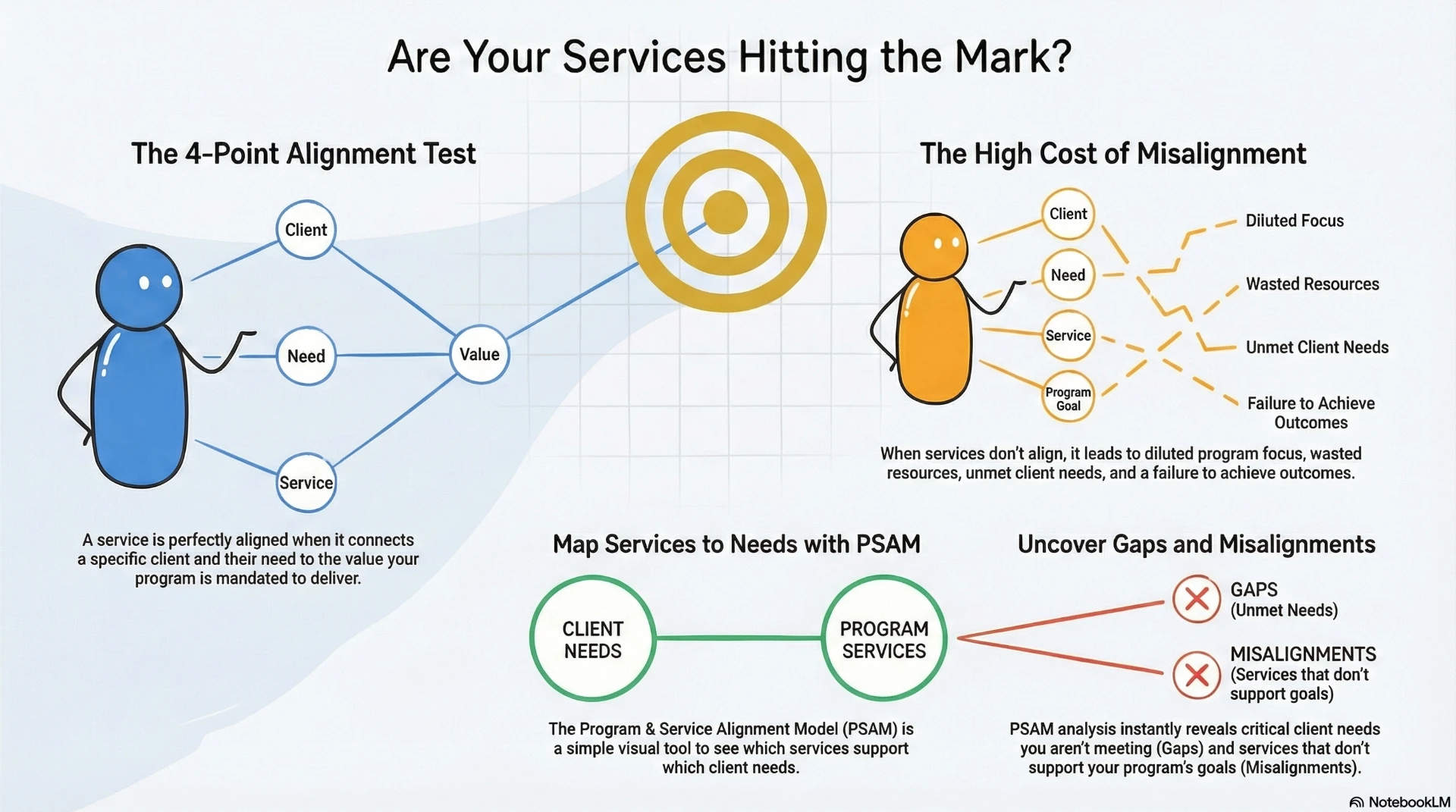
By the end of this chapter, you'll be able to:
Before moving to the next chapter, ensure you can:
Apply these concepts to your own context:
1. **Review a recent service addition or removal decision in your program. Was alignment with target group needs explicitly considered?** If you had built a PSAM before the decision, would it have changed the outcome?
2. **Examine your program's budget allocation across services. Does resource distribution align with target group need priorities?** If you found significant misalignment between high-priority needs and low resource allocation, what organizational factors drove that misalignment?
3. **If you built an enterprise-level PSAM for your most important target group, what would you expect to find?** Significant duplication across programs? Gaps between program mandates? Opportunities for integration? What prevents this analysis from happening routinely?
4. **Think about a service in your program that stakeholders question ("Why do we provide this?"). Can you articulate a clear value proposition connecting service outputs to recognized target group needs?** If not, is the service misaligned, or is the value proposition unclear?
5. **Consider the value propositions you currently use to describe services. Are they client-focused ("Reduces financial barriers") or process-focused ("Processes subsidy applications")?** If process-focused, how would you rewrite them to emphasize client value?