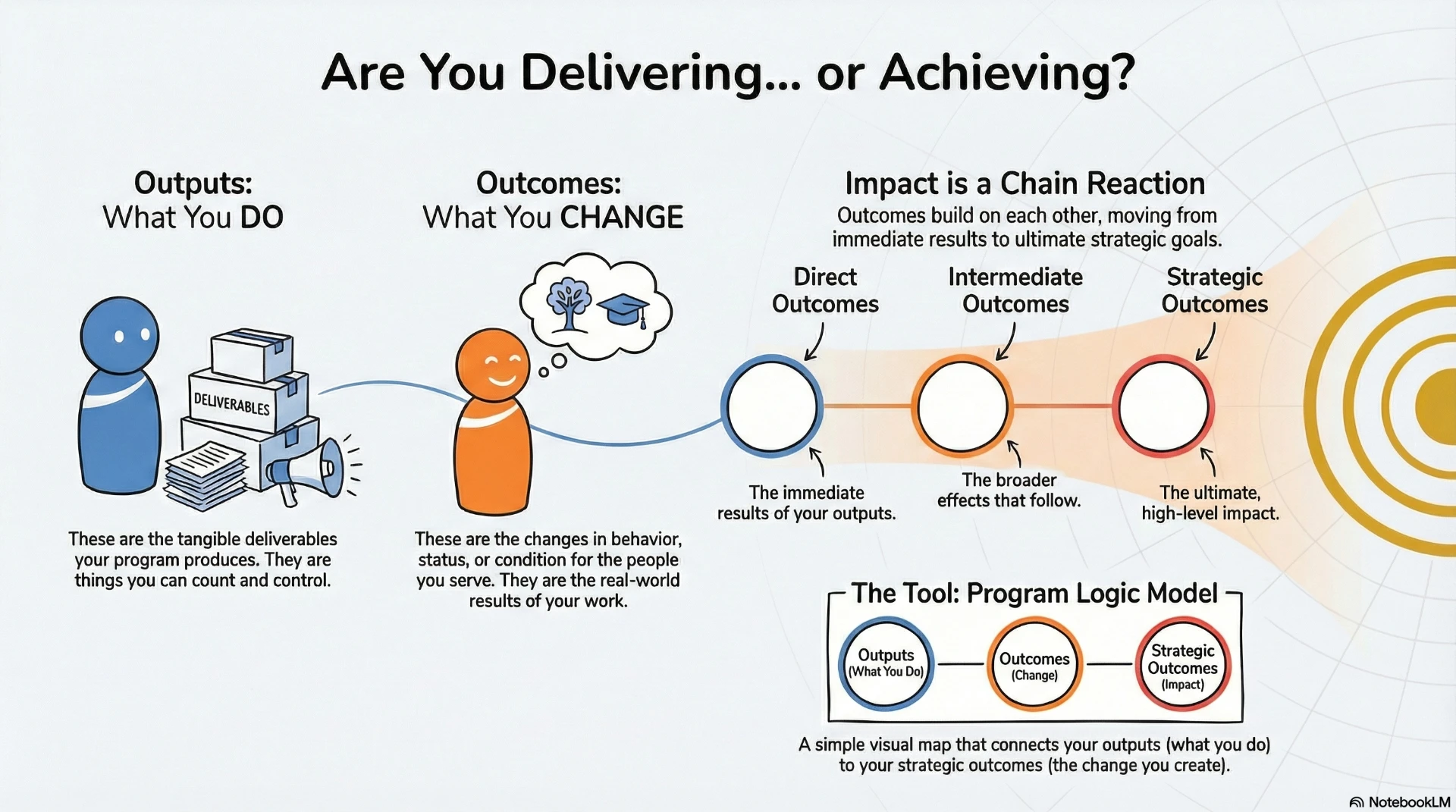
This chapter details how to model program outcomes using a three-tier hierarchy and Program Logic Models. It distinguishes outcomes from outputs to align service deliverables with government strategic priorities and guide resource allocation.
By the end of this chapter, you'll be able to:
Before moving to the next chapter, ensure you can:
Apply these concepts to your own context:
1. **In your organization, how are program outcomes currently defined?** Do definitions include target groups, needs, and desired future states, or are they vague aspirations? What would change if you applied the formal EBA220 definition?
2. **Think about performance measurement in a program you know well. Are you measuring outputs or outcomes?** If mostly outputs, what prevents measuring outcomes? If you measured outcomes systematically at all three tiers, what decisions might change?
3. **Consider a recent budget decision in your domain. Was the decision informed by understanding which service outputs create the most strategic value?** If you had built a PLM showing output-to-strategic-outcome connections, would the allocation have been different?
4. **Identify a program serving multiple target groups with different needs. Do all target groups experience the same direct outcomes from service outputs?** Should outcomes be segmented by target group? What would differentiated outcome measurement reveal?
5. **Think about a government strategic priority in your jurisdiction. How many programs contribute to it?** If you mapped all programs' PLMs converging on that strategic outcome, would you find gaps (needed services missing) or overlaps (duplication)?