This chapter refines the Public Sector Reference Model (PSRM) to distinguish outcome-focused programs for target groups from output-focused services for clients. It clarifies these core concepts to build a foundation for detailed business architecture modeling in government.
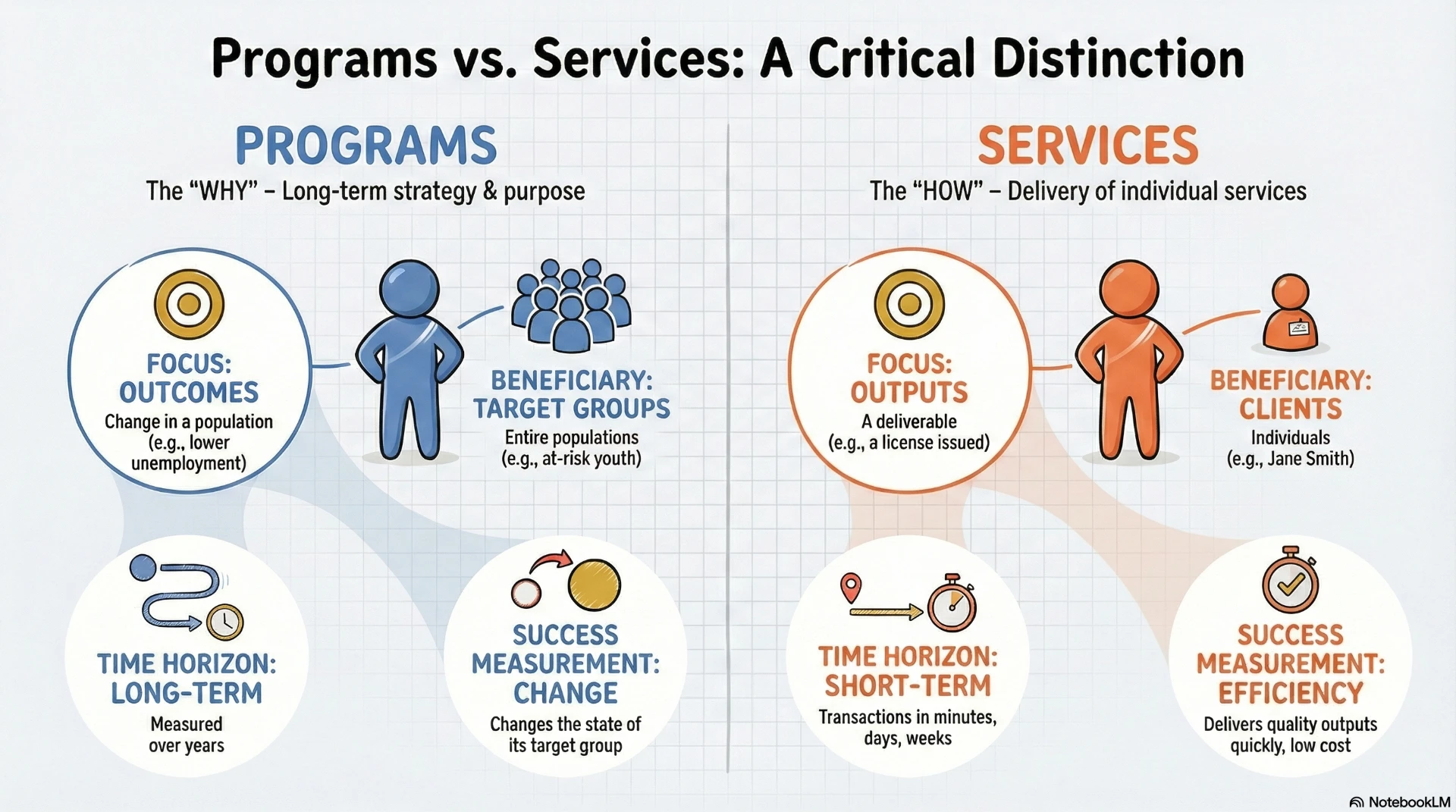
By the end of this chapter, you'll be able to:
Before moving to the next chapter, ensure you can:
Apply these concepts to your own context:
1. **Your Organization's Lens**: Does your organization naturally think in program terms (outcomes, target groups) or service terms (outputs, transactions)? What drives that orientation? What's the impact?
2. **Measurement Focus**: When your organization reports performance, does it emphasize outputs or outcomes? What gets measured gets managed - so what's being managed?
3. **The Alignment Question**: Can you trace clear connections between services your organization delivers and outcomes it's trying to achieve? If the connections are unclear, what's the consequence?
4. **Language Patterns**: Listen to conversations in your organization. Do people use "program" and "service" precisely, or interchangeably? Does imprecise language lead to confused strategy?
5. **Value Creation**: How does your organization define "success"? Is it activity-based (we delivered lots of outputs) or impact-based (we changed target group states)? What would shift if the definition changed?