This chapter introduces the Service Integration and Accountability Model (SIAM) to visualize horizontal service value chains. It explains how to map inter-service dependencies to identify bottlenecks, define horizontal accountability, and design AS-IS to TO-BE transformations,
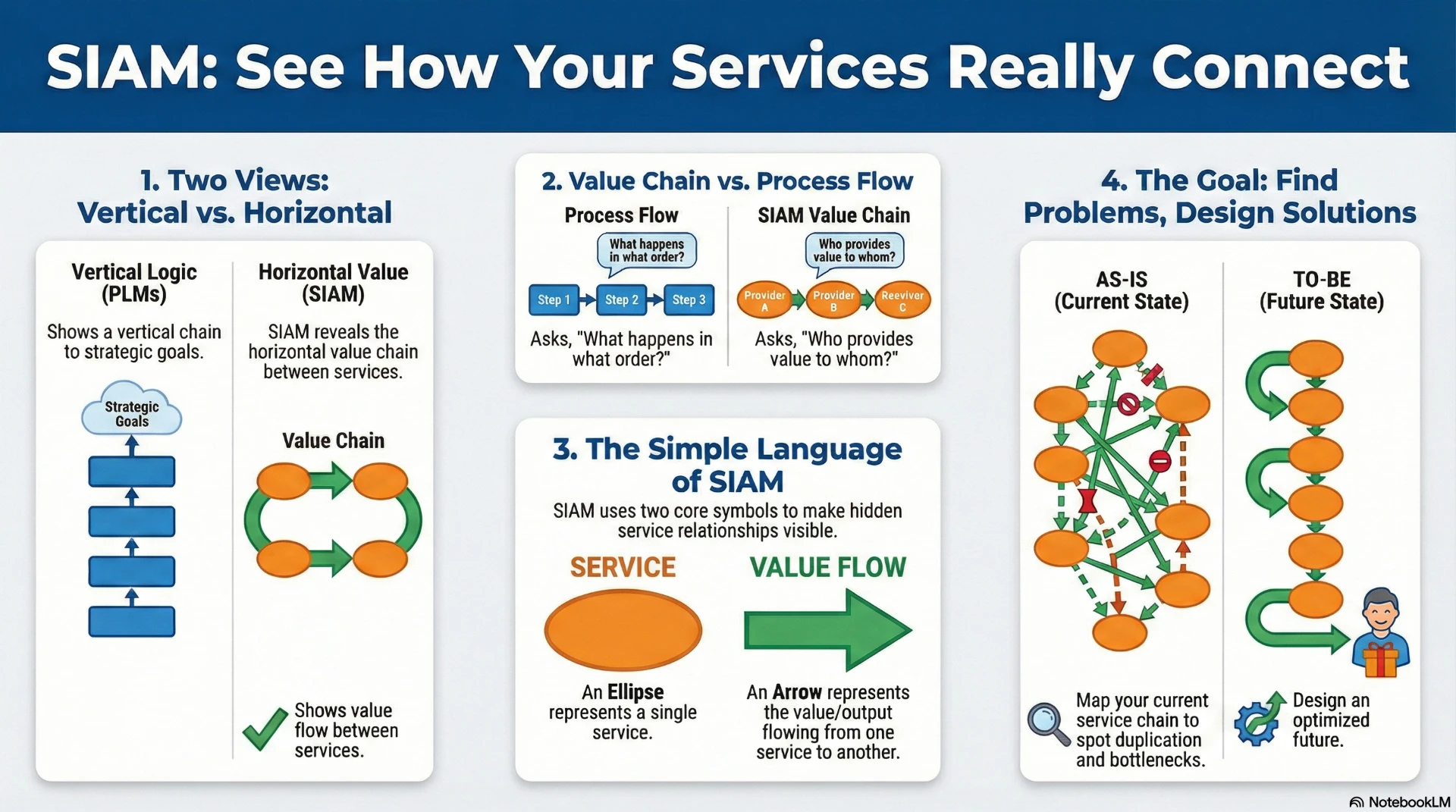
By the end of this chapter, you'll be able to:
Before moving to the next chapter, ensure you can:
Apply these concepts to your own context:
1. **Map a service value chain you experience as a citizen (e.g., renewing a license, filing taxes, applying for benefits).** How many services are involved that you don't see? Where do you experience integration problems?
2. **Consider a transformation initiative in your organization.** Does current planning consider horizontal service relationships, or is it focused mainly on vertical program logic? What would a SIAM reveal?
3. **Think about shared services in your context.** Which functions are currently distributed that could be consolidated? What organizational barriers would need to be addressed?
4. **Examine cross-organizational service relationships you participate in.** Are there formal SLAs? How is accountability enforced? What happens when one party underperforms?
5. **Consider the tension between consolidation and distribution.** In your experience, when has consolidation worked well? When has it created problems? What determined success or failure?