 myBusinessArchitectmyBusinessArchitectmyBusinessArchitect
Sandra Mwangi warned Fiona before the faculty workshop: "If you walk in there and show the faculty a chart that says they're underperforming, you will lose them in thirty seconds and never get them back." Fiona had simplified the visual. Sandra was not talking about the visual. She was talking about the room: twelve faculty leaders who believed the capability assessment was a prelude to program cuts, a union representative attending, and a director five months into the job who had not yet sat in most of their offices. Fiona and Sandra spent three days redesigning not the data, not the findings, but the conversation structure. The session worked because participants had a role beyond sitting and listening. This chapter is about that difference: between presenting architecture findings and facilitating an architecture conversation. And about the session Fiona lost on her own, and what it taught her.
By the end of this chapter, you'll be able to:
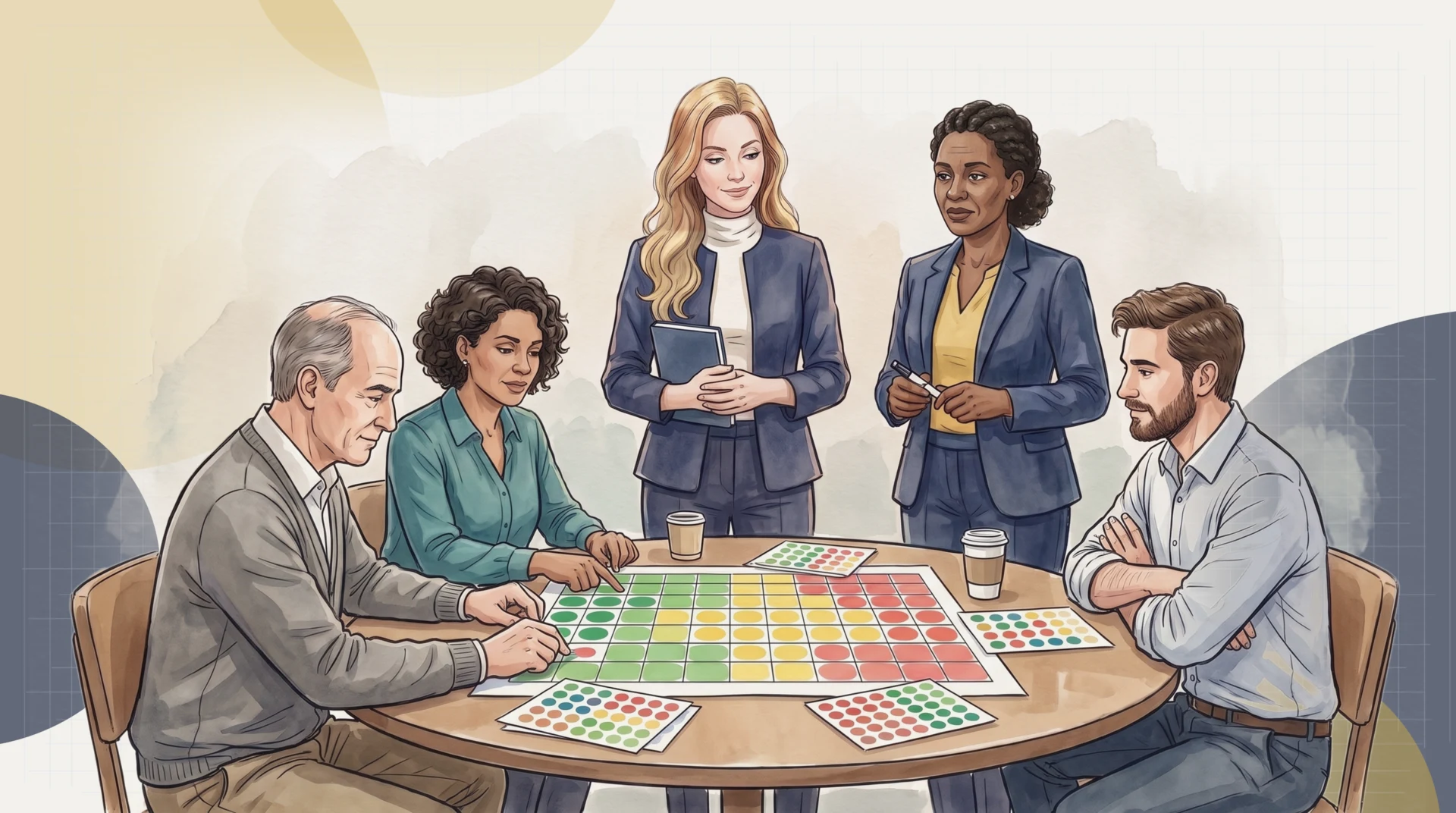 Sandra Mwangi had warned Fiona. "If you walk in there and show the faculty a chart that says they're underperforming, you will lose them in thirty seconds and never get them back."
Fiona had listened. She had simplified the heat map. She had filtered to the six strategic capabilities. She had annotated it with insight-driven labels. By the standards of Chapter 4, the visual was ready. But Sandra was not talking about the visual. She was talking about the room, and about who would be standing in front of it: a director five months into the job, who had assessed other people's faculties and had not yet sat in most of their offices.
The room would contain twelve faculty leaders from Skilled Trades, Community Services and Business Programs. They had heard rumours that a "capability assessment" had been done. Some believed it was a prelude to program cuts. For Business Programs, the rumour was partly true: its general business programs were already teaching out under the strategy the board had approved, and Sandra would have to say so plainly. Others suspected it was a tool to justify decisions that had already been made. The union representative had asked to attend. Two faculty members had emailed Sandra separately to say they felt the process was "disrespectful".
The visual was ready. The conversation was not.
Fiona and Sandra spent three days redesigning the session. They did not change the data. They did not soften the findings. They changed the conversation structure. Instead of Fiona presenting findings and asking for questions, they designed a facilitated workshop where faculty leaders would engage with the capability model directly, assess their own faculties against it, and co-design the investment plan. The architecture evidence would be the same. The experience of encountering it would be fundamentally different.
The session worked. Not because the findings were easy to hear. They were not. It worked because the conversation structure gave participants a role beyond sitting and listening. They were not being told what was wrong with their faculties. They were being asked to help design what needed to be built.
This chapter is about designing those conversations. Not generic facilitation technique. Architecture-specific facilitation: using capability models, heat maps, value streams, and other architecture artifacts as the basis for conversations that produce alignment, decisions, and commitment. The skill is not in the artifact. It is in how you structure the conversation around it.
Create a free account to access Communicating Business Architecture and start learning.