Your work is right.
Make it matter.
For business architects tired of being right on paper, yet invisible in the room where decisions get made.
Most strategies don't land.
The organisations they belong to have a gap they can't see. Find yours.
4 minutes. No sign-up required.
Instantly find your Strategy to Execution Gap.

Does any of this sound familiar?
You built the capability map. It has lived in a shared drive for eight months.
You were right about the analysis. The room moved on anyway.
You can see exactly what the organisation needs to do. Getting anyone else to see it is another problem entirely.
You designed the target state. Implementation shortcuts undermined it.
This is not a skills problem
The practitioners who hit this wall have the business architecture skills. Their work is rigorous. The problem isn't the work.
TOGAF, BIZBOK, and ArchiMate produce defensible representations of the enterprise. They do not ensure your architecture changes anything. They help you describe the concepts, and you need to move from concepts to practice.
What's missing is the practice layer
The practice layer between your architecture and the decisions it should be shaping. Without governance, funding alignment, and integration into delivery, there is no organisational traction.
With myBusinessArchitect, you develop the practice. The door opens, embedding architecture into how decisions are made, funded, and executed. It's the difference between your work being right and your work mattering.

This may not be for you if
You want simple answers. This teaches a way of asking better questions.
Business architecture core skills are still new to you. Start there.
You want exam preparation or a credential pathway.
You want theory with good case studies. There's plenty of that. This isn't it.

This is for you if
You have the business architecture core skills, but your work still isn't landing.
You've been right about the analysis and still couldn't move the room.
You're ready to apply your skills to your actual organisation, not a training scenario.
You want to be the practitioner your organisation can't execute its strategy without.
4 minutes. No sign-up required.
Instantly find your Strategy to Execution Gap.
How the missing layer becomes yours
Change what Monday looks like.
Most courses teach you what to do. You need to know how to see, and how to ask better questions. Here's what changes:
Every Core Practice course builds on the last. Every deliverable is built on your actual organisation. An AI coach works through the specifics with you: your gap, your stakeholders, your situation. Applied, not theoretical. You leave each course with meaningful work.
Closing the Strategy-Execution Gap
You have a 90-day First Cycle Blueprint scoped to your organisation's actual situation, and a name for the gap that has been breaking your strategy execution.
Building the Common Language
You have a means to audit shared vocabulary, the business case to get it adopted, and one test to catch every artifact that undermines alignment.
Communicating Business Architecture
You have a stakeholder map and six resistance types, each with a specific response. You stop explaining. You start translating.
Shaping What Gets Built
You have an erosion dashboard that makes scope erosion visible in real time. What gets built finally delivers the strategic intent the architecture defined.
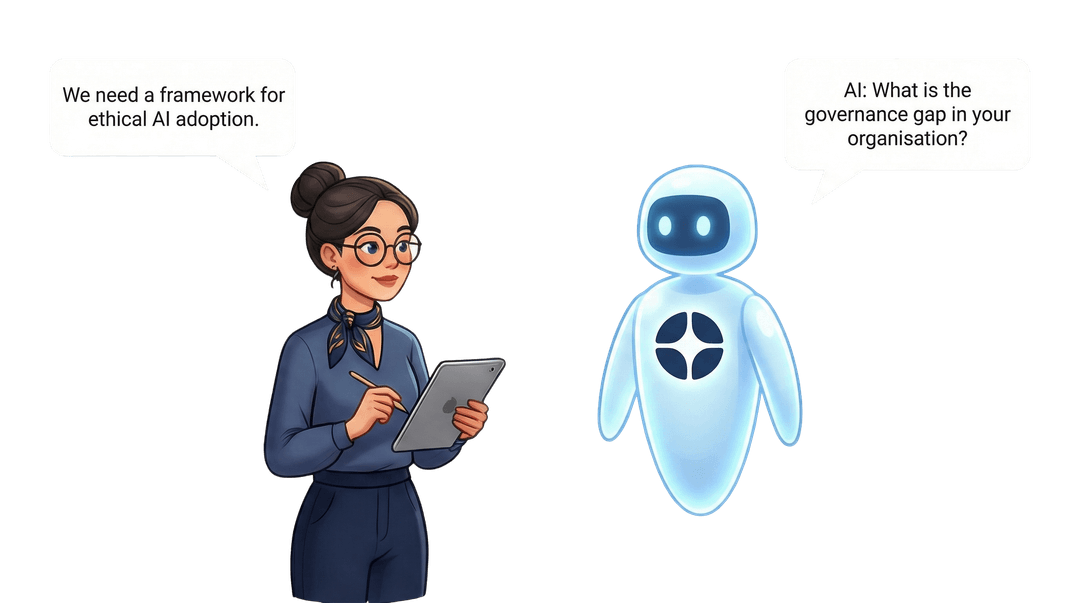
This is how the missing layer becomes yours. Every chapter teaches the practice. The AI coach helps you apply it to your organisation's specific context: your gap, your situation, your stakeholders. What you produce is the practice layer at work in your organisation. A deliverable, not a worksheet.

In Practice — Lakeshore Polytechnic
Lakeshore Polytechnic lost half its international enrolment to a visa cap in a single decision. The executive team met for two hours and left with forty-seven ideas on a whiteboard and no way to choose between them. The strategic plan, approved eight months earlier, had nothing to say.
The turn came when a board member asked why the institution existed. Marcus Chen, VP Strategy, stopped presenting findings and started asking one question at every decision point, before momentum made the answer inevitable: are we doing the right things? The architecture hadn't changed. What changed was how it was used. Marcus connected it to how decisions were made, funded, and executed. That's the practice layer, and it's not a new skill.
Eight months later, a funding announcement landed with a 60-day deadline. The same team made a clear, documented decision in two weeks. Marcus wasn't explaining business architecture anymore. He was being asked what to do next.
Your work is right. This is how you make it matter.
Start free. The rest is there when you want it.
Free Core Practice Courses
No card required.
Sign up to take Closing the Strategy-Execution Gap and Core Practice courses for free. Diagnose your gap. Build your 90-day First Cycle Blueprint.
Free forever. No card required.
Core Practice AI Coaching
billed $299/year
Access unlimited AI coaching on Core Practice courses for deliverables built on your organisation. Less per month than half an hour of consulting.
Cancel anytime.