Your organisation has smart people. Real commitment. Genuine urgency. And yet the strategic plan that looked brilliant in the boardroom is producing exactly nothing six months later.
This isn't a mystery. It's a pattern. And the pattern has a structure.
Most leaders, when execution stalls, look inward. They blame culture, or communication, or middle management. They launch accountability initiatives. They restructure. They hire consultants to tell them what they already know and fire the people who tried to tell them for free.
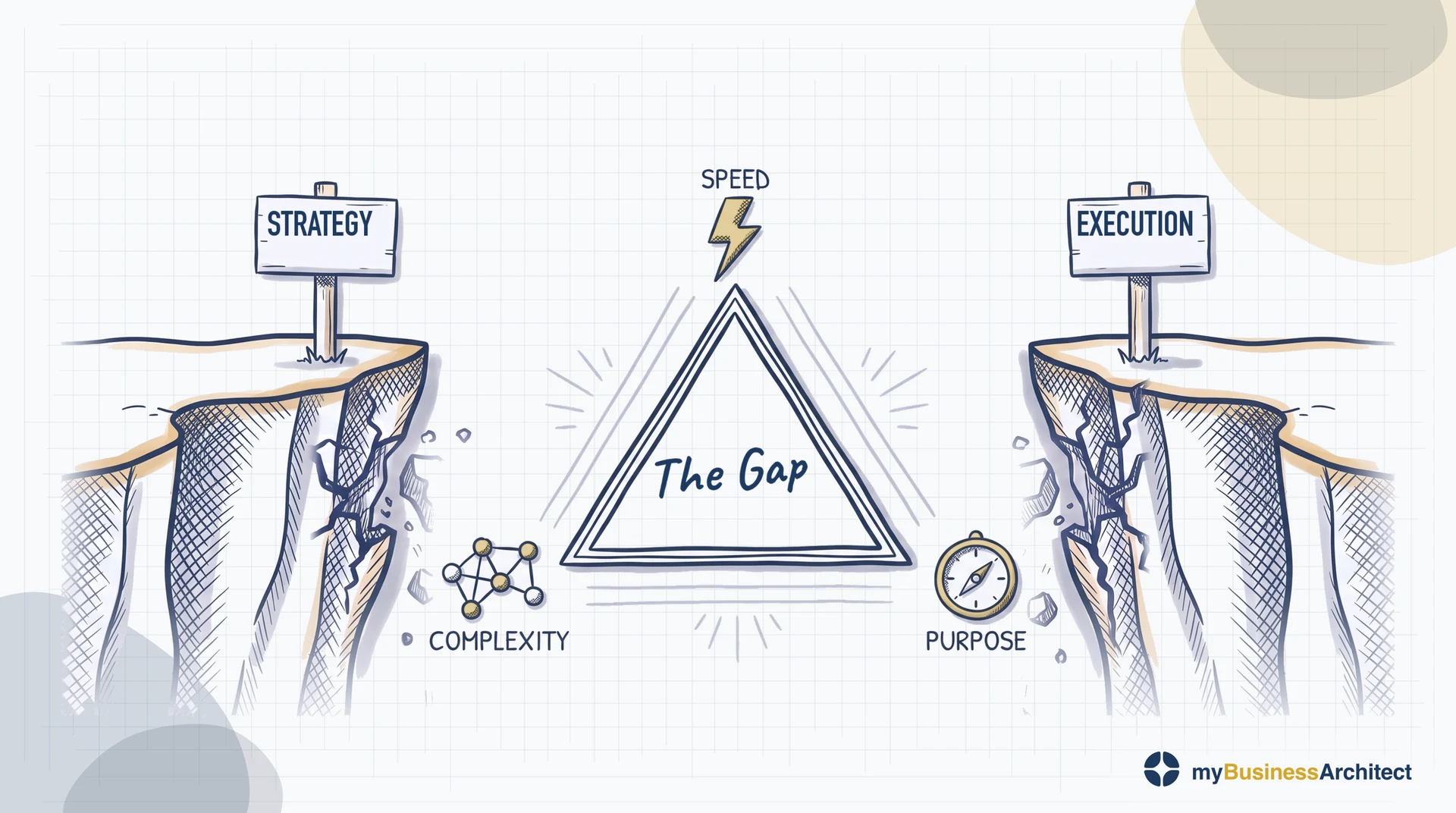
None of that works, because none of it addresses the actual problem. The gap between what your organisation intends and what it delivers isn't caused by a lack of effort. It's caused by three forces that are reshaping how every organisation operates, and most leadership teams haven't updated their playbook to account for even one of them.
1. The Speed Force
Markets and stakeholder expectations now move faster than planning cycles allow.
This is the one most leaders recognise, at least in the abstract. Product lifecycles that spanned decades now compress into months. Competitive advantages that took years to build get disrupted overnight. Customer expectations aren't set by your industry peers. They're set by the best experience anyone has ever given them. If a consumer can track a pizza from oven to doorstep in real time, they wonder why it takes eight weeks to get a response from their insurance provider.
The natural reaction is to speed up the planning process. Faster offsites. Shorter planning cycles. Agile everything.
But speed isn't the actual problem. The problem is that annual strategic plans, quarterly reviews, and multi-year transformation roadmaps were designed for a world where change was gradual and predictable. That world no longer exists. When the environment shifts mid-cycle, the organisation faces an impossible choice: stick with a plan that no longer fits, or abandon the plan and improvise.
What's needed isn't a faster version of the old process. It's a framework that enables rapid adaptation without losing strategic coherence. The ability to change direction quickly while still knowing where you're headed and why.
Most organisations don't have that. They have a plan. And when the plan breaks, they have a whiteboard full of ideas and no way to choose among them.
2. The Complexity Force
Speed alone would be manageable if organisations operated in isolation. They don't.
A hospital doesn't just treat patients. It coordinates with insurers, regulators, pharmaceutical companies, research institutions, technology vendors, and community organisations. A government agency doesn't just deliver services. It navigates legislative mandates, inter-departmental dependencies, public expectations, privacy requirements, and political cycles. A polytechnic doesn't just educate students. It balances employer needs, accreditation requirements, government funding conditions, faculty expertise, student expectations, and community development goals.
Success now requires alignment across stakeholders with fundamentally different (and sometimes conflicting) needs. The interests of shareholders, employees, customers, regulators, and communities don't always point in the same direction. Coordinating across these interests isn't just harder than it used to be. It's exponentially harder, because the number of relationships and dependencies grows faster than the organisation's ability to manage them.
Traditional planning handles complexity by simplifying it: break the organisation into neat boxes on an org chart and assign each box a set of objectives. But real value creation doesn't follow org charts. It flows across functions, across departments, across organisational boundaries.
When you plan in silos, you execute in silos. And siloed execution is where strategic intent goes to die.
This is why leadership meetings so often produce lists instead of decisions. Finance sees a budget problem. Operations sees a process problem. Marketing sees a brand problem. HR sees a talent problem. Each leader frames the situation through their own lens, and their proposed solutions reflect that framing. Nobody is wrong. But nobody is seeing the whole picture either.
3. The Purpose Force
The third force is the one most leadership teams underestimate.
Purpose (your organisation's fundamental "why") is no longer a branding exercise. It's a performance driver.
This shift is happening across every stakeholder group at once:
- Employees increasingly choose employers based on mission, not just compensation. The organisations that attract and retain the best talent are the ones that can articulate a purpose worth committing to.
- Customers actively seek out organisations whose values align with their own. They're willing to pay more, stay longer, and advocate louder for organisations they believe in.
- Investors have moved beyond pure financial returns. Sustainable investing (ESG criteria), impact investing (direct, measurable change), and stakeholder capitalism (value for all) are no longer fringe ideas. They're reshaping capital allocation globally.
- Regulators and communities demand accountability for social and environmental outcomes, not just financial performance.
The implication is clear. Your organisation must be able to articulate and deliver on an authentic purpose that goes beyond quarterly returns. Otherwise it will find it increasingly difficult to attract talent, retain customers, secure investment, and maintain its social licence to operate.
But here's where it gets uncomfortable. Your purpose can't just live in a mission statement on the wall. It has to flow through every strategic choice, every capability investment, and every operational process. When purpose stays at the top and never reaches the front line, the result is cynicism. And cynicism is the enemy of execution.
Try this test. Ask five leaders in your organisation: "Why does this organisation exist?" If you get five different answers, none specific enough to guide a single strategic choice, you've found the gap. Your stated purpose and your actual operating purpose have quietly diverged. And nobody noticed until something broke.
These Forces Don't Operate Independently
That's what makes them dangerous. They reinforce each other:
- Speed + Complexity: Decisions must be made faster, with more stakeholders involved and more consequences to consider.
- Speed + Purpose: The organisation must adapt quickly while staying true to its core identity. Pivoting without losing its soul.
- Complexity + Purpose: Authentic purpose must be translated across diverse stakeholder groups, each of whom experiences "value" differently.
Together, these three forces form what we call the Speed-Complexity-Purpose Triangle. It isn't a temporary condition. It's the permanent new operating reality. Organisations that treat it as a passing challenge (something to be managed with a better project plan or a new technology platform) will continue to see their strategies fail in execution.
So What Do You Do About It?
It isn't an execution problem, it's a structural problem. The answer isn't better planning. It's better architecture.
Not IT architecture. Not systems diagrams or technical blueprints. Business architecture: a discipline that connects your purpose to your strategy, your strategy to your capabilities, and your capabilities to what stakeholders actually experience.
The gap between intent and delivery breaks at four specific connection points. Business architecture exists to diagnose, align, and govern these connections. And the starting point depends on where your organisation feels the most pain.
If your vision inspires but doesn't translate into choices, the break is between purpose and strategy.
If your strategy assumes capabilities that don't exist, the break is between strategy and capability.
If your capabilities exist but never reach the stakeholder, the break is between capability and operations.
If your dashboards are green while your stakeholders are disengaged, the break is between operations and purpose.
The three forces aren't going away. The question is whether your organisation has the structural integrity to operate within them.
This post is drawn from the opening chapter of Closing the Strategy-Execution Gap, a self-paced course that follows one institution through all four breaks and shows how business architecture closes each one.