You have the certification. You can build a capability map, run a value stream analysis, and produce an architecture assessment that would satisfy any review board. And somewhere in your career, you've watched that work disappear. Into a shared drive. Into a parallel workstream. Into the space between the governance committee's approval and what the delivery team actually built.
This is the ceiling most experienced business architects hit. Not a skills ceiling. A framing ceiling. The practitioners who break through it don't become better architects. They become architects who change what organisations decide.
The credential-based training you've completed (TOGAF, BIZBOK, Zachman, ArchiMate) teaches you to document the architecture. It does not teach you to change what happens in the room where decisions get made. That is not an oversight. Those frameworks were designed to produce correct, defensible documentation, and they do. What they were not designed to do is give that documentation organisational traction. Until you can do the second, the first produces work that is correct, rigorous, and ignored.
The Design4 framework is built around that distinction. It was developed through work with organisations that had strong modelling discipline and were consistently failing to influence decisions; the pattern was consistent enough to point to a missing layer, not a skills deficit. It is not a replacement for the modelling disciplines you already know. It is the strategic and governance layer that gives those disciplines organisational traction, connecting the architecture you produce to the decisions you're trying to influence.
What Keeps Happening, and Why
There are two ways a business architecture initiative fails. The first is obvious: the work is wrong, the gaps are misdiagnosed, or the artifacts don't reflect reality. That failure is recoverable.
The second is harder. The work is right, the gaps are real, and the artifacts are accurate. And nothing changes anyway.
If you have been in that position, right about the analysis and still unable to move the room, you know that the problem is not the work. And nothing in your training explained why it kept happening.
This is the failure that credential-based training doesn't prepare you for, because it treats the architecture as the output. What the room does with the architecture, how the decision-makers hear it, whether the governance holds once the initiative is approved and delivery pressure begins: these are treated as organisational behaviour problems, not architecture problems.
They are architecture problems.
The Design4 framework starts from a different premise: the architecture is not a deliverable. It is a practice, a continuous discipline for testing whether the connections between your organisation's purpose, strategy, capabilities, and operations are holding, and for adjusting them when they drift. The question it is designed to answer is not "have we documented the architecture?" It is "are we governing the right connections, with evidence, in a rhythm that catches drift before it becomes a crisis?"
Name that practice plainly and it stops sounding abstract. Business architecture is the discipline that matures an organisation's capacity to make strategic choices and hold them while delivery pressure tries to erode them, and Design4 is the practice that does it. When your correct work doesn't land, that capacity is usually what was missing: the organisation had no reliable way to choose, so it defaulted, and your analysis lost to the default.
Related reading: The Phase Every Management System Skips: why OKRs, benefits tracking, and maturity models all fail in the same place, and what the discipline puts back.
That reframe changes what you build, where you intervene, and how you use your work in a room.
The Design4 Framework: Four Phases in a Continuous Cycle
The Design4 framework organises business architecture into four interconnected phases (Discover, Define, Develop, Deliver), each addressing a specific dimension of organisational alignment. The phases are not sequential steps you complete and leave behind. They are interconnected gears that turn together, continuously, generating evidence that sharpens each next pass.
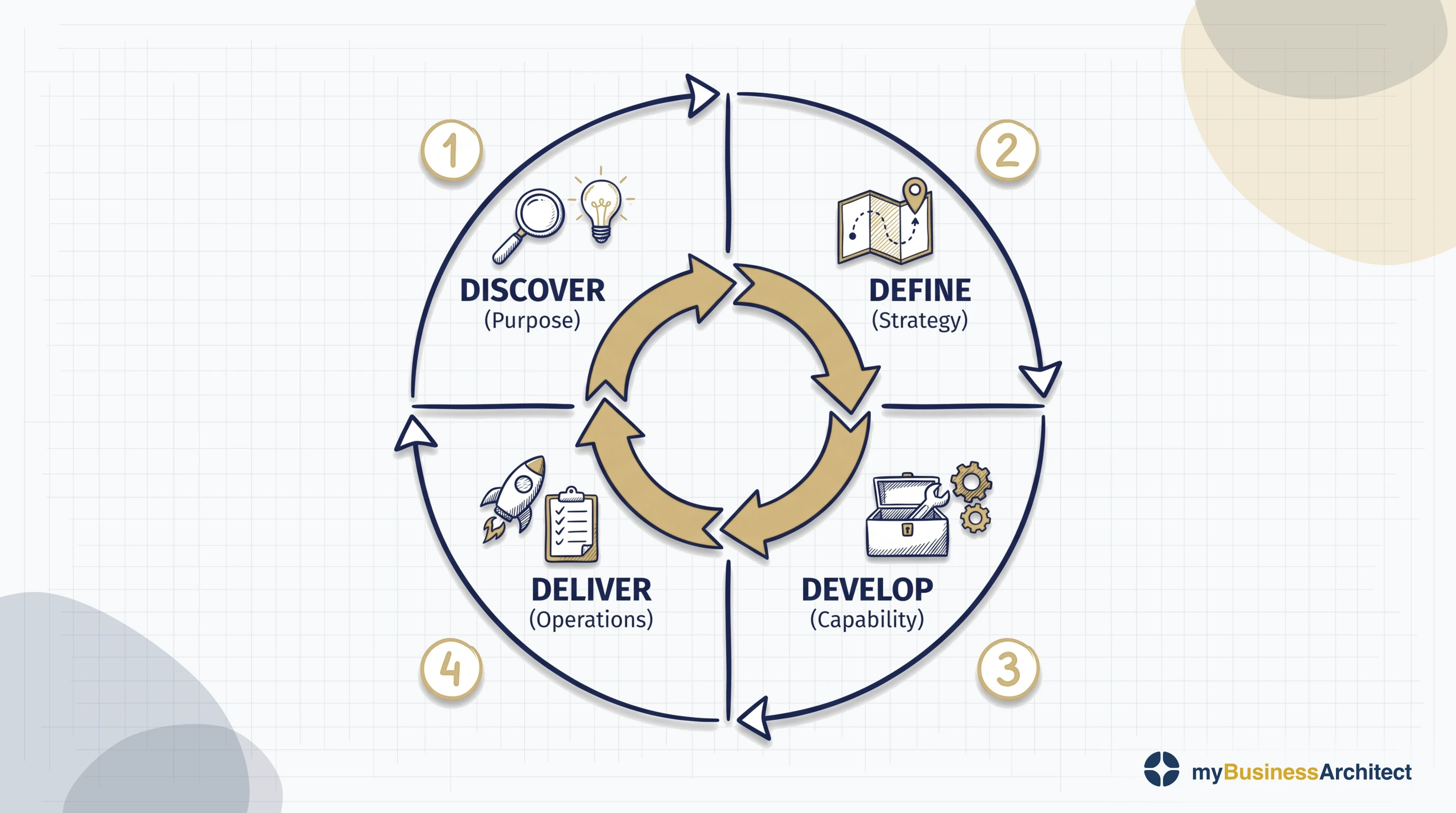 The Design4 cycle: four phases that connect purpose to operations through continuous practice.
Discover (Purpose)
Most experienced practitioners underinvest here, and pay for it throughout the rest of the cycle.
Ask your leadership team why the organisation exists. Not the mission statement. The actual answer. In most organisations, you will hear five different answers. Not because the leadership is incompetent, but because purpose has never been tested against a rigorous standard. The asking is a diagnostic, not a discovery method: divergent answers prove the purpose has never been tested, but answers improvised in a room are not the purpose either. That is recovered from the record of what the organisation has actually done, and tested against three criteria:
- Specificity. Is it specific enough to reject a proposal?
- Decision power. Can it actually say no to something that sounds reasonable?
- Stakeholder resonance. Would the people the organisation serves recognise themselves in it?
An organisation that cannot pass those three tests is not ready for Define. The conflict surfaces later, in scope debates, in capability investment fights, in delivery decisions where nobody can agree on what "success" means, and by then it has become political rather than architectural. Discover surfaces it early, when it is still solvable.
What Discover produces: A tested purpose statement, a stakeholder value map that connects organisational purpose to what specific people actually need, an environmental scan filtered for strategic impact, and evidence (not assumption) of whether stakeholders are receiving the value the organisation exists to create.
Define (Strategy)
Most strategy documents are evidence that an organisation has avoided its hardest choice.
The Define phase is where the organisation stops listing possibilities and commits to what it will do. Not "here are our ten strategic priorities," but "here is what we will say no to." Written criteria. Explicit trade-offs. A foundation for every subsequent investment decision that holds up under pressure, not politics.
The Strategic Choice Cascade (adapted from Lafley and Martin, Playing to Win) structures this as five integrated choices: Winning Aspiration, Where to Play, How to Win, Capabilities Required, Management Systems. Each choice constrains the next. An organisation that answers "Where to Play" specifically, with explicit exclusions, has already constrained which capabilities it must build and which investment proposals it should decline. That constraint is not a limitation. It is a decision criterion: a standard against which proposals can be evaluated that does not change based on who is in the room.
Of the five choices, "How to Win" is the hardest, and where the real strategic work lives. Where to Play narrows the field. How to Win requires an explicit claim about why stakeholders will choose you over every available alternative. That is the test for whether the cascade has done its work: Define is complete when the organisation can answer that question with specificity, not just with a list of what it has chosen to stop doing.
This is where the discipline of no lives. And it is where most experienced architects discover that the hardest conversation in business architecture is not about capability gaps or architecture models. It is about what the organisation is willing to stop doing, and whether stopping it clears the way for something distinctively better.
Stopping is a design decision in its own right. Retiring a service is a Define choice, where not to play, and Develop carries it out: decommissioning the processes and resources the service no longer needs is capability work too. A cycle with no place for that keeps services alive past their purpose.
What Define produces: A strategic choice cascade that structures five essential decisions, alongside a business model canvas that maps how value is created and captured, tested as hypotheses rather than fixed as plans.
Practitioner Tool Box: Strategy Cascade Tool: build and stress-test a strategy cascade using the Playing to Win framework.
Develop (Capabilities)
A capability is not a platform. Not a budget line. Not a technology purchase.
A capability is an integrated system of People, Processes, Technology, and Information working together. When any element is missing or misaligned, the capability is incomplete regardless of investment. You can buy the platform, hire the people, redesign the process, and still not have the capability, because the information model is wrong, because two departments define the same concept differently, and that inconsistency becomes a rigid constraint in every system built on top of it.
Develop maps this with precision. Value stream mapping traces how value actually flows from stakeholder need to stakeholder outcome, across functions, across silos, across the boundaries that organisational charts make invisible. Capability heat maps make gaps visible against strategic priority. The gap classification distinguishes between a maturity gap (you have it, it is not good enough), a resource gap (you do not have it), and an integration gap (the pieces exist but do not connect), because each type requires a different remedy, and applying the wrong one is how organisations spend years addressing the wrong problem.
What Develop produces: Value stream maps that make the chain from purpose to operations concrete and traceable, capability heat maps showing current versus required maturity, gap assessments classified by type, and capability development plans sequenced by strategic impact rather than organisational politics.
Deliver (Operations)
Here is the gap most capability investments fall into.
Develop designs what the organisation must be capable of. Deliver designs how that capability actually reaches the people it is supposed to serve. These are not the same design problem, and treating them as one is how the capability map ends up being accurate and the stakeholder experience remains unchanged.
Deliver shifts the design question from inside-out ("what are we efficient at?") to outside-in ("what do stakeholders actually experience?"). Service blueprints make this visible: mapping the stakeholder journey against the internal processes that support it, surfacing the points where capability handoffs break down and the experience fractures. The most common finding at this phase: each department's handoff is technically complete. The stakeholder's journey is not. The operating model is where that delivery gets organised: around the services that carry capability to a stakeholder, not around the org chart.
What Deliver produces: Service blueprints, outcome measurement frameworks that distinguish outcome metrics from process metrics, governance structures that maintain architectural integrity as operations evolve, and feedback loops that signal when operations are drifting from purpose before stakeholders feel it.
The Four Ares: Governance That Changes Rooms
A framework without governance produces documentation. The Design4 framework includes a built-in governance layer: John Thorp's Four Ares, four questions designed to be actionable in any meeting where strategic decisions are made.
| Question | Phase | What It Tests |
|---|---|---|
| Are we doing the right things? | Define | Strategic alignment: are investments flowing from purpose, not politics? |
| Are we doing them the right way? | Develop | Design quality: are capabilities built to match strategic choices? |
| Are we getting them done well? | Deliver | Execution quality: are operations delivering stakeholder outcomes? |
| Are we getting the benefits? | Discover | Value delivery: is purpose being fulfilled with evidence? |
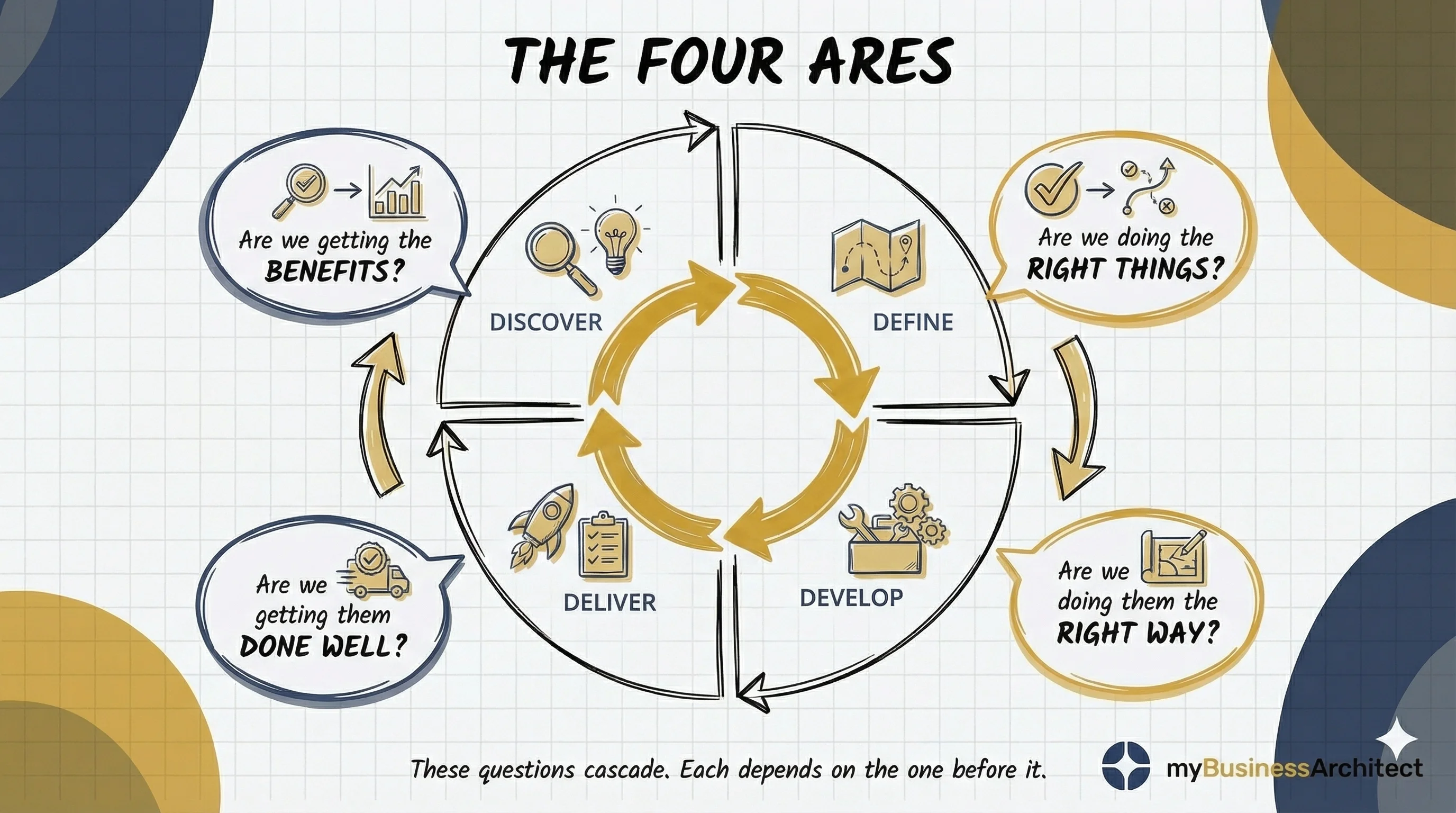 Four governance questions, each mapped to a Design4 phase. They cascade; each depends on the one before it.
The "Are we getting the benefits?" question maps to Discover, not Deliver, because the question of whether benefits materialised is inseparable from whether you were measuring against the right purpose in the first place. Benefits realisation that does not loop back to purpose is Measurement Theatre: it tells you whether the operation ran, not whether the organisation delivered what it exists to deliver. Purpose is where the organisation defined what "benefit" means in the first place. A delivery team that reports 94% system adoption has answered the Deliver question. Whether that adoption is serving the purpose the organisation exists to fulfil is the Discover question, and the answers are often different.
These questions cascade. You cannot assess whether you are doing things the right way unless you know you are doing the right things. You cannot measure benefits unless you know what "done well" looks like.
What makes them useful in practice (not just in architecture reviews, but in vendor selection meetings, steering committees, and strategy sessions where the room is about to decide based on incomplete framing) is their simplicity. "Before we go further: can we answer whether we're doing the right things?" That question, asked plainly, reframes the conversation from which option to select to whether the options are answering the right question. You do not need agenda authority to ask it. You need one sentence and the willingness to ask it before the momentum locks.
The most dangerous answer to any of the Four Ares: "We think so, but we don't have evidence." That answer is not neutral. It is the gap.
Related reading: Four Questions That Replace Your Strategic Plan: a deeper look at how the Four Ares work in practice.
In Practice: What a Broken Connection Looks Like
A regional health authority was well-regarded. Cardiac care was strong. Emergency services hit targets. Each department was competent, well-led, and meeting its metrics.
Patients with chronic conditions were falling through the gaps.
A diabetic patient discharged from cardiology needed coordinated follow-up: endocrinology, dietary counselling, primary care. Each department handled its piece. Nobody was accountable for whether the patient actually got healthier. The dashboards were green. Patient experience scores were declining.
Using the Four Ares as an entry point, the architects asked the first question: Are we doing the right things? The answer was not obviously no, each department was doing what it was funded to do. But the value stream told a different story. Mapping the end-to-end patient journey across every departmental boundary surfaced three critical handoff points where information dropped between systems and accountability dropped between departments. The referral to endocrinology was sent. Nobody tracked whether the patient arrived. Discharge notes went to a primary care provider who never received them. Each department's handoff was technically complete. The patient's journey was not.
No departmental dashboard could see this. The org chart made it invisible. The value stream made it concrete and specific enough to act on.
The first cycle took four months. The hardest conversation was not the analysis; it was showing department heads that making the handoff gaps visible also made departmental accountability visible. Not everyone welcomed that. It did not require replacing systems or restructuring departments. It required making visible what had always been true: the organisation's purpose was population health, its operations were designed for departmental efficiency, and nobody had connected the two.
By the second cycle, the Four Ares were embedded in quarterly governance. "Are we getting the benefits?" answered with patient outcome data, not bed occupancy rates, had become the standard against which every investment was evaluated. The second cycle was faster. The third faster still. That compounding effect, where each cycle builds on the foundation the previous one laid, is the flywheel. It starts slow. It is the reason practitioners who commit to the discipline become structurally more effective over time than those who rely on individual engagements.
What You Have Now, and What the Course Adds
You now have the structural logic of the Design4 framework: the four phases, the governance model, the gap taxonomy, and a demonstration of what the framework reveals when applied to a real organisational problem.
Understanding a framework and being able to practise it are different things.
The course, Closing the Strategy-Execution Gap, adds what a page cannot. It takes you through the complete Lakeshore Polytechnic case study: a real institutional crisis, fully rendered, where you diagnose the gaps, build the artifacts using the HERM reference models (a structured vocabulary for naming what you find in language organisations can act on), work through the five strategy traps that widen the gaps, and navigate the organisational and political dynamics that determine whether architecture survives contact with reality. You do not read about the discipline. You practise it, in the rooms where real decisions get made, with the political dynamics and organisational pressures intact, through exercises that produce a portfolio of work.
The course also introduces practitioner tools not covered here: the full strategy trap diagnostic, the reference model system for making architecture speak in each audience's language, and the governance disciplines that keep the architecture alive from design through delivery.
Ready to go deeper? Closing the Strategy-Execution Gap: the foundational course that teaches the full Design4 framework through narrative-driven practice.
Before you look at the course: identify your entry point. Most practitioners who get this far already sense where their gap is. What they don't have is a name for it, and without a name, it's hard to scope a first move. The 4-minute diagnostic turns that sense into a specific entry point. Find your entry point →
The Four-Course Arc
The Design4 framework is the foundation of a four-course curriculum, each course adding a distinct layer of practitioner capability:
| Course | What It Adds |
|---|---|
| Closing the Strategy-Execution Gap | The strategic framework and governance model: how to see the whole board |
| Building the Common Language | Reference model literacy: how to name what you find so others can act on it |
| Communicating Business Architecture | Audience-first translation: how to make the architecture move decisions |
| Shaping What Gets Built | Delivery-phase governance for practitioners who need the architecture to survive implementation |
Practitioners who have strong modelling skills and have reached the ceiling of credential-based training find that the third and fourth courses address the specific gap they've been hitting: the distance between producing rigorous architecture and influencing what the organisation actually does with it.
Practitioners who work through the full arc describe the same shift: they stopped trying to improve the architecture and started changing what the organisation decided to do with it. This curriculum is not a certification path. It is a practice development program for practitioners who already have credentials and need to develop influence.
Getting Started
You don't start with the framework. You start with the connection that has the most visible evidence of breaking.
Before you start: identify your sponsor. Business architecture surfaces misalignments that cross departmental boundaries, and not everyone welcomes what becomes visible. Identify the senior leader who will champion the work before you begin. Architecture without sponsorship is an exercise. Architecture with sponsorship is a practice. If you cannot yet identify a sponsor, your first move is not the framework: it is finding the leader whose problem the framework will solve. The framework addresses the framing dimension of resistance: what you build, where you intervene, how the governance questions open conversations that were closed. The political dimension, when the work is right and the room still won't move because it threatens someone's budget or authority, requires sponsorship, not better framing. Both are real. The sponsor is your political infrastructure.
- Identify your gap. Which connection is breaking most visibly: Purpose → Strategy, Strategy → Capability, Capability → Operations, Operations → Purpose? That is your entry point.
- Ask the Four Ares. For the gap you identified: can you answer the corresponding governance question with evidence rather than assumption?
- Build one artifact, framed as a question rather than a recommendation. The signature artifact for your phase, a tested purpose statement (Discover), a strategic choice cascade (Define), a capability heat map with gap classification (Develop), or a service blueprint (Deliver), is most effective when it opens a conversation, not closes one.
- Use it in a real conversation. The artifact's value comes from making alignment visible and discussable, not from the diagram itself.
Frequently Asked Questions
How does Design4 relate to BIZBOK and TOGAF?
Complementary in practice, but built on a different premise. BIZBOK describes what business architecture contains. TOGAF describes how to build it. Neither addresses the gap that most experienced practitioners actually hit: how to govern whether the architecture is working, how to navigate the political terrain between rigorous documentation and organisational decision-making, and how to keep the architecture alive as a practice once delivery pressure begins. BIZBOK's governance guidance assumes organisational receptivity it does not help you build. Design4 addresses the building. Practitioners with BIZBOK or TOGAF training find that the modelling competence transfers directly. What changes is the frame around it, and the frame turns out to matter more than they expected.
Is Design4 related to the Double Diamond?
No. The shared vocabulary is a coincidence, and the difference matters. The Double Diamond is a design-process model: it designs the thing (a product, a service, an experience). Design4 operates one level up: it designs the organisation that decides, funds, and delivers those things. The word "Define" is where the confusion bites. In the Double Diamond, Define means converging on a problem statement. In Design4, Define means making strategic choices: what the organisation will do, and what it will explicitly stop doing. An institution that has run an excellent diagnostic consultation has completed Discover. It has not touched Define until the choices are made. If you arrive from a design background, keep the two levels separate: your Double Diamond runs inside the Deliver phase of Design4, not alongside it.
Which phase do experienced practitioners most often skip, and what does it cost them?
Discover is the most ignored. Practitioners with strong technical skills default to capability mapping and value stream analysis without first testing whether the organisation's purpose holds up under scrutiny. The cost: the capability gaps they identify are real, but the investment priorities they derive are contested, because nobody has agreed on what the organisation is actually trying to be capable of. The political fights in Define and Develop are usually downstream symptoms of an undone Discover phase. Getting purpose right is not a philosophical exercise. It is the precondition for every prioritisation decision that follows.
What changes in the second cycle versus the first?
Everything. The first cycle is diagnostic: it reveals gaps the organisation could not previously see or name, builds shared language, and creates the artifacts and governance mechanisms from scratch. The second cycle starts from shared language, tested purpose, and explicit strategic choices. The Four Ares shift from revealing gaps to testing whether the remedies worked. Each subsequent cycle is faster, more precisely targeted, and harder to derail. This compounding effect, where each cycle builds on the foundation the previous one laid, is the flywheel. Organisations that commit to the discipline become structurally more effective with each pass. Organisations that treat it as a one-time exercise reset to zero.
How do you use the Four Ares when you don't control the governance agenda?
You do not need the governance agenda. The Four Ares are questions, not a process. A practitioner who asks "Before we go further, can we answer whether we're doing the right things?" in a vendor selection meeting, a steering committee, or a strategy session does not need agenda authority to change the frame of the conversation. The governance rhythm formalises what practitioners can begin doing immediately, in any room, with the standing they already have.
How does Design4 apply in government and nonprofit organisations?
Directly. The four governance questions apply regardless of sector. "Are we getting the benefits?" is especially powerful in organisations where there is no profit motive to serve as a proxy for value delivery. Government agencies, health authorities, educational institutions, and nonprofits that use outcome-level measurement rather than operational metrics find that the Four Ares give them the governance discipline that market signals provide to commercial organisations.
Continue Learning
Courses
- Closing the Strategy-Execution Gap: the foundational course, introducing Design4 through the Lakeshore Polytechnic narrative
- Building the Common Language: reference model literacy that makes the architecture speak in organisational language
- Communicating Business Architecture: the audience-first discipline that turns architecture work into decisions
- Shaping What Gets Built: delivery-phase governance for practitioners who need the architecture to survive implementation
Blog posts
- Four Questions That Replace Your Strategic Plan
- Your Organisation Doesn't Have a Strategy Problem. It Has a Purpose Problem.
- You Know Something Needs to Change. Here's Where to Start.
- The Most Important Word in Strategy Is "No"
- A Certification Proves You Know the Framework. It Doesn't Prove You Can Use It.
Resources