You've seen this gap from the inside. The initiative that never turned into real choices. The capability investment that delivered exactly what was asked for, and changed nothing. The operations that quietly drifted from the mission while every dashboard insisted things were on track.
That's not a pattern you're imagining. It's structural.
The chain from purpose to daily operations breaks at specific, predictable points. The problem isn't the analysis. You've probably been in the room where the diagnosis was right, the gaps were real, and the organisation funded something else anyway. That's not a failure of your work. It's what happens when the connections in the chain are broken and nobody is responsible for maintaining them.
Practitioners who close the gap don't become better architects. They become people who understand exactly why correct diagnoses keep getting set aside. And then they change it.
Here is where the chain breaks, what keeps it broken, and what a continuous discipline for closing it actually looks like.
Four Tests for Your Gap
You don't need a full framework to know where the chain is broken in your organisation. These four questions surface it in under ten minutes. The most telling answer to any of them: "We think so, but we don't have evidence."
1. Can your leadership team articulate, with specificity, why your organisation exists? Not a generic mission statement. A purpose specific enough that it would cause the organisation to say "no" to a plausible-sounding initiative. If the answer is vague or produces five different answers from five different leaders, your gap is between Purpose and Strategy.
2. Does your strategy require capabilities you haven't honestly assessed? List the top three strategic commitments. For each one: does the organisation have the people, processes, technology, and information to deliver this within the stated timeframe? If the honest answer is "not yet" or "we haven't checked," your gap is between Strategy and Capability.
3. Can a new employee trace how the strategy shows up in what they do on Tuesday morning? Not through a chain of abstracted objectives. Through visible, operationalised practice. If the strategy lives in a document in a shared drive that nobody references in daily work, your gap is between Capability and Operations.
4. Are your top metrics measuring outcomes or activity? Look at your five most-reported organisational metrics. How many measure what stakeholders actually experience versus what the organisation produces internally? If most track volume, efficiency, or compliance rather than stakeholder impact, your gap is from Operations back to Purpose.
Run these tests in your current engagement. The gap with the weakest evidence base is your entry point.
Take the full diagnostic: Find Your Gap: 4-minute assessment →
Where the Chain Breaks: The Four Gaps
Strategy doesn't fail all at once. It fails at specific handoff points: moments where intent must be translated into action, and something gets lost. The chain looks like this:
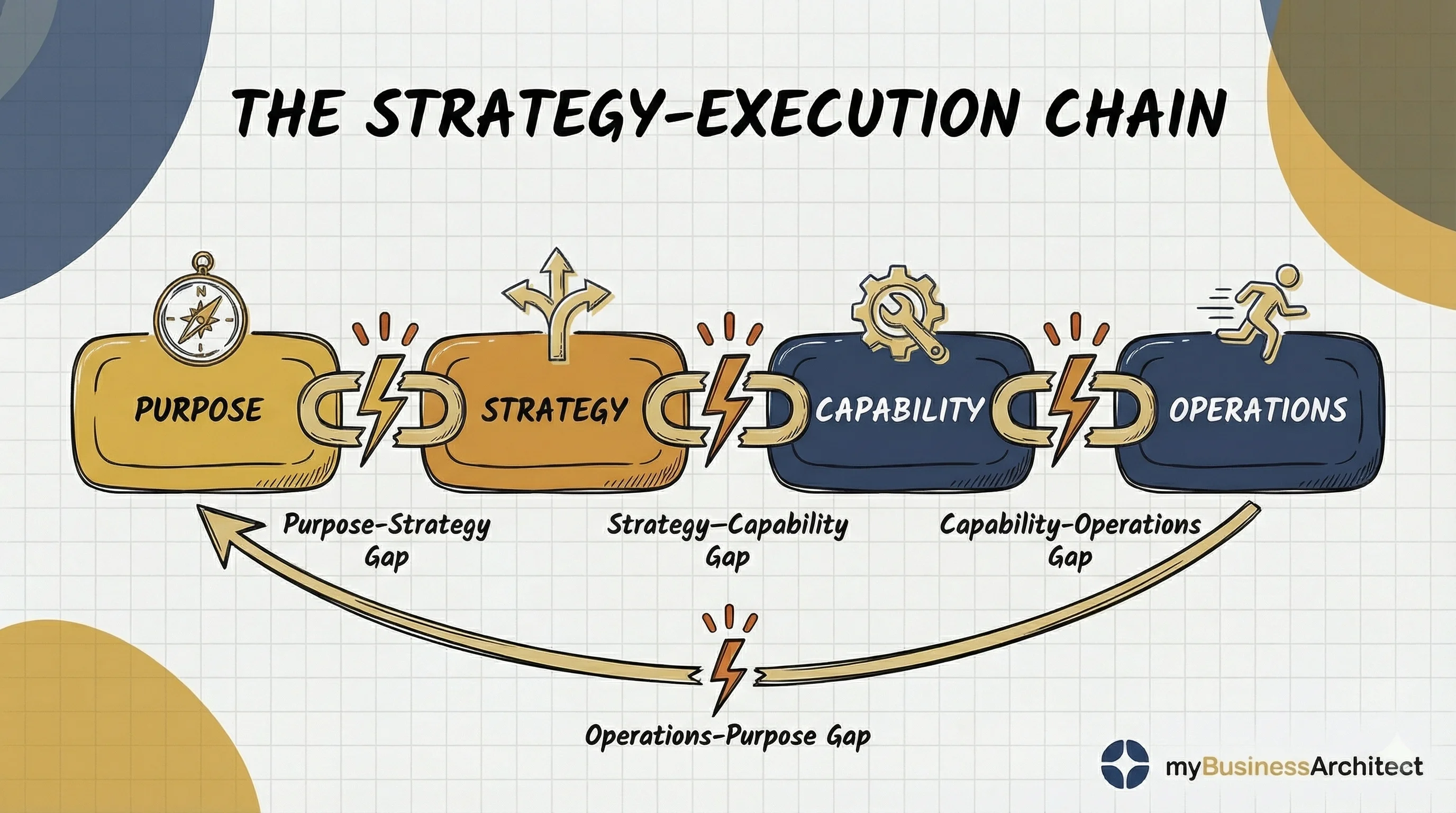 Purpose → Strategy → Capability → Operations: every gap is a broken link in this chain.
Each link has a specific failure mode. Recognising which one is active in your organisation is the first move.
Gap 1: Purpose → Strategy
The symptom: Inspiring vision, no criteria for choosing.
The CEO delivers a compelling speech about customer-centricity. The board approves a bold new direction. And then nothing changes. The budget still funds the same initiatives. The same metrics drive the same behaviours.
The root cause is almost always the same, the purpose was never translated into choices. A vision statement isn't a strategy. "Be the most customer-centric organisation in our industry" sounds compelling, but it doesn't tell anyone what to stop doing. Without explicit decisions about where to focus and what to sacrifice, everyone interprets the purpose differently, and the organisation pulls in multiple directions at once.
Gap 2: Strategy → Capability
The symptom: Bold commitments, no capacity to deliver.
Leadership makes strategic promises without honestly assessing whether the organisation can execute them. The strategy calls for a digital-first customer experience in 18 months. But the IT infrastructure is legacy, the staff have limited digital skills, procurement takes 12 months, and data is siloed across departments that don't share well.
The assumption, sometimes explicit and often unconscious, is that capabilities can be bought, built, or willed into existence on whatever timeline the strategy demands. But organisational capabilities are deeply embedded systems of people, processes, technology, and information. You can't bolt on a new capability like adding an app to a phone.
Gap 3: Capability → Operations
The symptom: Impressive investments, unchanged stakeholder experience.
The organisation invests in new technology, trains teams, redesigns processes. The capability exists on paper. But it never shows up reliably in the stakeholder's experience. Program managers don't use the new data in their daily decisions. The outcomes reports go to the board quarterly and get filed away. The capability lives in a parallel universe that doesn't touch the real work.
Having a capability and operationalising it are fundamentally different things. The gap often hides in information: departments that define the same concepts differently, handoffs where data arrives in a format the receiving team can't use, eligibility rules that contradict each other because nobody designed them to work together. The result is inconsistency: the organisation can sometimes do brilliant work, for some stakeholders, through some channels, on good days.
Gap 4: Operations → Purpose
The symptom: Green dashboards, disengaged stakeholders.
This gap develops slowly. That's what makes it the most insidious. Efficiency pressures cause operations to drift from the original mission. The organisation begins optimising for activity rather than outcomes, measuring what is easy to count rather than what actually matters. Call centres track handle time instead of problem resolution. Hospitals track bed occupancy instead of patient outcomes. Government agencies count applications processed instead of citizens served.
Everyone is busy. KPIs are met. And the organisation has quietly stopped delivering on its reason for existing.
Related reading: Your Organisation Doesn't Have a Strategy Problem. It Has a Purpose Problem.
The Political Reality
This is the part most strategy frameworks skip.
A capability heat map showing a function at maturity level 1 is architectural evidence. When the person responsible for that capability is in the room, the same heat map becomes a political document. The conversation shifts from "What does this tell us?" to "Who does this implicate?" A value stream that crosses three departmental boundaries makes the heads of those departments jointly accountable for a gap none of them officially owns. An operations audit that reveals purpose drift implicates whoever set the metrics.
Correct diagnosis doesn't neutralise political resistance. In most organisations, it intensifies it.
This is why the strategy-execution gap persists even when smart, experienced people can see exactly where the chain is broken. The analytical problem is solvable. The organisational problem is harder. It requires a senior leader whose authority extends across the boundaries the gap crosses, and whose willingness to act on uncomfortable findings doesn't waver when those findings implicate people in the room.
Business architecture surfaces misalignment that crosses departmental boundaries. Without a senior sponsor who can convene those conversations and protect the work when findings are politically inconvenient, the diagnosis stays academic.
Identifying your sponsor isn't a preliminary step. It's the first strategic move. The right sponsor has three things: authority that extends across the departmental boundaries the gap crosses, a problem the gap represents (not just a problem it creates for them), and the willingness to act on findings that will implicate people in the room. If you can't identify someone who has all three, the diagnostic work stays academic until the crisis makes the sponsor's problem visible enough that they have no choice but to act.
Five Patterns That Widen the Gap
The four gaps don't emerge in a vacuum. They're created and widened by recognisable patterns that look like strategic thinking but undermine execution.
The Do-It-All Trap. Refusing to make choices. Trying to serve every market, every customer segment, every opportunity. The result is an organisation spread too thin to excel at anything. This trap widens the Purpose → Strategy gap by producing lists of priorities in which every priority is equal.
The Don Quixote Trap. Making bold strategic commitments without honestly assessing whether the organisation can deliver them. The vision is inspiring. The strategy deck is compelling. But nobody checked whether the people, processes, technology, and information exist to execute within the stated timeframe. This trap widens the Strategy → Capability gap. The diagnostic signal: the strategy was set before any capability assessment. The conversation to have is with whoever approved the commitment: it starts by naming the gap between what was promised and what exists.
The Program-of-the-Month Trap. Launching new strategic initiatives before previous ones take root. Each new priority displaces the last, creating organisational whiplash. Nothing gets the sustained attention it needs. This trap widens the Capability → Operations gap by ensuring that no capability investment ever reaches the front line before the next one is announced.
The Dreams-That-Never-Come-True Trap. Strategic aspirations that never translate into organisational action. The choices are made. The direction is clear. But the decisions never reach the teams who have to build something different. The strategy lives in the boardroom and dies in the hallway. This trap widens the Strategy → Capability gap from a different direction: not ambition without assessment, but decisions without follow-through. The diagnostic signal: the capability teams can describe the strategy but weren't involved in designing how to execute it. The conversation to have is about who owns the handoff between strategic choice and capability planning, because right now nobody does.
The Metrics Trap. Measuring what is easy rather than what matters. When the organisation optimises for the metrics it tracks, and those metrics don't reflect purpose, operations drift. This trap widens the Operations → Purpose gap, often invisibly, until the gap is too wide to ignore.
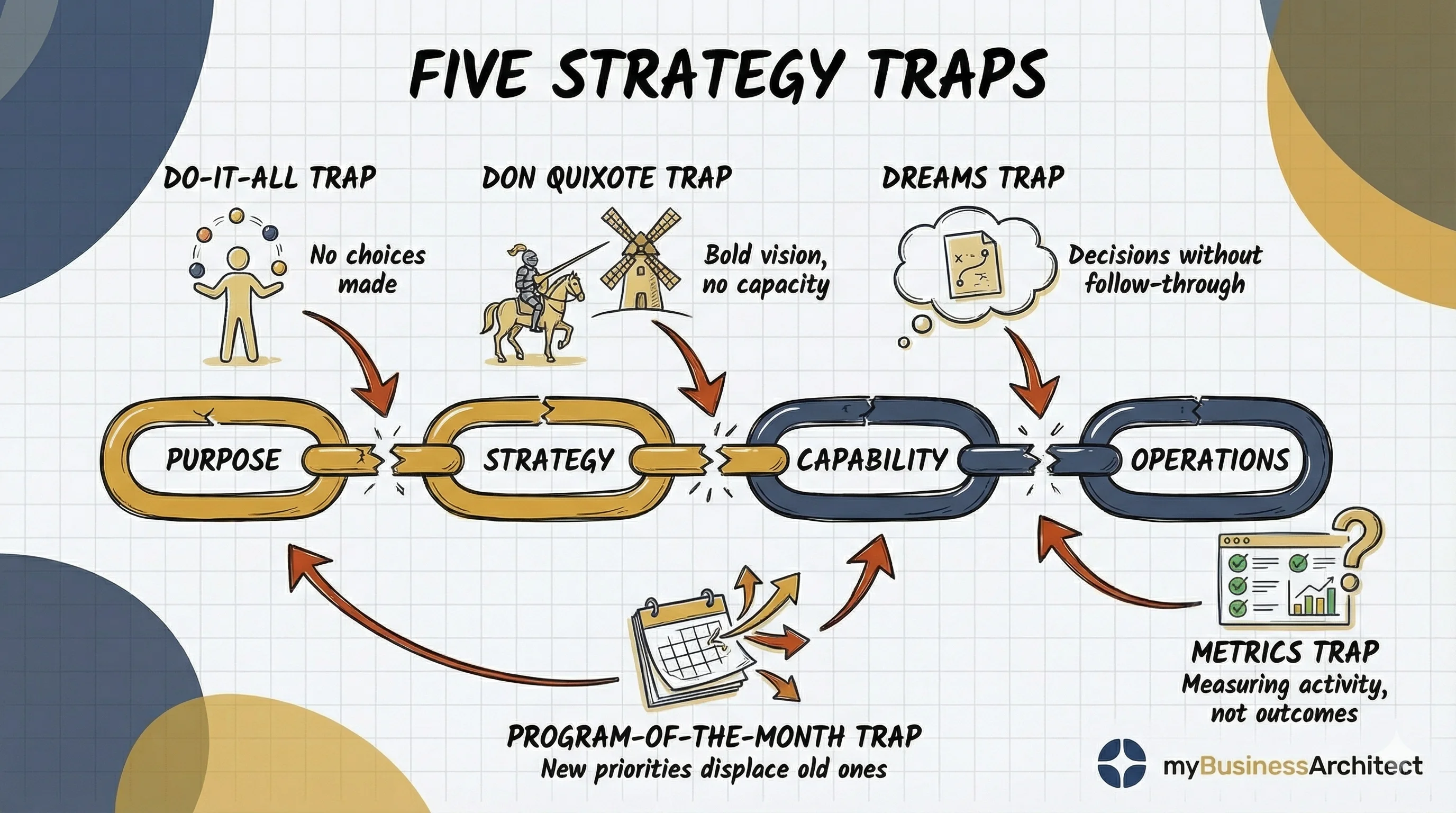 Each trap widens a specific gap in the strategy-execution chain.
Related reading: The Most Important Word in Strategy Is "No"
Why Planning Harder Makes It Worse
The standard response to a strategy-execution gap is to plan more thoroughly: more detail, more milestones, more accountability mechanisms. This reinforces the mindset that caused the problem.
Traditional strategic planning follows a line:
Plan → Execute → Review (annually)
This model assumes the environment stays stable between planning cycles, that execution is primarily a matter of discipline, and that annual reviews provide adequate feedback. All three assumptions are false. They've been false longer than most planning processes acknowledge.
In practice, the linear model breaks in three predictable ways.
Plans become obsolete before execution completes. When the environment shifts mid-cycle, the organisation faces a choice between a plan that no longer fits and the disruption of improvisation.
Execution reveals gaps the plan never anticipated. The linear model treats these as implementation problems rather than design feedback, so the root cause never gets addressed.
Annual reviews come too late. By the time the organisation formally assesses results, misalignment has already wasted resources, missed opportunities, and eroded stakeholder trust.
The alternative isn't a better plan. It's a different way of thinking about the relationship between strategy and execution.
Related reading: Your Strategy Failed. Your Second One Will Too. Unless You Change How You Think.
A Framework Built for This Problem
What replaces the linear model? A framework designed for the current environment needs three properties. It needs to be cyclical rather than linear, so that feedback loops keep strategy connected to reality as conditions shift. It needs to be diagnostic rather than prescriptive, so that the organisation identifies which specific connection is broken before jumping to solutions. And it needs to treat purpose as an active constraint tested through evidence, not a passive aspiration assumed through optimism.
These aren't abstract design requirements. They're the specific properties the linear planning model lacks, and that the strategy-execution gap consistently exposes.
The Design4 framework structures this discipline into four interconnected phases, each closing a specific gap and governed by a specific question:
| Phase | Focus | Gap It Closes | Governance Question |
|---|---|---|---|
| Discover | Anchor in purpose, understand stakeholders | Operations → Purpose | Are we getting the benefits? |
| Define | Translate purpose into strategic choices | Purpose → Strategy | Are we doing the right things? |
| Develop | Build capabilities the strategy requires | Strategy → Capability | Are we doing them the right way? |
| Deliver | Operationalise value for stakeholders | Capability → Operations | Are we getting them done well? |
The governance questions form a cycle, not a checklist. Discover starts by asking whether the organisation is currently delivering value to stakeholders, because the evidence of what's working and what isn't determines where the cycle needs to focus next. If benefits are being delivered, the chain is intact. If they aren't, something upstream is broken, and the cycle begins.
The phases aren't sequential steps you complete and leave behind. They're interconnected gears that turn together. A discovery about shifting stakeholder needs forces a reassessment of strategic choices. A capability gap revealed during development may require adjustments to the operating model. A performance shortfall in delivery triggers questions about whether the organisation is still anchored in the right purpose.
Each subsequent cycle builds on what came before. Purpose becomes clearer. Choices become sharper. Capabilities become more targeted. The organisation gets better at the discipline itself. Traditional planning resets to zero every time the calendar rolls over. A continuous framework preserves momentum and compounds.
Practitioners who commit to the discipline describe the same shift: they stopped trying to fix the plan, and started maintaining the connections. That's a different job, with different skills, and a fundamentally different relationship with what the organisation decides to do.
Go deeper: Business Architecture Framework: The Design4 Approach: a detailed guide to the four phases, artifacts, and governance model.
What Closing a Gap Actually Looks Like
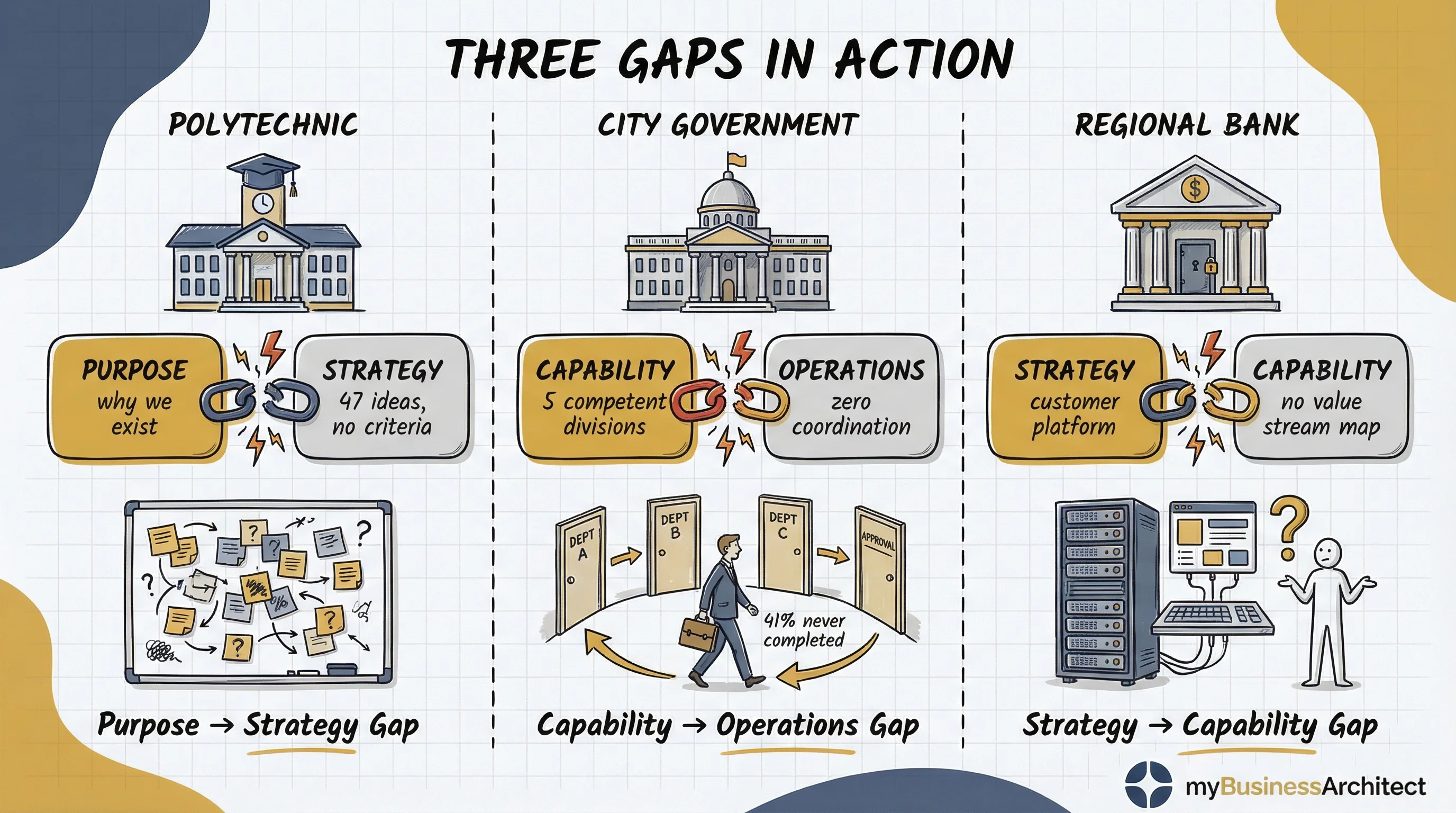 Three real-world examples of the strategy-execution gap: each case maps to a specific broken link in the chain.
Forty-Seven Ideas and No Direction
A polytechnic facing a $38 million shortfall convened its leadership team. The VP Finance proposed cutting 30% of programs. The VP Academic pushed back. The Director of International Education wanted to pivot to corporate markets. The Dean of Health Sciences pointed out that his programs were full. By the end of two hours, they had forty-seven ideas on a whiteboard, with no criteria for choosing.
The problem wasn't a lack of ideas. It was the Purpose → Strategy gap: no shared understanding of why the institution existed, and therefore no basis for deciding which ideas mattered.
A purpose stress test surfaced what the leadership team had never formally agreed on: the institution existed to deliver workforce-connected credentials to regional learners who couldn't access urban university programs. That constraint eliminated forty of the forty-seven ideas immediately, not through debate, but through criteria. The remaining seven were evaluated on a shared basis. The institution made three choices it could actually defend. The gap that had produced two hours of circular debate closed in a morning.
Five Divisions, One Resident, Zero Coordination
A city government's Department of Community Services operated five divisions: housing, childcare, workforce development, income support, and family services. A single mother needing help from three divisions encountered conflicting eligibility requirements that trapped her in a loop no single division created and no single division could see. Forty-one percent of residents who applied to multiple divisions never completed a second application.
The gap wasn't within any division. It was the Capability → Operations gap: competent services that had never been designed to work together from the resident's perspective.
Value stream mapping across all five divisions from the resident's point of view surfaced six eligibility rule conflicts, three duplicated intake processes, and two information handoffs that failed structurally on every pass. No new technology was purchased. No division was restructured. A cross-divisional coordination protocol and a shared eligibility vocabulary reduced incomplete multi-division applications from 41% to 11% within the first year.
The Platform That Changed Nothing
A regional bank invested millions in a new customer platform. The technology worked. Customer experience didn't improve.
The harder conversation came before the fix. Recommending a capability assessment to the leadership team that had just approved the platform purchase meant framing the next step as preparation for the follow-on investment, not as a post-mortem on the one just made. That positioning required its own sponsor conversation before any analysis began.
The reason the platform hadn't worked: nobody had mapped how customer value actually flowed across departments before selecting the technology. The bank had treated a design problem as a technology purchase. The platform couldn't fix what the design had never addressed, because the underlying gaps (a fragmented data model, unclear role ownership, and three process handoffs that broke on every exception) were invisible to the selection process.
A capability-first assessment before the next investment decision identified those three foundational gaps explicitly. The following investment was sequenced differently: data model first, then role clarity, then process integration, then platform. Customer satisfaction scores improved within eight months. The platform hadn't changed. The organisation's ability to use it had.
Related reading: You Bought the Platform. Nothing Changed. Here's Why.
Frequently Asked Questions
Why do strategies fail in execution?
Not because the people are wrong. Because the connections are broken. The chain from purpose to operations fails at specific handoff points: purpose doesn't translate into choices, choices assume capabilities that don't exist, capabilities don't reach daily operations, operations drift from mission. Fix the people and the gap remains. Fix the connections and the people can finally deliver.
How do you know which gap to address when more than one is active?
They're rarely active in isolation. The Purpose → Strategy gap and the Strategy → Capability gap often compound: unclear purpose produces a scattered strategy, which produces misaligned capability investments, which produces operations that drift. The diagnostic question is: which gap is generating the others? Start where the evidence is weakest. The gap with the most "we think so, but we don't have evidence" answers is almost always the primary one. Close it and the downstream gaps become more tractable.
How do you measure strategy execution?
Traditional metrics (budget variance, milestone completion, activity volume) measure whether the plan is being followed, not whether it's working. Effective strategy execution measurement uses four governance questions: Are we doing the right things? Are we doing them the right way? Are we getting them done well? Are we getting the benefits? Each question requires evidence, not opinion. The ratio of evidence-based answers to assumption-based answers tells you more about execution health than any dashboard.
What is the difference between strategy implementation and strategy execution?
Implementation asks "Did we follow the plan?" Execution asks "Did we deliver the outcome?" The distinction matters because following the plan perfectly can still produce the wrong result if conditions changed after the plan was written. Organisations that focus on implementation succeed at the plan but fail at the outcome. Organisations that focus on execution build the adaptive capacity to adjust their approach while maintaining alignment with purpose.
What do you do when you've correctly diagnosed the gap and the organisation funds something else anyway?
You document the finding, update whatever tracking you're using, and return the following week. This isn't resignation: it's governance discipline. The diagnosis is now on record. When the funded initiative encounters the gap you identified, the organisation will be back for the conversation it wasn't ready to have. The practitioner who held the position without personalising the outcome is the one in the room when the next cycle starts.
Where do you start if you can see the gap but can't move the organisation?
With the sponsor question. The gap you can see analytically is almost never the hardest part. The hardest part is identifying the senior leader whose problem the gap represents, whose authority extends across the boundaries the gap crosses, and who has the willingness to act on findings that may be politically inconvenient. Without that person, the diagnosis stays academic. With that person, the first cycle is possible. Start there before you start anywhere else.
The strategy-execution gap isn't a mystery. It's a structural problem with identifiable causes and fixable connections. The first step is always the same: stop examining the plan and start examining the chain. Purpose to strategy to capability to operations. One of those links is breaking right now. Now you know how to find it.
The practitioners who do this work describe the same shift over time. They stop being the analyst whose correct diagnosis gets set aside. They become the person in the room who knows which link is breaking, who the sponsor needs to be, and what the first cycle looks like. That's not a better analytical skill. It's a different relationship with how organisations actually change.
Continue Learning
Pillar pages
- What Is Business Architecture?: the discipline that closes the strategy-execution gap
- Business Architecture Framework: The Design4 Approach: the four-phase cycle in depth
Courses
- Closing the Strategy-Execution Gap: the foundational course, taught through the Lakeshore Polytechnic narrative
- Building the Common Language: standardised models for naming what you see
Blog posts
- Three Forces That Make Strategy Fail
- Your Strategy Failed. Your Second One Will Too.
- Your Organisation Doesn't Have a Strategy Problem.
- The Most Important Word in Strategy Is "No"
- You Know Something Needs to Change. Here's Where to Start.
- You Bought the Platform. Nothing Changed.
Resources