You've been in that meeting. The one where the strategy is right, the analysis is solid, and the room funds something else anyway. Or the one where the platform goes live and three months later nothing about the stakeholder experience has changed. Or the one where every department hits its KPIs and the organisation is still falling behind.
These aren't isolated failures. They're symptoms of the same structural problem: most organisations can feel the gap but cannot name it.
Business architecture is the discipline that names it.
It is a strategic management discipline that connects an organisation's purpose, strategy, capabilities, and operations into a coherent, manageable system. Every organisation has a purpose: a reason it exists. That purpose should drive strategic choices about where to focus. Those choices should determine what capabilities the organisation needs. And those capabilities should show up in how the organisation operates every day.
When that chain is intact, the organisation delivers value. When any link breaks, you get the strategy-execution gap: sound analysis, real commitment, and outcomes that drift from intent.
Business architecture is the discipline that makes these connections visible, tests whether they hold, and fixes them when they break.
Why Business Architecture Matters
Strategic plans become obsolete within months. Reorganisations launch with fanfare and fade without impact. Platforms get built and stakeholder experiences don't change. These aren't failures of intelligence or intention. They're failures of connection.
The problem shows up in four predictable places:
Purpose doesn't connect to strategy. The organisation has an inspiring vision but no criteria for choosing between competing priorities. Result: forty-seven ideas on a whiteboard and no way to decide which ones matter.
Strategy doesn't connect to capability. Leadership makes bold commitments without honestly assessing whether the organisation can deliver. Result: strategies that look brilliant on paper and fail in practice.
Capability doesn't connect to operations. Investments are made, capabilities are built, but they never reach the day-to-day work. Result: impressive PowerPoints and unchanged stakeholder experiences.
Operations don't connect back to purpose. Efficiency pressures cause daily work to drift from the mission. Dashboards are green, KPIs are met, but the organisation has quietly stopped delivering on its reason for existing.
Business architecture exists to diagnose, design, and govern these connections. It's the discipline that ensures the whole system works, not just the individual parts.
Related reading: Three Forces That Make Strategy Fail (and None of Them Are Effort)
What Business Architecture Is Not
Before going deeper, it helps to clear up common misconceptions:
It's not IT architecture. Business architecture focuses on the business itself: purpose, strategy, capabilities, value delivery. Enterprise and IT architecture focus on technology systems. Business architecture provides the strategic context that technology decisions need, but it's not a technical discipline.
It's not strategic planning. Strategic plans produce documents. Business architecture produces a continuous practice. Plans are snapshots; architecture is a living system that adapts as the environment changes.
It's not org design. Org charts describe reporting relationships. Business architecture describes how value flows across the organisation, regardless of who reports to whom. The most important connections in any organisation cut across the org chart, not down it.
It's not a diagram. Business architects produce artifacts (capability maps, value streams, service blueprints), but the artifacts are tools for conversation, not ends in themselves. A beautiful capability model that sits in a drawer has zero value.
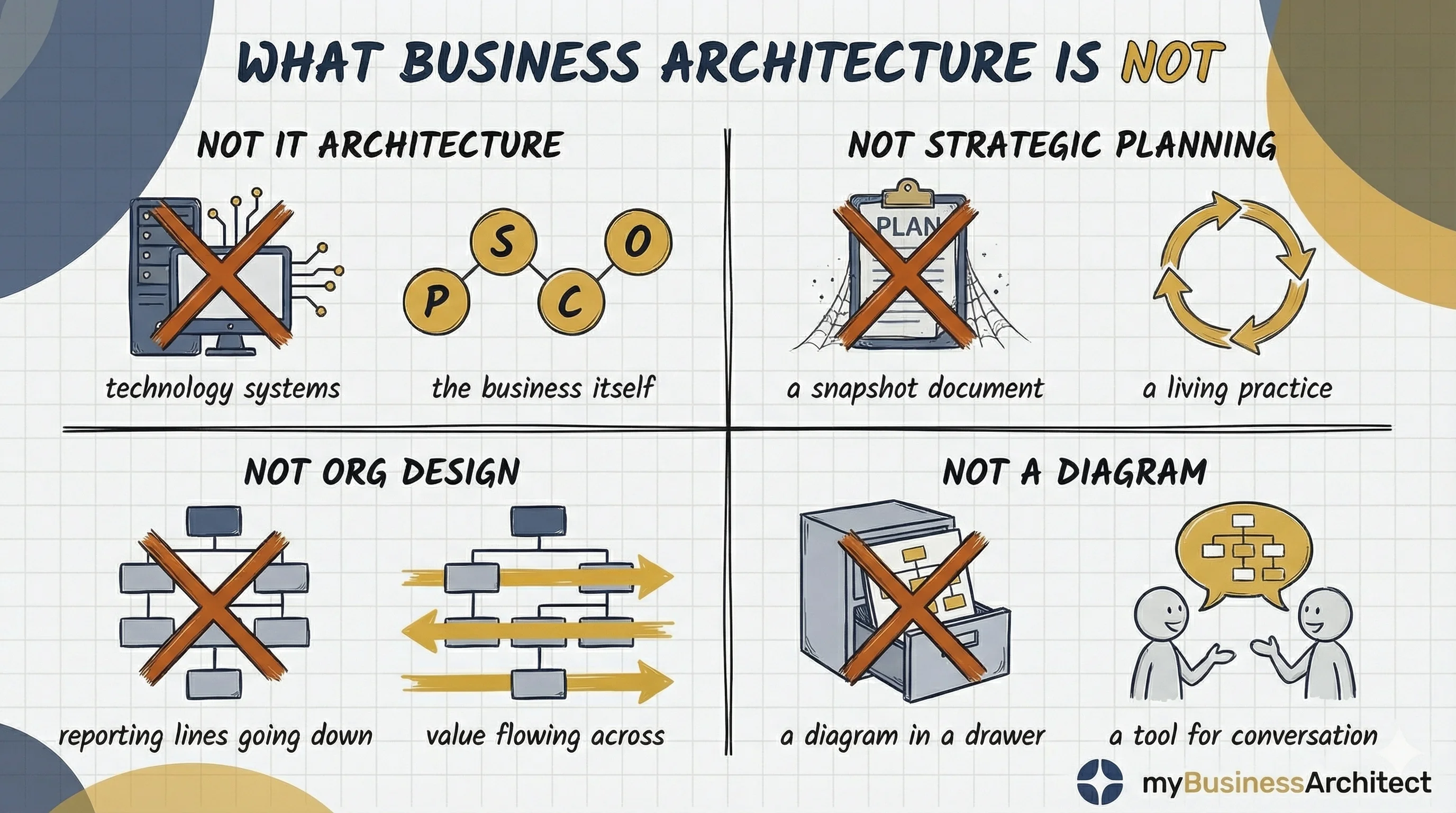 Four common misconceptions: what business architecture is not.
If these patterns look familiar, the next question isn't what business architecture is: it's whether your organisation needs it. What follows shifts from concept to practice.
What Business Architects Actually Do
Here's what most descriptions of business architecture get wrong: they frame it as organisational design. It's actually organisational self-awareness. Most organisations cannot see themselves accurately. They see the org chart, the budget, the project portfolio, but not the connections between them. Business architecture's primary value isn't designing the organisation. It's giving the organisation the ability to see itself clearly enough to know where it's breaking.
A business architect's job is to help the organisation see the whole picture and act on it. In practice, this means:
Diagnosing alignment gaps. Identifying where the connections between purpose, strategy, capability, and operations are breaking. This often means asking questions that nobody in the room is willing to ask: Can we actually do what our strategy promises? Are we measuring outcomes or just activity? Does our operating model reflect our stated purpose?
Making the invisible visible. Organisations struggle with what they can't see. Business architects create artifacts (maps, models, blueprints) that make organisational connections visible, debatable, and manageable. The value isn't the artifact. It's the conversation the artifact enables.
Related reading: Walk Down the Hall. The Gap You See Is the Gap Nobody Can Name.
Translating between audiences. Strategy teams speak one language. Technology teams speak another. Operations teams speak a third. Business architects bridge these conversations, ensuring that strategic intent survives translation into actual investment decisions, technology choices, and operating processes.
Governing ongoing alignment. Alignment isn't something you achieve once. It's something you maintain continuously. Business architects build governance mechanisms that detect drift early, before misalignment becomes a crisis.
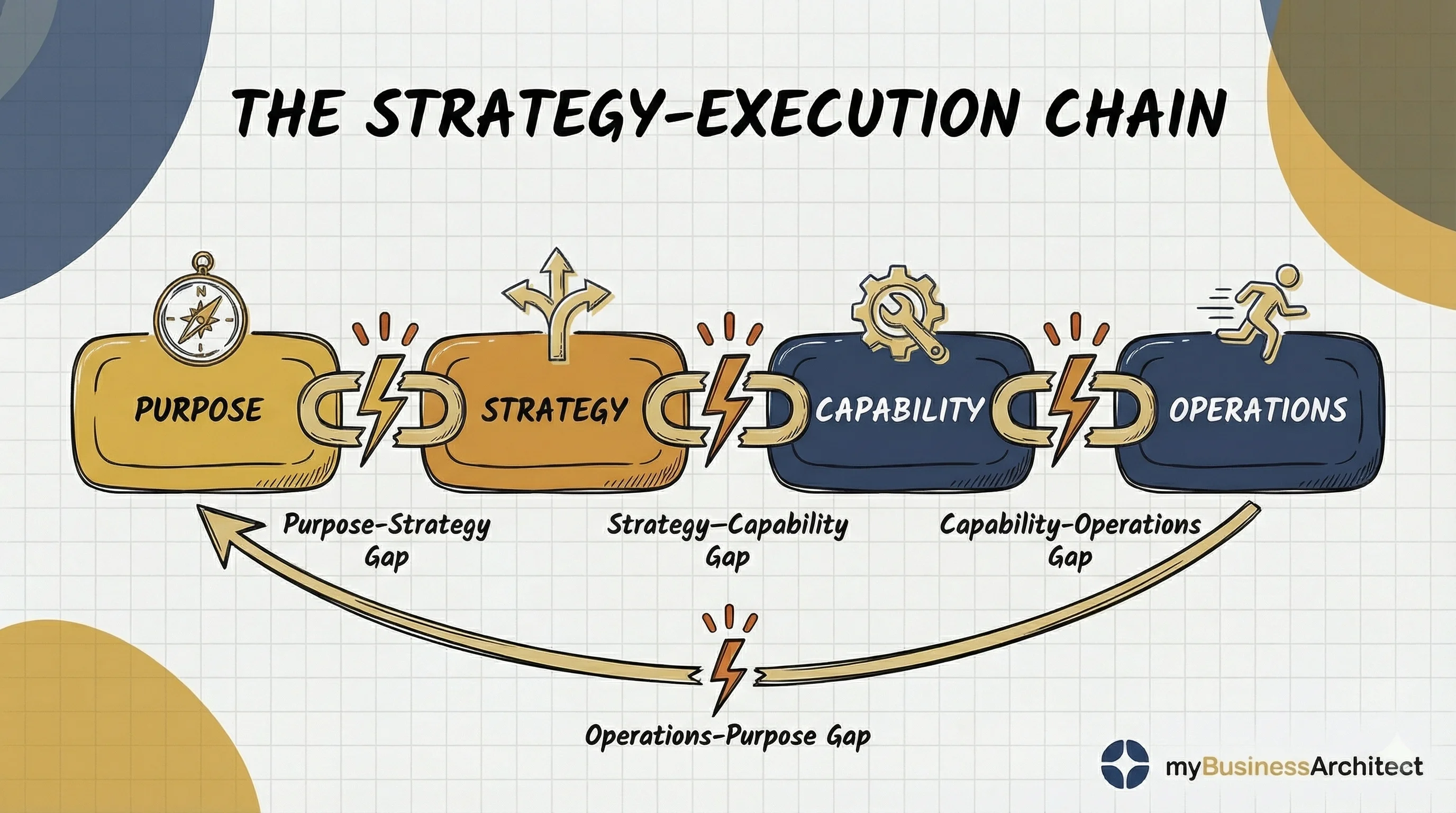 The purpose-to-operations chain: when any link breaks, you get the strategy-execution gap.
Guarding conceptual integrity. When different departments use the same term to mean different things, or organise concepts into hierarchies that reflect operational habit rather than actual business structure, the imprecision seems harmless. It isn't. Loose terminology and flawed relationships in requirements become rigid constraints in implemented systems. Business architects work at the conceptual level, ensuring that enterprise information models capture the true semantic structure of the business domain and the correct relationships between concepts, before solution architects translate those models into system designs. Today's information architecture will either constrain or enable the organisation's operations for years to come. The business architect's job is to make sure the concepts are right before they become permanent.
Go deeper: The Business Architect: What the Role Is, What It Isn't, and What It's Becoming. What the role actually requires day to day, and how it differs from adjacent titles.
Key Business Architecture Artifacts
Each of the gaps described above has a corresponding instrument that makes it visible and discussable in the room where decisions get made. Business architects use these tools not to produce diagrams, but to surface the conversations that organisations avoid:
| Artifact | What It Does | When You Need It |
|---|---|---|
| Golden Circle / Purpose Statement | Articulates the organisation's "Why": its authentic purpose beyond financial returns | When leadership can't explain why the organisation exists in terms specific enough to guide choices |
| Strategic Choice Cascade | Structures the five essential strategic decisions and forces explicit trade-offs | When the organisation has too many priorities and no criteria for choosing between them |
| Business Model Canvas | Maps how value is created, delivered, and captured across the organisation | When the business model is assumed rather than examined |
| Capability Heat Map | Shows current vs. required capability maturity across strategic priorities | When investments are driven by politics rather than evidence of need |
| Value Stream Map | The organising construct of the architecture: traces how value flows end-to-end from stakeholder need to stakeholder outcome, across every function and silo boundary. Without value streams, capabilities are an inventory; with them, they become a system | When nobody can describe end-to-end how a service reaches the stakeholder, or when capabilities exist but don't connect into coherent delivery |
| Service Blueprint | Maps the stakeholder experience alongside internal processes that support it | When operations are designed from the inside out instead of the outside in |
The Design4 framework deliberately synthesises established tools (the Strategic Choice Cascade builds on Lafley and Martin's work, the Golden Circle draws from Sinek, the Business Model Canvas from Osterwalder) and integrates them into a single connected practice. The curatorial choice matters: these aren't arbitrary selections. Each artifact addresses a specific link in the purpose-to-operations chain, the same chain Design4 organises into four phases: Discover (Purpose), Define (Strategy), Develop (Capabilities), Deliver (Operations).
These artifacts connect into a system. The purpose statement informs strategic choices. Strategic choices identify required capabilities. Capability assessments reveal gaps. Service blueprints translate capabilities into stakeholder experiences. And outcome measurement feeds back into purpose validation.
Go deeper: Business Architecture Framework: The Design4 Approach. A detailed guide to the four-phase cycle that organises these artifacts into a continuous practice.
Business Architecture Examples
Business architecture applies wherever an organisation faces a gap between intent and execution. Here are three examples across different sectors:
Nonprofit
An international development nonprofit operated field offices across twelve countries. Each office set its own priorities, tracked its own metrics, and reported success in terms of activities delivered: wells dug, workshops held, meals distributed. When the board asked a simple question (Are the communities we serve measurably better off?) nobody could answer with evidence. Business architecture diagnosed the disconnect: the organisation had never connected its operational metrics to its stated purpose of sustainable community development. Once it mapped the chain from purpose through capabilities to field operations, 30% of its programs turned out to be high-effort, low-impact work that served the organisation's reporting needs more than the communities it existed for.
Manufacturing
A mid-size manufacturer announced a strategic pivot from commodity components to engineered solutions: higher-margin, custom-designed products for specific industrial applications. The strategy was sound. But twelve months in, the sales team was still quoting commodity prices, the production floor was still optimised for volume runs, and engineering was buried in custom requests they didn't have capacity to handle. Business architecture revealed what had gone wrong: leadership had changed the strategy without assessing which capabilities needed to change with it. A capability heat map showed that three critical capabilities (solution engineering, consultative selling, and custom production planning) were at foundational maturity when the strategy required advanced. That evidence changed the decision: leadership delayed the go-to-market by six months and invested in building solution engineering capacity first, rather than launching into a market the organisation wasn't yet equipped to serve.
Insurance
A national insurance provider's claims operation was a model of efficiency. Average processing time had dropped 40% over three years. Cost per claim was at an industry benchmark. Every operational KPI was green. But customer retention was falling and satisfaction scores had hit a five-year low. Business architecture revealed a Capability → Operations gap: the organisation had the capability. Experienced adjusters with the judgment to assess complex situations and the communication skills to support policyholders through difficult moments. But when the operating model was redesigned for speed and cost, those capabilities were stripped out. Automated triage replaced human assessment. Scripted responses replaced empathetic communication. The capabilities still existed on paper. They had simply been designed out of the operation that needed them most.
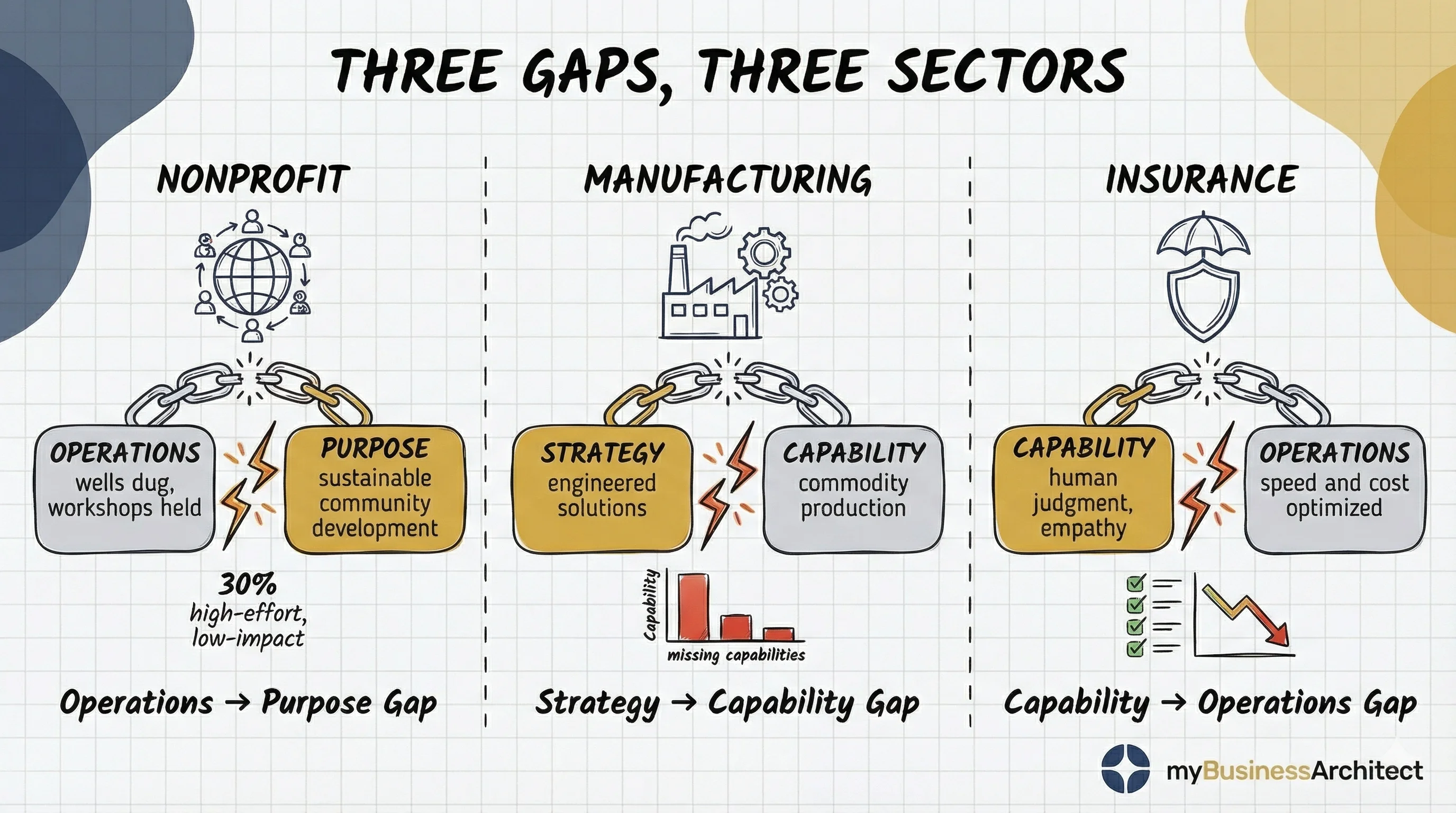 Three sectors, three different gaps: the same diagnostic discipline applied each time.
Related reading: You Redesigned the Engine. Nobody Redesigned the Ride.
Business Architecture vs. Enterprise Architecture
This is the most common question practitioners encounter. Here's the distinction:
| Business Architecture | Enterprise Architecture | |
|---|---|---|
| Focus | Purpose, strategy, capabilities, value delivery | Technology landscape: applications, data, infrastructure |
| Primary question | Are we building the right things? | Are we building them the right way technically? |
| Audience | Business leaders, strategy teams, operations | IT leaders, solution architects, technology teams |
| Output | Capability maps, value streams, business models | Application portfolios, data models, technology roadmaps |
| Scope | The business as a system | The technology that supports the business |
They're complementary, not competing. Business architecture provides the strategic context that enterprise architecture needs to make good technology decisions. Without business architecture, enterprise architecture becomes technology optimisation without strategic direction. Without enterprise architecture, business architecture becomes strategic intent without technical execution.
In practice, the strongest organisations invest in both, and connect them explicitly. For the fuller comparison, including what current hiring evidence shows about where the two roles genuinely converge and where they don't: Business Architect vs Enterprise Architect.
How to Get Started
You don't need a formal program or a consulting engagement to start practicing business architecture. You need a diagnostic question and the willingness to follow where it leads.
Before you start: Find your sponsor. Business architecture requires cross-functional visibility, access to strategic conversations, and the authority to act on findings. Before you build your first artifact, identify the senior leader who will champion the work and protect it when it surfaces uncomfortable truths. Without sponsorship, the architecture will be analytically correct and organisationally irrelevant.
Step 1: Pick your gap. Which connection feels most broken in your organisation: purpose→strategy, strategy→capability, capability→operations, or operations→purpose? Start there.
Step 2: Ask the hard question. Use the Four Ares to test your assumptions:
- Are we doing the right things?
- Are we doing them the right way?
- Are we getting them done well?
- Are we getting the benefits?
If any of these draws a blank (no evidence, just optimism) you've found where business architecture creates value.
Step 3: Make something visible. Build one artifact that makes the gap tangible. A purpose statement that's specific enough to filter decisions. A capability heat map that shows where you're thin. A value stream map that traces the stakeholder's actual experience. Something the leadership team can look at together and say: That's where we're breaking.
Step 4: Use it. The artifact's value comes from the conversation it enables, not from the diagram itself. Bring it to a real decision. Watch what happens.
Take the diagnostic: Find Your Gap: 4-minute assessment →
Frequently Asked Questions
What's the difference between business architecture and business analysis?
They're often confused because they share the word "architecture" with "analysis." The difference is scope. A business analyst asks "What does this project need?" A business architect asks "Does this project connect to what the organisation needs?" Analysis optimises the part. Architecture tests whether the parts add up to a coherent whole. For the fuller distinction, including what the two roles actually do differently day to day: The Business Architect: What the Role Is, What It Isn't, and What It's Becoming.
Do I need a certification to be a business architect?
No. Nobody ever closed a strategy-execution gap by showing a certificate. Business architecture is a discipline built through practice, not a credential earned through examination. Certifications exist, and structured learning accelerates development, but what matters is whether you can help an organisation see its alignment gaps and close them.
What industries use business architecture?
Every industry where there's a gap between intent and execution (which is all of them). The discipline is particularly valuable in sectors where complexity makes the gap hardest to see: healthcare, government, financial services, higher education, and large nonprofits. But any organisation where purpose must connect to operations through strategy and capability, and where that connection is breaking, benefits from the practice.
How is business architecture different from management consulting?
The exit criteria are different. A consultant's engagement ends when the recommendation is delivered. A business architect's work succeeds when the organisation can see and manage its own alignment without them. The goal isn't a report. It's a practice the organisation owns and sustains after the architect steps back.
Where does business architecture sit in the organisation?
There's no single right answer. Business architecture functions can sit under strategy, under the CIO, under transformation offices, or as an independent function. What matters more than reporting line is mandate: the business architect needs access to strategy conversations, investment decisions, and operational data. Without that access, the discipline becomes theoretical.
Business architecture doesn't ask you to work harder. It asks you to see the whole system: the chain from purpose to operations, and the connections that matter most to fix. The organisations that practice it don't just execute better. They learn to see where they're breaking before the break becomes a crisis.
Continue Learning
Pillar pages
- The Business Architect: What the Role Is, What It Isn't, and What It's Becoming: the discipline explains what business architecture is; this pillar explains who practices it and what the job actually requires
- Business Architecture Framework: The Design4 Approach: the four-phase cycle and governance model in depth
Courses
- Closing the Strategy-Execution Gap: learn the full Design4 framework through the Lakeshore Polytechnic narrative
- Building the Common Language: standardised reference models for naming what you see
- Communicating Business Architecture: making strategy visible and conversations productive
- Shaping What Gets Built: ensuring strategic intent survives translation into solutions
Blog posts
- Four Questions That Replace Your Strategic Plan
- Your Organisation Doesn't Have a Strategy Problem. It Has a Purpose Problem.
- You Know Something Needs to Change. Here's Where to Start.
- Walk Down the Hall. The Gap You See Is the Gap Nobody Can Name.
Resources