You know this document. It lives in a shared drive somewhere. It's called "Strategic Plan." It took months to produce. Consultants were involved. There were offsites, workshops, and a final presentation with enough slides to outlast the afternoon. It describes the organisation's vision, its goals, its pillars, its strategic themes. It describes everything.
It decides nothing.
This is the most common failure mode in strategy: a plan that lists everything the organisation could pursue without choosing what it will actually commit to. Everyone leaves the offsite feeling aligned, then returns to their desks and continues doing exactly what they were doing before, because the plan gave them no reason to do anything different.
The problem isn't intelligence or effort. It's the absence of choices. If your strategy does not force you to say "no" to something plausible, it is not a strategy. It is a wish list dressed in executive language.
The strategy choice cascade, sometimes called the strategic choice cascade or simply the strategy cascade, is the antidote. It replaces the wish list with five integrated choices that tell the organisation where to focus, what to sacrifice, and how to win.
What Is the Strategy Choice Cascade?
The strategy choice cascade is a framework forged in practice at Procter & Gamble under CEO A.G. Lafley, then articulated jointly by Lafley and Roger Martin in their book Playing to Win: How Strategy Really Works. It structures strategy as five interconnected choices, each building on the one before:
- Winning Aspiration. What does winning look like?
- Where to Play. Which markets, segments, and geographies will we focus on?
- How to Win. What is our competitive advantage in those chosen arenas?
- Capabilities Required. What must we be great at to win in this way?
- Management Systems. What processes and structures will sustain these choices?
What separates the cascade from most strategy frameworks is that the five choices must work as an integrated system. Change one and the others must change with it. Consider what happens when they do not: an organisation aspires to be the regional leader in patient-centred care (Choice 1), but chooses to compete in every service line rather than focusing on chronic conditions (Choice 2). Its "how to win" claims coordination across departments (Choice 3), but its capabilities are siloed by specialty (Choice 4), and its management systems reward department-level volume, not patient outcomes (Choice 5). Every choice sounds reasonable in isolation. Together, they describe an organisation pulling in five directions at once.
The power is not in any single choice. It is in the system they create together. In Martin's framing, the Playing to Win strategy comes down to a single test: if you are not saying no to something plausible, you have a wish list, not a strategy. The cascade of choices only works when every choice reinforces the others.
Choice 1: Winning Aspiration
The cascade begins not with market analysis or competitive positioning, but with aspiration: what does winning look like for this organisation?
A winning aspiration is not a financial target. It is a statement of the impact you intend to have. Consider the difference:
| Financial Target | Winning Aspiration |
|---|---|
| Grow revenue 15% by 2027 | Become the most trusted partner for small businesses navigating digital transformation |
| Reduce costs by $10M | Deliver the fastest path from diagnosis to treatment for patients in regional communities |
| Increase market share to 25% | Be the institution this region cannot do without for building careers in fields that matter |
The financial target tells you what to count. The winning aspiration tells you what to build, who to serve, and how to measure whether you are actually creating value.
A good winning aspiration has three properties. It is connected to the organisation's purpose, not just its financial ambitions. It is specific enough that it excludes plausible alternatives. And it provides the criteria against which every subsequent choice will be evaluated.
But here is the challenge most leadership teams avoid: articulating a winning aspiration requires agreement on purpose, and most leadership teams have never tested whether that agreement exists. Ask five leaders why the organisation exists and you will often get five different answers. The cascade does not resolve that disagreement. It exposes it. And until you sit with that discomfort long enough to forge a shared answer, every choice that follows will rest on a foundation that different leaders interpret differently.
The test: Does your aspiration tell you what to say no to? If it could apply to any organisation in your sector without modification, it is not specific enough to drive choices.
Related reading: Your Organisation Doesn't Have a Strategy Problem. It Has a Purpose Problem.
Choice 2: Where to Play
This is where strategy gets specific. The "where to play, how to win" pairing is the heart of the cascade, and where the discipline of "no" becomes essential.
"Where to play" defines the playing field: which geographies, customer segments, channels, product categories, and value chain stages the organisation will focus on. But its real power lies in what it excludes. Every market you choose to enter is a commitment of resources. Every segment you pursue is attention drawn from somewhere else. Without explicit "where not to play" decisions, the organisation defaults to playing everywhere, spreading resources thin and excelling at nothing.
Effective "where to play" choices share three characteristics:
- Specific enough to guide action. "We serve mid-market healthcare organisations in North America" is a choice. "We serve organisations that need our help" is not.
- Connected to purpose. The chosen playing field should be where the organisation can most authentically fulfil its reason for existing.
- Defensible. The organisation should have a plausible reason to believe it can win in this space, not just participate.
Every good strategy has two lists. The first is where you will focus. Most organisations can produce this list. The second list is where you will not play: which markets you will exit, which stakeholders you will deprioritise, which capabilities you will stop investing in. This second list is where strategy actually lives. Because until you have named what you are giving up, you have not made a real choice.
There is a human cost to "where not to play" decisions that strategic frameworks rarely acknowledge. When a leadership team decides to exit a market or deprioritise a program, they are making a choice that affects real people: the team that built that program, the customers who relied on it, the leader who championed it. The moment you stop acknowledging that cost, you are just a spreadsheet with a title. But acknowledging the cost does not mean avoiding the choice. It means making it honestly.
Related reading: The Most Important Word in Strategy Is "No"
Choice 3: How to Win
Given your chosen playing field, how will you create value that stakeholders prefer over alternatives? What is your competitive advantage: the thing you do differently or better that makes you the preferred choice?
This is where most traditional strategy documents start, and where they often fail. The failure comes from treating competitive advantage as an independent choice rather than as a consequence of the choices that precede it. Your "how to win" must be consistent with your aspiration, appropriate for your chosen playing field, and enabled by capabilities you either have or can build.
Two broad categories of competitive advantage are most common:
- Cost advantage: Delivering comparable value at lower cost, through scale, efficiency, simplification, or technology leverage
- Differentiation advantage: Delivering unique value that justifies a premium, through innovation, expertise, relationships, or experience design
But the most powerful strategies refuse to accept this as a binary trade-off. They ask a harder question: "How might we deliver distinctive quality at a competitive cost?" This is what Martin calls integrative thinking: the discipline of holding two opposing models in mind simultaneously and, rather than choosing one at the expense of the other, finding a creative resolution that is superior to both. It is not an analytical exercise. It is a creative act that requires leaders to sit in the tension long enough to find a path that honours both. The answer often lies in capability design: building systems of people, processes, technology, and information that deliver differentiated outcomes at sustainable cost.
The test: Can a competitor replicate your "how to win" by simply spending more money? If the answer is yes, it is not a durable advantage. Durable advantages come from integrated systems of capabilities that are difficult to copy because they were built over time, not purchased.
Consider a healthcare organisation that wins not through the most advanced equipment (purchasable by any competitor) but through an integrated care model where nurses, specialists, and community health workers share a single patient record and coordinate treatment in real time. The equipment is a commodity. The coordination is an architecture. Architectures are hard to replicate.
Choices 4 and 5: Capabilities Required and Management Systems
The final two choices bridge the gap between strategy and execution, between what you have decided and what you can actually deliver.
Capabilities Required asks: given our "how to win," what must we be great at? This choice does not design the capabilities; it identifies them. It translates strategic intent into a shortlist that tells the organisation where to invest. A capability is not a technology platform or a budget line. It is an integrated system of people, processes, technology, and information. When any element is missing, the capability is incomplete, regardless of how much was invested in the others.
Management Systems asks: what processes, structures, and governance mechanisms will support and reinforce the other four choices? This is the choice most organisations skip, and it is why so many strategies die in execution. The most common failure mode: strategy says "innovate" but management systems reward "do not take risks." Strategy says "collaborate across departments" but budgets are allocated by silo. Strategy says "prioritise long-term value" but bonuses are tied to quarterly results.
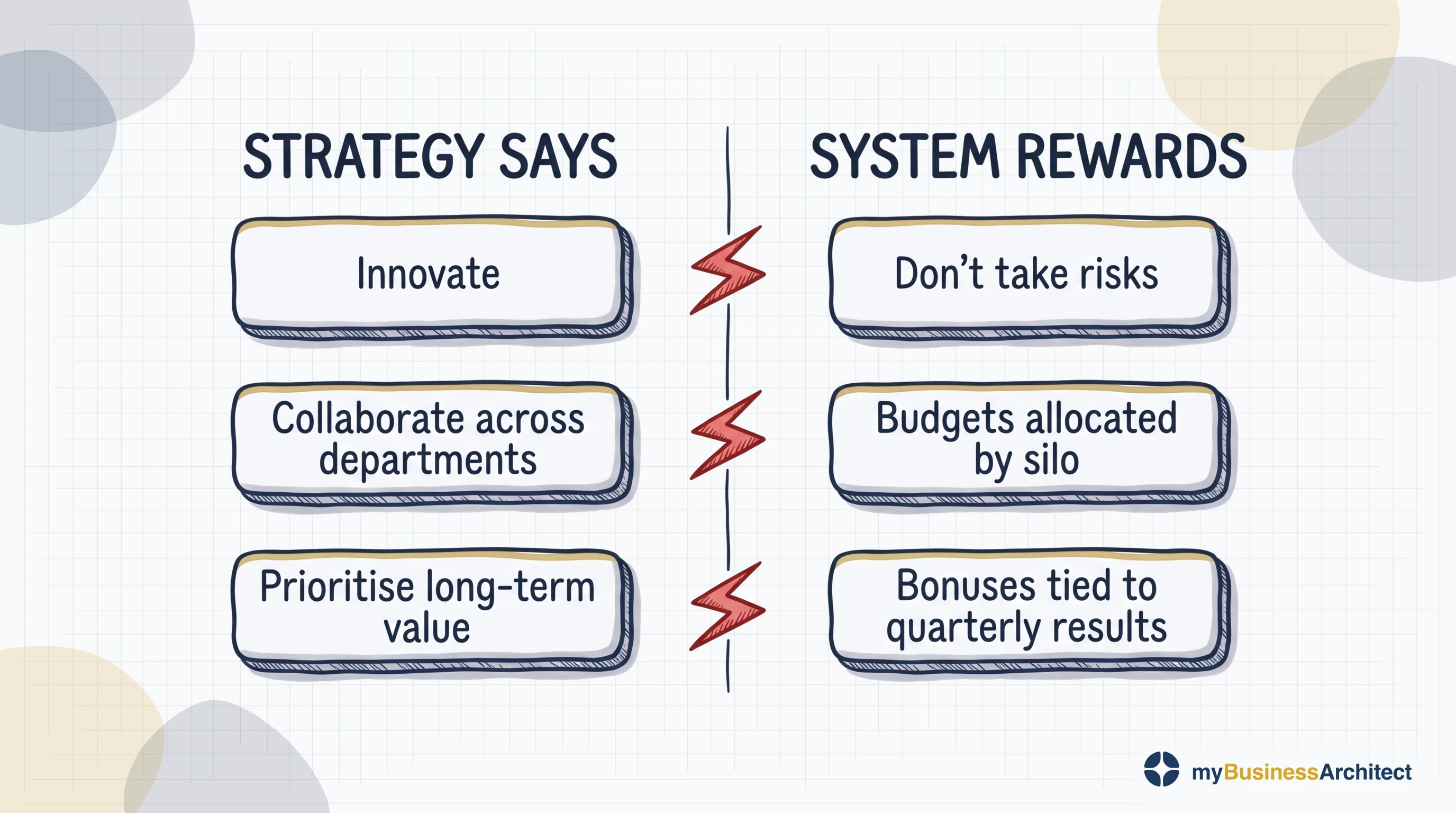 What the strategy says and what the systems actually reward are often two different messages.
When management systems contradict strategic choices, the management systems always win. People respond to incentives, not intentions. They do what is inspected over what is expected. And people notice these contradictions long before leadership does. They learn to read the incentives, not the slide deck. When they stop trusting the strategy because the systems contradict it, that trust is extraordinarily difficult to rebuild. The cascade forces this contradiction into the open by making management systems an explicit strategic choice rather than something that gets inherited from the previous era and never re-examined.
Together, these two choices ensure that strategy does not stop at aspiration and market selection. They create the bridge to execution: the capabilities to build and the systems to sustain them.
Related reading: Strategy to Execution: How to Close the Gap, a deeper look at why the bridge from strategy to execution breaks, and how to repair it.
Why No Single Choice Works Alone
Each choice constrains and enables the others. Change your winning aspiration and your "where to play" decisions must change. Shift your "where to play" and your "how to win" may no longer hold. Discover a capability gap and you may need to revisit your "how to win" or narrow your "where to play."
This is what makes the cascade a system rather than a checklist. The test for integration is simple: pick any single choice and change it. Then trace the implications through the other four. If the rest of the cascade still holds, either the change was trivial or your cascade is not truly integrated.
 Five choices, one integrated system. Each choice constrains and enables the others.
The cascade is also not a one-time exercise. The environment shifts. Stakeholder needs evolve. The cascade should be revisited regularly, not by starting from scratch, but by testing whether the integration still holds. Has anything changed that breaks a connection between choices?
This is where the cascade connects to the broader discipline of business architecture: the practice of making organisational connections visible, testable, and manageable over time.
Strategy Choice Cascade Example: Testing with the Business Model Canvas
The cascade gives you the logic of your strategy. But logic in text form is hard to test. The Business Model Canvas (BMC), developed by Alexander Osterwalder, provides a one-page spatial map of how an organisation creates, delivers, and captures value. It takes the cascade's choices and forces them into relationship with each other visually.
Here is what the Canvas reveals that the cascade alone cannot: contradictions. An organisation's cascade might say "we win through innovation" (Choice 3). The Canvas forces you to place that commitment alongside the cost structure, the revenue model, and the key activities. When the cost structure leaves no room for R&D, when the revenue model depends on volume that innovation would disrupt, the Canvas makes the contradiction visible on a single page. No amount of strategic narrative can hide a revenue model that contradicts the stated "how to win."
The Canvas also shifts the mindset from plans to hypotheses. Every element is an assumption to be tested:
- "We believe this customer segment values this proposition"
- "We believe this channel is the most effective way to reach them"
- "We believe this cost structure is sustainable given our revenue model"
Traditional planning treats these as facts. The cascade and Canvas together treat them as hypotheses. When evidence contradicts an assumption, that is not failure. That is learning. And an organisation that learns faster than its environment changes is an organisation that wins.
Five Ways Organisations Break the Cascade
Five patterns that undermine the cascade in practice:
1. Starting with "How to Win" before "Where to Play." Organisations jump to competitive advantage before defining their playing field. The result: a generic advantage that does not connect to any specific market reality. Sequence matters. Where you play determines what winning looks like.
2. Writing aspirations that are financial targets. "Grow revenue 15%" is a target, not an aspiration. It tells you what to count but not what to build or whom to serve. Financial targets belong in management systems, not at the top of the cascade.
3. Choosing capabilities without assessing current state. The cascade identifies required capabilities. But if you do not honestly assess which capabilities already exist (and at what maturity), you will build a strategy that assumes an organisational reality that does not exist.
4. Treating the cascade as a one-time exercise. The cascade is not a deliverable to be completed and filed. It is a discipline to be practised. The choices must be retested whenever evidence suggests a connection has broken.
5. Skipping the exclusion list. Every "where to play" choice implies a "where not to play" choice. If you cannot name what you are giving up, you have not made a real choice. The exclusion list is not an afterthought. It is the proof that your strategy is real.
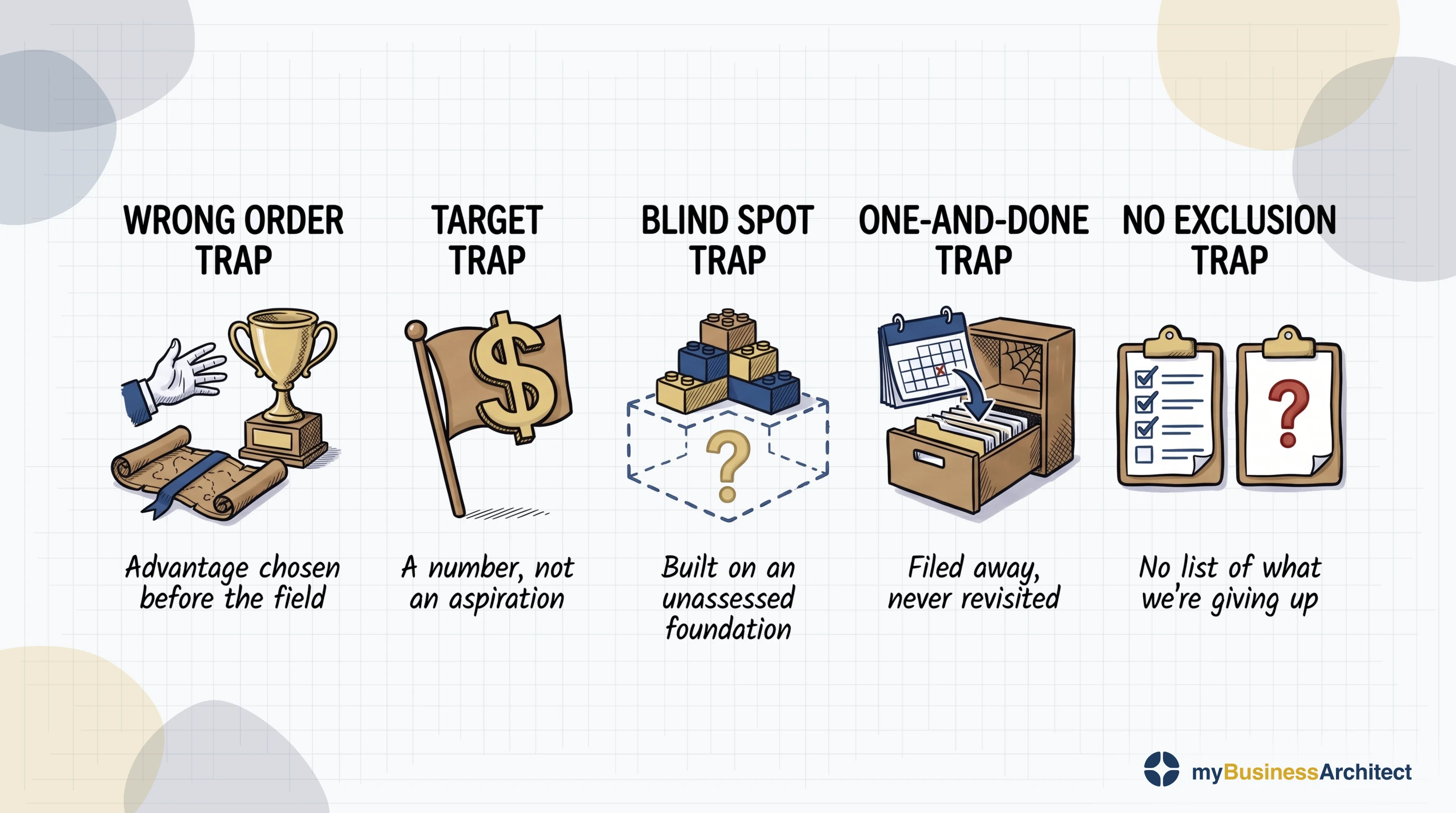 Each trap breaks the cascade in a different place, but all five end the same way: strategy that sounds right and does not hold together.
Getting Started
You do not need a full strategic overhaul. You need four things:
1. Write your winning aspiration in one sentence. Not a mission statement. Not a financial target. A statement of the impact you intend to have that is specific enough to make someone in the room uncomfortable. If it could describe any organisation in your sector, it is not finished.
2. List three things you will stop doing. Not things you might deprioritise. Things you will actually stop. Programs, markets, initiatives, investments. If your exclusion list does not disappoint at least one stakeholder, it is not cutting deep enough.
3. Test the integration. Take your winning aspiration, your "where to play" choices, and your "how to win" statement. Read them together. Does each one reinforce the others? Does "how to win" depend on the playing field you have chosen? Does the playing field serve the aspiration? If any choice could stand alone without the others, the cascade is not yet a system.
4. Reverse-engineer your real strategy. Look at your organisation's actual resource allocation: where the budget goes, where leadership attention flows, what gets funded when budgets are tight. That pattern reveals your real strategy, regardless of what your strategic plan says. If the real strategy and the stated strategy do not match, the cascade has already told you something important.
The cascade does not make strategy easier. It makes it honest. It replaces the comfort of a comprehensive plan with the discomfort of real choices. But organisations that embrace that discomfort discover something unexpected: clarity is energising. When people know where the organisation is going and why, when they can see how their work connects to a larger purpose, they bring more of themselves to it. The cascade is not just a strategy tool. It is a leadership act. And it starts with the willingness to say, in front of your team, "Here is what we are choosing not to do, and here is why."
Download the template: Strategy Choice Cascade Template (PDF), a one-page worksheet for working through all five choices with your leadership team.
Take the diagnostic: Find Your Gap: 4-minute assessment. Identify which connection between purpose, strategy, and execution is breaking in your organisation.
Frequently Asked Questions
What is the strategy choice cascade?
The strategy choice cascade is a framework for structuring strategic decisions as five integrated choices: winning aspiration, where to play, how to win, capabilities required, and management systems. Developed by Roger Martin and A.G. Lafley in Playing to Win, the cascade treats strategy as a set of choices that must work together as a system, not a list of goals to be pursued independently.
What is the Playing to Win framework by Roger Martin?
Playing to Win: How Strategy Really Works is the book by Roger Martin and A.G. Lafley that introduced this framework. The Playing to Win framework is the strategic approach they developed based on their experience at Procter & Gamble. The framework's core contribution is the strategy choice cascade: five interconnected choices that convert broad strategic intent into specific, actionable commitments. The framework emphasises that strategy is fundamentally about choosing what not to do.
What are the five choices in the strategic choice cascade?
The five choices are: (1) Winning Aspiration, defining what success looks like in terms of impact; (2) Where to Play, selecting the markets, segments, and geographies to focus on; (3) How to Win, identifying the competitive advantage in those chosen arenas; (4) Capabilities Required, naming what the organisation must be great at; and (5) Management Systems, designing the processes and structures that sustain the other four choices.
How is the cascade different from SWOT analysis or balanced scorecard?
SWOT analysis describes the current situation (strengths, weaknesses, opportunities, threats) but does not force choices. You can complete a SWOT and still pursue everything. The balanced scorecard is a powerful performance management system, but it does not determine strategic choices; it tracks their execution. The cascade sits upstream: it forces the choices that the balanced scorecard then measures. The cascade is prescriptive where SWOT is descriptive, and it is a decision framework where the balanced scorecard is an execution framework. They serve different purposes and can be complementary.
Can small organisations use the strategy choice cascade?
Yes, and in some ways it matters more. A multinational corporation can survive an unfocused strategy for years because it has the resources to absorb the waste. A 50-person nonprofit choosing between three program areas does not have that luxury. Every dollar spent on the wrong program is a dollar taken from the right one. Every hour spent on a low-impact initiative is an hour a small team will never get back. The cascade is not a big-company tool adapted for small organisations. It is a discipline of honest choosing, and organisations with fewer resources need that discipline most.
What is a winning aspiration vs. a mission statement?
A mission statement describes why the organisation exists. A winning aspiration describes what success looks like when the organisation fulfils that mission in a specific competitive context. Mission statements tend to be broad and enduring. Winning aspirations are sharper: they name the impact, the stakeholders, and the criteria for knowing whether you are winning. A winning aspiration should evolve as the competitive environment shifts.
Continue Learning
Pillar pages
- Strategy to Execution: How to Close the Gap: why strategies fail in execution and the four gaps that break the chain
- Business Architecture Framework: The Design4 Approach: the four-phase cycle that turns strategic choices into organisational capability
- What Is Business Architecture?: the discipline that makes strategy visible and executable
Courses
- Closing the Strategy-Execution Gap: learn the full strategy choice cascade through a narrative-driven case study
- Building the Common Language: standardised models for naming what you see
Blog posts
- The Most Important Word in Strategy Is "No"
- Your Organisation Doesn't Have a Strategy Problem. It Has a Purpose Problem.
- Four Questions That Replace Your Strategic Plan
- Your Strategy Failed. Your Second One Will Too.
Resources