A cap on student visas arrived without warning. The executive team met. Forty-seven ideas went up on the whiteboard, and none of them was in the five-year plan. The plan had nothing to say about what had just happened.
That isn't a failure of execution. It's a design flaw, and the flaw is in the tool itself.
You know this feeling even if you've never faced that particular crisis. You've been to the offsite. The plan gets saved to the shared drive, the board approves it, and the organisation lines up behind it. Then something changes (a funding cut, a new regulation, a competitor's move) and you find the plan has no way of responding. That's not because the analysis was wrong or the execution was weak. It's because the plan was designed to predict the future, and the environment no longer stays still long enough to be predicted.
Strategic planning isn't failing because the wrong people are in the room or because the strategy wasn't clear enough. It's failing because the planning cycle was designed for a world that no longer behaves the way it assumes. The organisations coping well aren't writing better plans. They're replacing the tool. Those that haven't are discovering what that costs. The higher education sector shows this failure especially clearly.
Start with the Most Useful Diagnostic
Before getting into the structural argument, here's a test you can run at your next leadership meeting.
Ask these four questions. Don't ask them rhetorically. The point is to see what evidence actually exists.
- Are we doing the right things? Not "are we busy?" but "are we genuinely focused on what matters to the people we exist to serve?" Evidence here means documented trade-offs: what you chose to focus on, and what you explicitly chose not to.
- Are we doing them the right way? Do we actually have the capabilities to deliver what the strategy promises? Evidence here means an honest assessment of capability, not a show of confidence.
- Are we getting them done well? Are stakeholders experiencing the value we intend to create? Evidence here means output measures, not just activity measures.
- Are we getting the benefits? Are the people we exist to serve actually better off? Evidence here means measurable contribution to outcomes and impact on stakeholders, not just completed projects.
In most organisations, the answer you'll hear most often, to any of these, is some version of "We think so, but we don't have evidence." That answer is the diagnosis. It doesn't mean people are wrong. It means the planning cycle never asked for evidence in the first place. It only asked for agreement.
These four questions, known as the Four Ares, come from governance research by John Thorp in the 1990s. He noticed that organisations kept approving projects that delivered outputs but not outcomes. The questions were designed to create improvements all the way from strategic intent to results for stakeholders. They form the backbone of the Design4 cycle, which we'll come back to shortly.
If your team can't answer these questions with evidence, that tells you something about your current planning cycle. The first step is to say so openly, not as an accusation but as information. What the questions expose is the gap between what the plan assumed and what is actually true.
Take the full diagnostic: Find Your Gap: 4-minute assessment →
Why the Plan Fails Before Execution Begins
Traditional strategic planning rests on one basic assumption: that the future is predictable enough to plan for in advance.
You gather data, model scenarios, and build a roadmap. If the analysis is sound and the execution strong, the plan delivers. That assumption was reasonable when environments changed slowly. It became a structural weakness once they began changing faster than organisations could plan.
In most sectors, the operating environment now moves faster than the planning cycle. When that happens, the result is specific. The strategic plan doesn't just go out of date; it becomes a constraint. The organisation has committed its resources to one direction, the environment has moved, and it is left with two bad options: stick with a plan that no longer fits, or abandon it and improvise. Most organisations swing back and forth between the two, and neither delivers what the plan promised.
This leads to four specific failures.
- The plan can't see change coming. It can't detect shifts in stakeholder needs before they become crises. It only updates when the planning cycle comes round again.
- Decisions are locked in. When the environment changes six months after the offsite, the organisation has no way to revisit the commitments it made there.
- Capability doesn't build over time. The organisation assesses its readiness once a year, instead of developing the ability to make decisions faster with each cycle.
- Strategy isn't funded. In most organisations, the strategic plan and the operating budget are separate tools. The strategy sets the direction, but the annual operating cycle controls the money. Strategic commitments get acted on when funding happens to line up (a grant, some discretionary budget, lucky timing) and get postponed when it doesn't. The plan looks ambitious, but the flow of resources tells a different story.
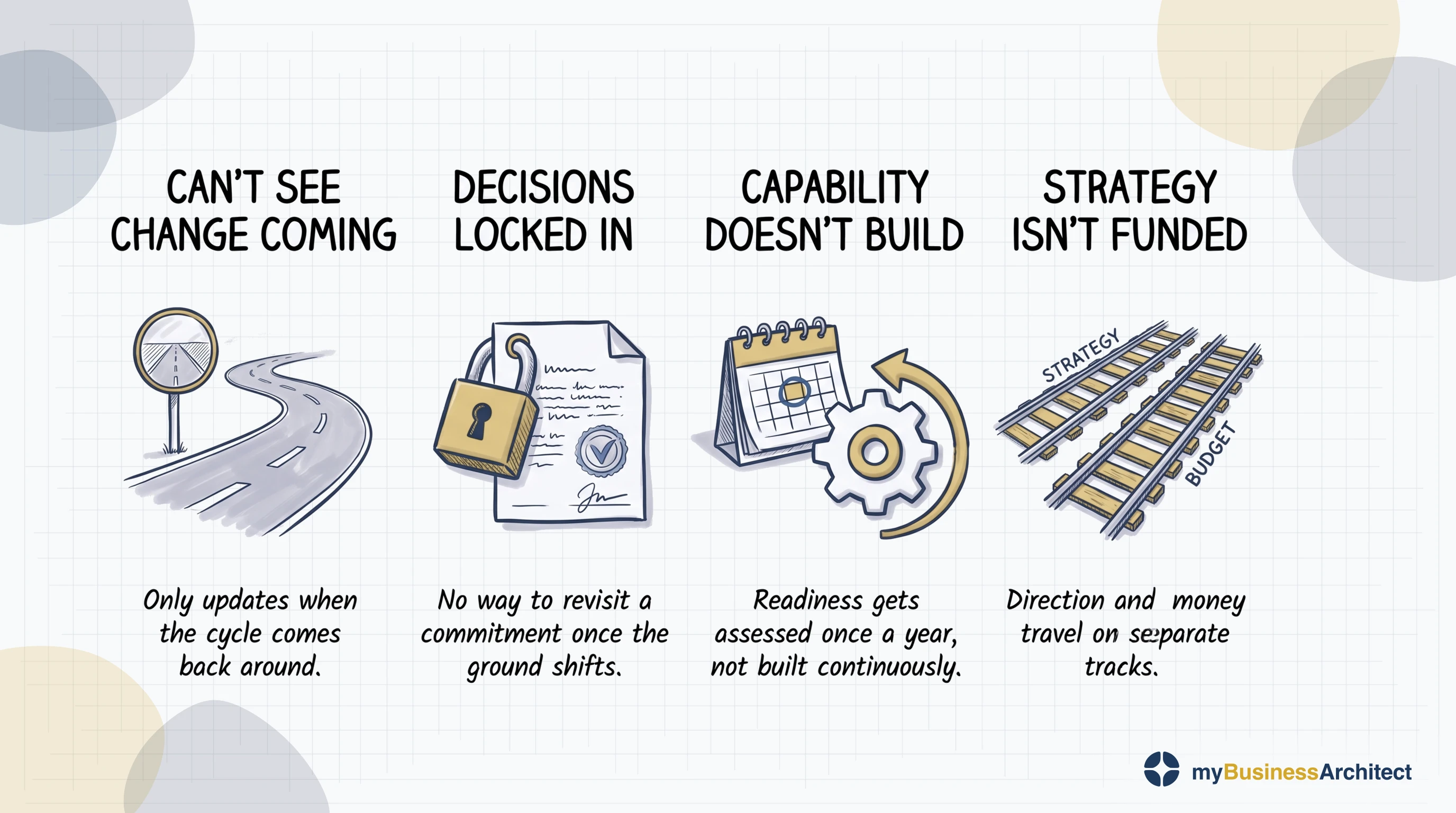 Four independent failure modes, one shared root cause: a plan built to predict, not to sense and adapt.
This is what structural failure looks like in practice. It isn't a good plan carried out badly. It's a plan that was the wrong tool for the environment it was meant to guide the organisation through.
So the question that matters isn't "Did we execute the plan?" It's: "Can our planning cycle keep up with how fast our environment is changing?" For most institutions today, the honest answer is no.
Strategic Planning in Higher Education
Every sector is experiencing some version of the structural failure just described. Higher education shows it in a form that is unusually fast, unusually clear, and unusually instructive. The reason is that a university's core product, knowledge and credentials, can now be almost entirely digitised. Once a product can be digitised, a competitor can unbundle it, reprice it, and scale it without carrying any of the established provider's costs.
By the first quarter of 2026, Coursera had reached 205 million registered learners. Its merger with Udemy, completed in May 2026, created a combined platform of around 290 million learners, offering credentials at a fraction of the cost of a traditional degree. These platforms aren't competing with universities on the universities' terms. They're redefining what the product is. The World Economic Forum estimates that 59% of the global workforce will need reskilling or upskilling by 2030, and students increasingly see education as an ongoing part of working life rather than a one-time preparation for it.
The planning model itself has held most institutions back. A 2025 Future Campus analysis of the flagship strategies of 28 universities found that not one recognised AI as a fundamental threat to the institution's business model. The plans treated AI as a technology question, not a structural one. The plan exists, and so does the disruption. But the plan has no way of absorbing what it didn't foresee.
The way universities are governed makes the problem worse. Shared governance, built on faculty consultation, committee review, and broad consensus, was designed to provide accountability in a stable environment. In a fast-moving one, it acts as a structural brake. A decision a digital-first competitor makes in days can take a traditional institution months to reach agreement on. That isn't a failure of management. It's a consequence of the design.
You don't have to work in higher education to recognise this pattern. Universities are simply a sector where the problem is unusually easy to see from the outside. Everyone understands committee governance, long planning cycles, and the gap between what a five-year plan says and what the institution actually does in a crisis. The same mechanism is at work in your organisation. This sector just makes it more visible.
What Replaces Strategic Planning
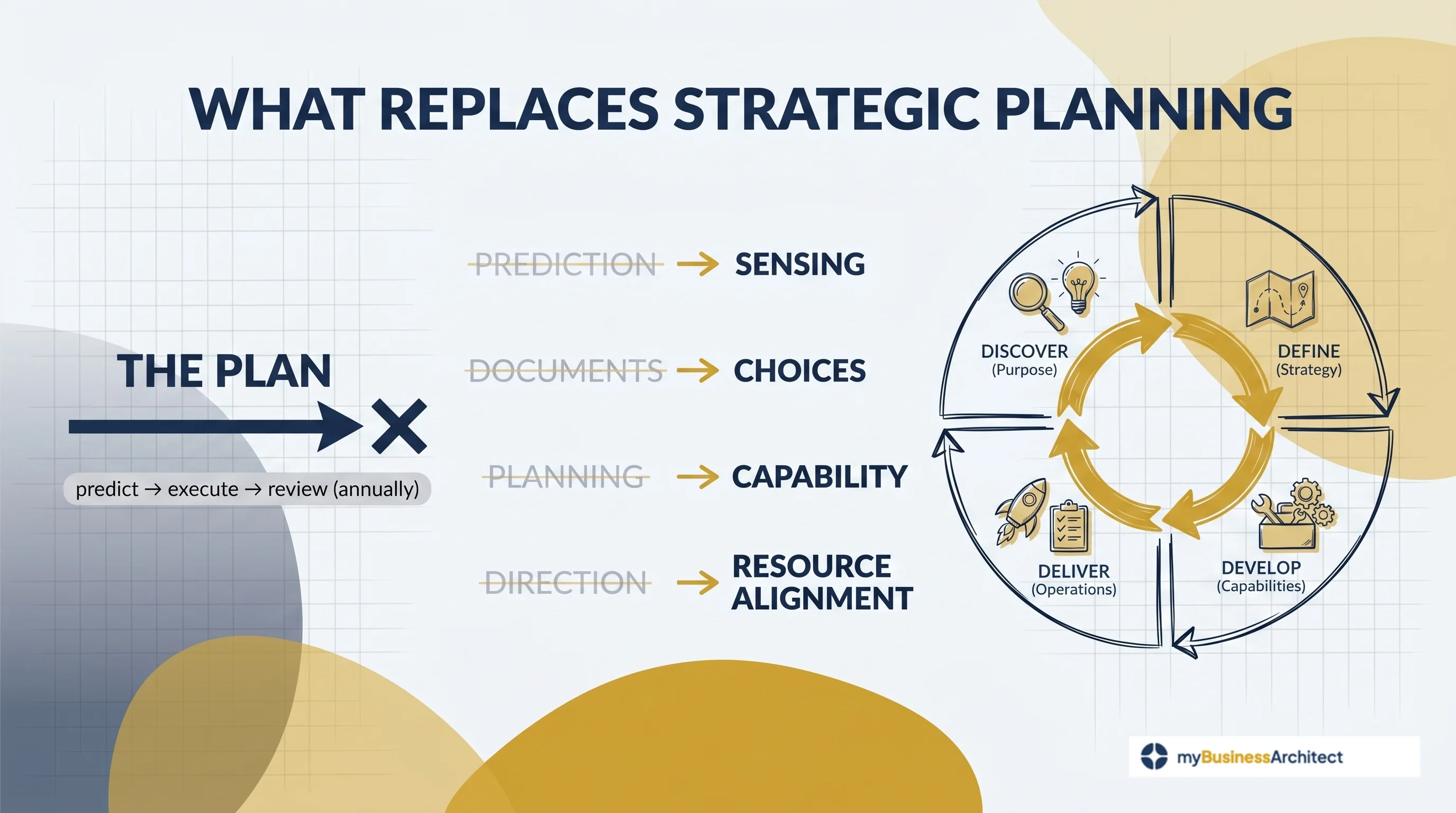
The alternative isn't to stop doing strategy. It's to give strategy a different structure, one that keeps it running continuously.
Whatever replaces strategic planning has to do four things the plan can't, and each one answers one of the four failures described earlier:
- See change coming. It must detect shifts in stakeholder needs before they turn into crises.
- Keep decisions open. It must produce real choices, not just lists of priorities, and keep producing them as conditions change.
- Build capability over time. It must build capability into the decision-making cycle itself, so that each round makes the next one faster.
- Fund the strategy. It must connect strategic direction to the resource decisions that actually determine what gets done.
The Design4 cycle was built to meet exactly those four requirements.
Four structural shifts make this concrete.
From prediction to sensing. The planning cycle is a tool for predicting. The Design4 cycle is a tool for sensing. Building the means to detect changes in stakeholder needs, the competitive environment, and capability gaps on a rolling basis doesn't have to be expensive, but it does have to be continuous. And the infrastructure isn't enough on its own. The people with the most up-to-date knowledge, those in daily contact with students, employers, and competitors, are often shut out of the strategy conversation by the way the organisation is structured. Sensing only works if the organisation has also decided whose knowledge it is prepared to trust. The test is simple: do you find out about major shifts before they demand an emergency response, or after? For the specific signals to watch, see Your Strategy Failed. Your Second One Will Too.
From documents to choices. Most strategic plans contain aspirations and priorities. Few contain real choices: explicit decisions about what the organisation will not do, what it will stop investing in, and what it will walk away from. A real choice does more than name what you won't do. It also makes a claim about why the path you've chosen creates more value for the stakeholders you serve than any alternative open to them. Running the Define phase of the Design4 cycle continuously means the organisation is always making and revisiting its trade-offs, instead of setting them once and leaving them in the shared drive. If you can't name three things your organisation explicitly decided not to do in the past year, your planning cycle has been producing agreement, not strategy. To diagnose which trap that leads to, see Five Traps That Break the Flywheel.
From planning to capability. The most lasting result of a continuous cycle isn't a better strategy. It's a more capable organisation. By the third or fourth round, your team's question has changed from "Did we execute the plan?" to "Are we the kind of organisation that can respond well when the plan runs out?" For the full argument on why this capability builds on itself, and what that means for how your organisation faces its next disruption, see Your Strategy Failed. Your Second One Will Too.
From direction to resource alignment. Most strategic plans set a direction without controlling any resources. The operating budget is a separate tool, run on a separate cycle, and strategic commitments only get funded when discretionary money happens to line up or when someone argues hard enough. A continuous cycle doesn't just decide what to do. It builds the discipline of tying those decisions to what actually gets funded. The test isn't whether the strategic plan was approved. It's whether the operating budget reflects it.
The shift isn't conceptual; it's structural. The strategic plan asks, "What direction are we heading in over the next three to five years?" The continuous cycle asks, "What's true right now, and are we still pointed at it?" These are different questions, and they need different tools.
The Design4 cycle works through four phases in a continuous loop:
- Discover what stakeholders genuinely need.
- Define the strategic choices: real ones, with explicit trade-offs.
- Develop the capabilities those choices actually require.
- Deliver in a way stakeholders experience as value.
The evidence from Deliver then feeds back into Discover, and the cycle runs again
The first time through takes the most effort. You're setting out your purpose for the first time, making choices that have long been avoided, and assessing your capabilities honestly rather than hopefully. It's slower than writing a plan.
The second time is faster. You have evidence, you understand your stakeholders better, and you've built the habit of making trade-offs explicitly. By the third time, something different in kind has emerged. It isn't just a better strategy; it's the organisation's ability to keep making good decisions as its environment changes. Each cycle makes the next one faster.
One more thing is worth pointing out. The first cycle is the hardest not only because it takes more effort, but because it brings to the surface everything the strategic plan had been quietly covering up: gaps in capability, choices the organisation dodged instead of making, and assumptions about stakeholder needs that haven't been tested in years. That isn't the cycle failing. It's the cycle working. The discomfort of the first round is what the strategic plan had been costing you all along. You just couldn't see it.
For a closer look at exactly where the link between strategy and execution breaks, and the four connections that need to be maintained, see Strategy to Execution: How to Close the Gap.
What It Looks Like From the Inside
Here is the full story behind the executive team meeting described at the start.
A federal cap on student visas wiped out roughly half of a regional polytechnic's international enrolment in a single decision. In revenue terms, that left a $38 million hole in a $180 million budget.
The executive team met for two hours. They were experienced leaders with a whiteboard, and by the end of the meeting there were forty-seven ideas on it: diversifying revenue, shifting to domestic recruitment, developing new programs, cutting costs, forming partnerships. Each idea was someone's answer. Together, they had no way to choose between them. That meeting began ninety days of deliberation.
The five-year strategic plan, approved eight months earlier, said nothing about this scenario. It wasn't a bad plan. It had simply assumed that international enrolment would keep growing. When that assumption collapsed overnight, the plan had nothing to offer.
The problem wasn't the people in the room. Every one of them was experienced, motivated, and working hard. The problem was structural. The institution had no continuous way of sensing shifts before they became crises. It had no shared purpose clear enough to judge competing responses against. And it had no map of its capabilities that separated what it was genuinely ready to do from what it merely hoped to do. The planning cycle had never asked for any of these things. All it had asked for was agreement.
What changed the outcome wasn't a better plan. It was a better way of making decisions. Over the following months, the institution did four things:
- It wrote a purpose statement that could filter decisions, not just inspire people.
- It made explicit strategic choices that named what the institution would and wouldn't do.
- It completed an honest assessment of its capabilities, separating where it was ready to act from where it wasn't.
- It redesigned at least one service around what students and employers actually needed, rather than around the org chart.
Eight months later, a $200 million clean energy funding opportunity was announced, with a sixty-day application window. The same team that had spent ninety days working through forty-seven ideas made a clear, documented decision in two weeks. Same people, different structural capacity.
That is what a continuous cycle produces. Not a better plan, but the ability to respond well once the plan no longer applies.
The Institutions Getting It Right
Two universities offer useful examples of what structural agility looks like in practice.
Arizona State University in the US built an online learning unit, EdPlus, that grew to serve 120,000 students. More significantly, it moved IT out of the back office and made it an active partner in shaping institutional strategy, bringing all 32 of its colleges into a single view of their data through a partnership with Salesforce. The result was real-time visibility across the whole institution, which is the precondition for making informed decisions quickly rather than waiting for the planning cycle to reveal what's working. Adaptive courseware delivered through this infrastructure raised success rates in large introductory courses; in microeconomics, for example, the share of students earning a C or better rose from 73% to 85%. This is the shift from prediction to sensing, built into the structure. The institution can now see what's working, and what isn't, before a problem grows, instead of finding out a year later in the annual review.
Coventry University in the UK didn't improve its planning cycle. It questioned the product the cycle was planning for. After testing the approach at its CU campuses, it replaced the traditional semester with six-week teaching blocks across all its campuses, with six intakes a year instead of two. Students can now pause their studies and rejoin at the next intake without losing a whole academic year. Its postgraduate students rate it among the most satisfied in the UK, at 93% overall satisfaction in 2025. This is the shift from documents to choices in practice. Rather than fine-tuning the semester model, Coventry asked whether that model was the right choice for the students it serves, and made an explicit decision to leave it behind.
What the two institutions have in common isn't a technology investment or a charismatic leader. It's a structural decision to treat sensing, deciding, and learning as continuous processes rather than annual events.
What the Course Adds
This post sets out the structural argument and an outline of the framework. The full course, Closing the Strategy-Execution Gap, shows you how to put it into practice.
It follows one institution through every round of the cycle, from the forty-seven-ideas crisis to its clean energy response eight months later. This isn't a tidy success story. It's a real institutional journey, complete with resistance from governance bodies, gaps in capability, leaders who disagreed, and choices that were genuinely uncomfortable. The case study is the curriculum.
If you're taking this argument to a leadership team that isn't yet convinced, the course gives you the diagnostic tools, the worked examples, and the language to make the case where decisions actually get made.
Frequently Asked Questions
Our institution has tried adaptive planning before and it didn't stick. Why would this be different?
In large institutions, adaptive planning frameworks usually fail because they change the planning process without changing the governance model underneath it. The Design4 cycle isn't a project management method. It's a governance structure that changes who asks which questions, when they ask them, and what evidence they rely on. If the governance model underneath stays the same, adaptive planning just produces more documents, not faster or better-informed decisions.
We have a five-year plan approved by the board. We can't abandon it mid-cycle.
You don't have to. The five-year plan sets the strategic direction. The continuous cycle manages the gap between that direction and what's actually happening: it detects when the environment shifts, and it brings forward the choices the plan didn't foresee. Over time, though, the plan's role changes. It stops being the tool you steer by and becomes the statement of direction that the cycle keeps testing.
How do we get leadership buy-in when the board expects an annual plan?
Start with the diagnostic, not the framework. Put the four questions to your senior team and ask for evidence, not reassurance. The silence that usually follows is enough to open the conversation. The board approved the plan, but the plan can't answer these questions. That gap is the case for the cycle.
If you're not in a position to run the diagnostic with the senior team, start smaller. Apply the four questions to your own area of work. Find the one gap where your team's honest answer is "We think so, but we don't have evidence." Take that specific gap to a sponsor, documented rather than argued. One real gap is more persuasive than a structural argument. Build your mandate one cycle at a time.
Isn't this just scenario planning?
No. Scenario planning asks "What if?" and prepares responses to imagined futures. It's still a prediction tool; it just predicts several futures instead of one. The Design4 cycle asks "What's true right now?" and builds the ability to respond to what actually happens. The two can work together, because they solve different problems. Scenario planning prepares for possible futures. The cycle manages the gap between where you are now and what your stakeholders actually need today.
How long before the cycle produces a visible difference?
The first cycle takes the most effort and is the most uncomfortable, especially the Define phase, where teams have to make real choices and defend them. Most institutions see a clear improvement in the quality of their decisions within six to eight months of starting Discover in earnest. The bigger result, the organisation's ability to respond well to disruption, takes two to three full cycles to become lasting and self-sustaining.
This sounds right for a university. Does it apply in other sectors?
Yes. The structural argument applies wherever the environment is changing faster than the planning cycle. Higher education makes a useful example because its problems are unusually easy to see from the outside: committee governance, long planning horizons, and the gap between a plan and a live crisis are all visible in ways they aren't in sectors whose inner workings are less public. The same mechanism operates in healthcare, government, professional services, and large corporations. Higher education is the example. The structural failure is the pattern.
The Practitioners Who Do This Work
The people who do this work don't become better planners. They become the people their organisations turn to when the environment moves in a direction the plan didn't foresee.
Before you take this argument into a leadership meeting, be clear about one thing. The current planning cycle isn't just a planning tool. It also distributes authority: control of budgets, visibility, credit, and accountability. A continuous cycle redistributes all of those. For some leaders, then, the obstacle won't be understanding. The structural argument will land, and they still won't move. Understanding it and acting on it are different problems when your position rests on the very tool you're being asked to replace.
Resistance tends to take one of three forms. Some of it is political: the planning cycle is the source of a leader's authority, and they won't give that up. Some of it is a matter of belief: they genuinely think the plan still works. A better argument rarely shifts either. And in some institutions the obstacle is neither of these. The governance model itself blocks adaptation, even when leaders want it. That is a different problem, and naming it clearly is the first step to solving it. Know which situation you're in before you walk into the room. If you don't yet have the mandate to act on what the cycle reveals, decide whether to build that mandate before you begin, or to start small enough that you don't need it yet.
The discipline that does this work is business architecture. That doesn't mean org charts or governance diagrams. It means the practice of connecting what an organisation decides with what it actually becomes. The Design4 cycle is the framework a business architect uses to make strategy continuous rather than periodic. The four shifts described in this piece (from prediction to sensing, from documents to choices, from planning to capability, and from direction to resource alignment) are the practical work of that role. If you're reading this and thinking "we need to build this," a business architect is the person who should own it.
Strategic plans will keep being written, and boards will keep expecting them. What changes is what sits alongside the plan, and who built it.
You already know the next disruption is coming. The question isn't whether your organisation will face one. It's whether you will be the person who built the ability to respond before it arrived. That's what the cycle is. Not a planning tool, but a way of becoming the leader your organisation needs when the plan runs out.