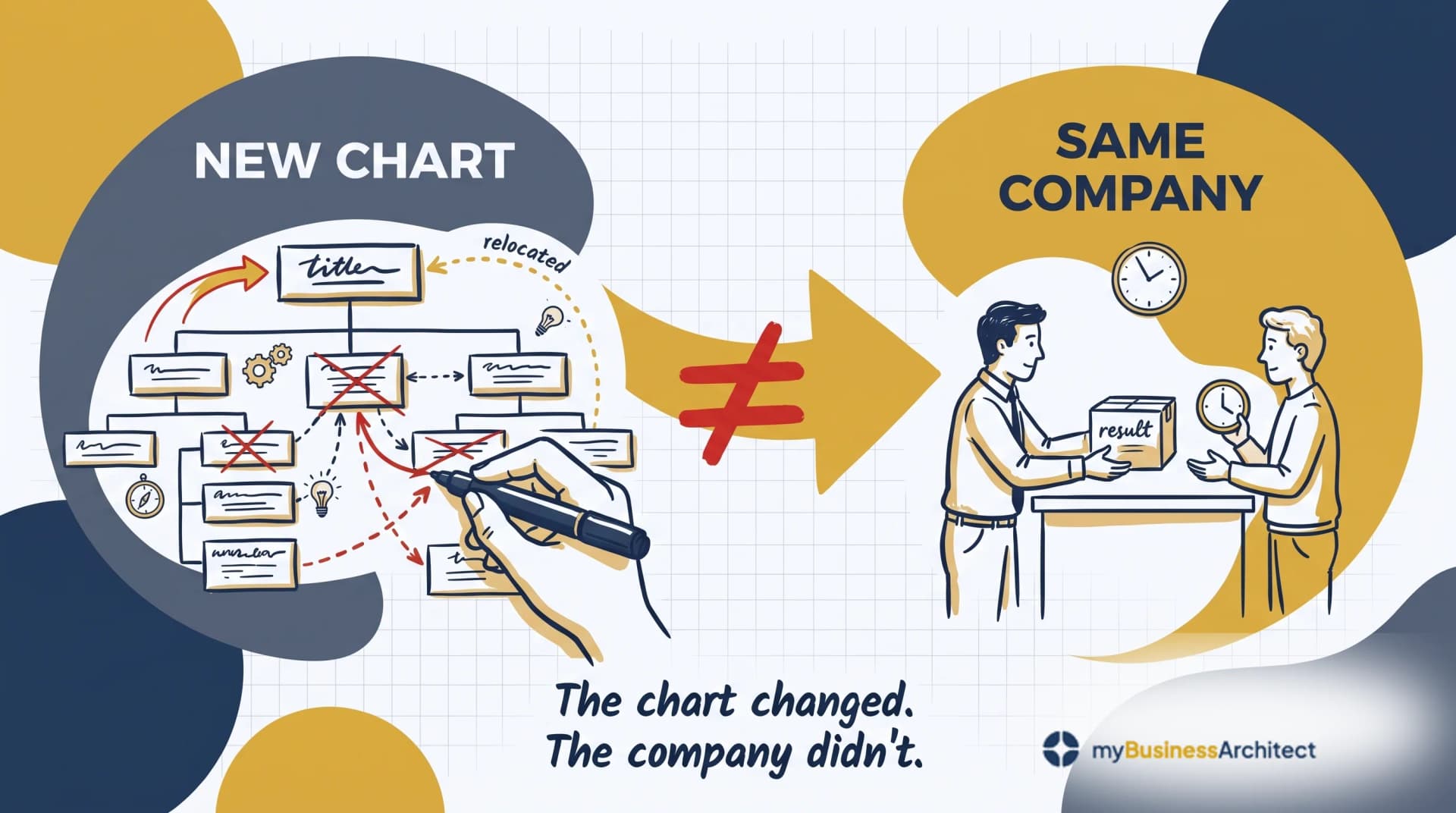
You've lived through at least one. A new org chart on a slide, boxes and reporting lines redrawn, a town hall to explain the logic, a wave of who-do-I-report-to-now. Six months later, the work is done the same way, by the same people, for the same customers. The chart changed. The company didn't.
That is the Reorg Reflex: the instinct to answer a strategy that isn't landing by redrawing the structure. It is the most common response to a stalled strategy, and one of the least effective, and those two facts are related. The reorg gets reached for precisely because it's the easy lever, and it fails for the same reason.
Why leaders reach for it
Put yourself in the chair. The strategy was signed off, the market moved, the results are flat, and the board wants to see action. Of everything you could change about how the organisation actually works, the org chart is the one thing that's visible, within your gift, and changeable by Friday. You can announce it. You can draw it. You can point to it as evidence that you did something.
Almost nothing else about an operating model has those properties. Rebuilding a capability takes years. Redesigning how a service reaches a customer is slow and unglamorous. Changing what the organisation refuses to do is a political fight. The chart, by contrast, is a slide. So when a strategy stalls, the reflex fires: move the boxes, and be seen to move.
The trouble is that being seen to act and actually changing how work gets done are different things, and the reorg only reliably delivers the first.
Why it fails
Structure is the weakest lever an operating model has. That isn't a slogan; it's what the redesign research keeps finding. The Bridgespan Group, reviewing operating-model redesigns, warns organisations to "look past structure," because reporting lines "rarely hold the key" to delivering a strategy. The org chart is one domain of an operating model, the organisation-and-people domain, and the least strategic one. It describes who answers to whom. It says nothing about how a customer request becomes a delivered result, which is the only thing an operating model exists to do.
So when you redraw the chart, you change the reporting lines and leave the work untouched. The handoffs that were failing still fail, now between differently-named departments. The process that optimised for internal convenience still does. The capability that never reached the customer still doesn't. You have rearranged the boxes around the work without changing the work, which is why, six months on, the same people deliver the same thing the same way. The reflex confused the map for the territory.
And a reorg has a cost the slide never shows. Every reshuffle spends a season of the organisation's attention on itself: new reporting lines, new turf, relationships rebuilt, priorities relitigated. That is real energy, drawn out of serving customers and spent on the internal weather, in exchange for a change that leaves the delivered result exactly as it was.
What actually broke
Here is the diagnosis the reorg skips. In most stalled strategies, the capability isn't missing. The programs exist, the technology is installed, the people are trained. What breaks is the step between "we can do this" and "the customer experienced value." The capability is there; it never reached the person it was for.
That gap isn't a structural problem, so structure can't fix it. It is an operationalisation problem: the work of turning a capability into a service that actually reaches a stakeholder, at a standard you can hold it to. A reorg reshuffles the people who hold the capability. It does nothing about the service that was supposed to carry the capability across to the customer, because the service was never the thing on the slide.
What to reach for instead
The alternative to the org chart is the service model: organise the operation around the services it delivers, not the boxes that hold them. A capability is what the organisation can do; a service is how that capability is operationalised to reach a customer. When a strategy stalls, the question that actually moves things isn't "who should report to whom," it's "which service is failing to deliver its outcome, and why."
Ask that, and the answer is never a new chart. It is a redesigned service: a different way of operationalising the same capability so it reaches the customer at the cost, speed, and quality the strategy promised. The classic example is airline check-in. No airline fixed check-in with a reorg. They re-operationalised the service, from a staffed counter to a kiosk to an app, and transformed the customer experience and the cost base without touching the org chart. The capability held constant. The service, the how, is where every gain came from.
One honest qualifier, because the reflex has a grain of truth in it. Decision rights and accountabilities do matter, and getting them wrong genuinely stalls delivery. But in a service model they attach to the services, not to the boxes: someone owns the check-in service and holds its standard. Structure sometimes has to change too, but it follows the service redesign rather than leading it. Lead with structure and you get the reflex. Lead with the service and structure falls out where the work needs it.
The tell
You can catch the reflex in yourself with one question: does this change move any lever other than structure? If the proposal is a new org chart and little else, no redesigned service, no changed process, no new decision rights attached to an outcome, it's the reflex, and it will change the picture without changing the work. If it starts from a service that's failing its customer and works backward to what must change to fix it, structure included, it's a redesign.
The reorg is what you reach for when a strategy isn't landing. The service model is what actually makes it land. You'll know the reflex by what it leaves untouched: the work, and the customer on the far end of it.
Map your own operating model before you touch the org chart with the free Service Operating Model Canvas, and see the full argument in the operating model pillar. The discipline of choosing and holding a strategy, so the operating model has something real to serve, is what the Closing the Strategy-Execution Gap course teaches.