Your transformation program has a dashboard. It shows deliverable completion, broken down by workstream. Red, amber, green. Updated every two weeks.
But the board wants to know what value is being delivered. The program manager, eight months into this, can't answer. Even though everything is being tracked.
The problem is that percentage of deliverables complete answers a different question than the one the board is asking. Their question is about value. The program dashboard answers questions about activity. No amount of additional rigour will close that gap.
The gap isn't between the measurement and the data. It's between the question the board is asking and the layer at which the program benefits were defined.
This is how benefits realization fails most often. Not from lack of measurement, but from measurement at the wrong layer. The program is tracked. The PMO is staffed. Governance is meeting. There's a benefits register somewhere. But at the first serious ask: what value is this delivering? The only answer that can be offered up is a progress report.
That's not a measurement problem. It's a definition problem dressed up in measurement clothes.
But before you can fix any of it, you need to be able to see it.
One scoping note before the diagnostic, because two different disciplines get filed under the same heading. This is about change: a program, a transformation, an investment with a beginning and an end, which will one day close and hand something over. If your question is the other one, whether the services you run every day are actually leaving anyone better off, that is a different discipline with a different time-shape, and it doesn't terminate. The governance questions are the same four. Everything about how you answer them is not.
The Measurement Theatre Diagnostic
Benefits get defined at one of four layers: what the project produces (delivery), whether the operating model genuinely improved (capability), whether the right things were built (strategic), and whether the people the organisation exists to serve are materially better off (purpose). Most dashboards answer at the delivery layer. The board's question lives at the purpose layer.
Five questions will show you which layer your program is operating at.
1. Can you trace each tracked metric to a stakeholder who's materially better off?
Not a system that's deployed, or a process that changed, or a milestone that was hit. A person or group of people whose situation has measurably improved. If your dashboard shows adoption rates, deliverable completion, or training compliance, none of these trace to a stakeholder outcome. They trace to organisational activity. If you can't complete the sentence "because of this program, [specific stakeholder group] can now [specific improvement]", the benefits are defined at the wrong layer.
2. Were your benefits defined before the program was approved, or after?
If the benefits register was created after the business case was written, or after the program started, the benefits were reverse-engineered to justify a decision already made. One distinction keeps this test honest: refining the indicators after approval, as understanding improves, is legitimate iteration. Creating the benefits themselves after approval is rationalisation. Reverse-engineered benefits measure compliance with the original justification. They don't measure delivery of purpose. Every credible benefits management framework is unambiguous about this: benefits planning belongs in what the Design4 framework refers to as the Discover and Define phases, before a vendor is selected or a workstream is staffed.
3. Who defined the benefits?
The benefit author is a reliable proxy for the layer the benefit inhabits. A benefit defined by a project manager lives at the delivery layer. A benefit defined by a system architect lives at the capability layer. A benefit defined by the VP whose division the program is transforming lives at the strategic or purpose layer. People define benefits at the layer where they're accountable. If the accountability for benefit definition never reached a business executive, the benefit never reached the purpose layer.
4. Can the board answer "are we getting the benefits?" independently of the PMO report?
A program that defines benefits at the delivery layer can always report success, regardless of what happened to the people it was supposed to serve. The operation was a success. Whether the patient recovered is a different question, and the answer lives outside the operating theatre.

The operation was a success. Whether the patient recovered is a different question, and the answer lives outside the operating theatre.
The board is asking the patient question. The test here is whether they have access to data that answers it independently of what the program tells them. When benefits are defined at the purpose layer, the board can cross-check outcomes against standing business data they already receive: student retention, patient outcomes, customer satisfaction, staff turnover. When the PMO dashboard is the only source of evidence, the program is simply reporting on the success of the operation.
5. When the program closes, do the benefits continue to be measured?
If the measurement stops when the program closes, the metrics were program metrics, not benefit metrics. Real benefits persist in operations and show up in indicators that exist independently of the program's reporting infrastructure. An organisation that measures percentage of staff trained during the program and then stops measuring whether that training changed behaviour has produced a Layer 1 metric and called it a benefit.
If three or more of these questions don't have a clean answer in your context, the dashboard is doing Measurement Theatre. The fix isn't more measurement. It's redesigning where the benefits are anchored.
Take the full diagnostic: Find Your Gap: 4-minute assessment →
Related reading: The Phase Every Management System Skips. Measurement Theatre, OKR Theatre, and Maturity Theatre share one root: none of them does the Define phase, the strategic choice that would anchor the benefits to the purpose the board is actually asking about.
This isn't unique to transformation programs. The pattern has a name in the literature: once a measure becomes consequential, people stop reporting reality through it and start responding to the measurement system itself, what Dahler-Larsen calls the constitutive effects of performance indicators (Dahler-Larsen, 2014). Elton documented the identical failure in higher education specifically, under Goodhart's own name (Elton, Goodhart's Law and Performance Indicators in Higher Education, 2004). The dashboard problem above is a well-studied phenomenon, not a one-off.
The Benefits Stack
The reason Measurement Theatre is structural rather than accidental comes down to where in the organisation benefits get defined. There are four distinct layers, and they're not interchangeable.
Layer 1: Operational Benefits
The project manager, the workstream lead, the PMO director: all need to know whether execution is on track. That is a real and legitimate need, and a deliverable completion dashboard serves it well. But completion is project control, not a benefit. The first benefit question comes once the solution is live: how well is the service producing the output it was built for, counted where it meets the people it serves and read for efficiency, quality and effectiveness? Referrals routed, students contacted before they reach probation, claims settled first time, at what cost, to what standard, and doing what they were for. Those are its results, and operations answers for them.
What Layer 1 doesn't do is answer the board's question. Layer 1 answers: are we getting them done well? That's the Deliver question. It's not the benefits question.
An organisation can be at 100% deliverable completion, with its new service running smoothly, and 0% benefit delivery simultaneously. If the deliverables were the wrong ones, built for the wrong capabilities, in service of purposes that were never tested, completion means nothing above Layer 1.
Layer 1 metrics are essential leading indicators. But they become Measurement Theatre when they're promoted to the benefits layer without passing through Layers 2, 3, and 4.
Layer 2: Capability Benefits
The operational manager who commissioned a transformation needs to know whether the capability they were promised is actually better than the one they had. That question has an answer at Layer 2: throughput increased, cycle times shortened, error rates reduced, data quality improved. The capability is now operational and measurably better.
These are genuine benefits. They're also not the answer to the board's question.
"Our advisors can now process applications 30% faster" is a Layer 2 capability benefit. Whether that speed improvement serves the organisation's purpose is a Layer 3 and Layer 4 question. Are students in fact getting better decisions about their education? Is the freed capacity being redeployed toward outcomes?
One qualification matters here. A capability improvement is only a benefit if that capability is operative in the value stream that reaches the stakeholder. Throughput improved inside a system that doesn't connect end to end to the person it was supposed to serve is Layer 2 activity, not Layer 2 benefit. Within the capability layer, information architecture is frequently the last dimension tested and the first to fail in production. That is not because it's unimportant, but because it's invisible until the full flow is attempted. The Phoenix case study below shows what that failure looks like at national scale.
The capability gap sits between what the program delivered and the results the service produces on it. Closing it is the condition for those results, not an outcome in itself: the change has been provisioned into the service, and the service can produce its output to the required level.
Layer 3: Strategic Benefits
The executive who committed to a strategic position (a lower cost base, faster service delivery, better outcomes than the alternatives) needs to know whether the capability investment is actually advancing that position. That is the Layer 3 question.
A Layer 3 benefit connects capability improvement to an explicit strategic choice. The positions the organisation decided to hold, the things it decided to be better at. A benefit at this layer answers the question: are we doing the right things?
A Layer 3 benefit is a cheque drawn on a capability account. The strategy commits to a position (lower cost base, faster service, better outcomes) and the Layer 2 capability is the account that must hold the balance for the cheque to clear. When the benefit is defined at Layer 3 without testing whether the Layer 2 account exists, the strategy is writing cheques it can't cash. The governance layer doesn't discover this until the benefit fails to materialise, which is always after the point where course-correction is cheap.
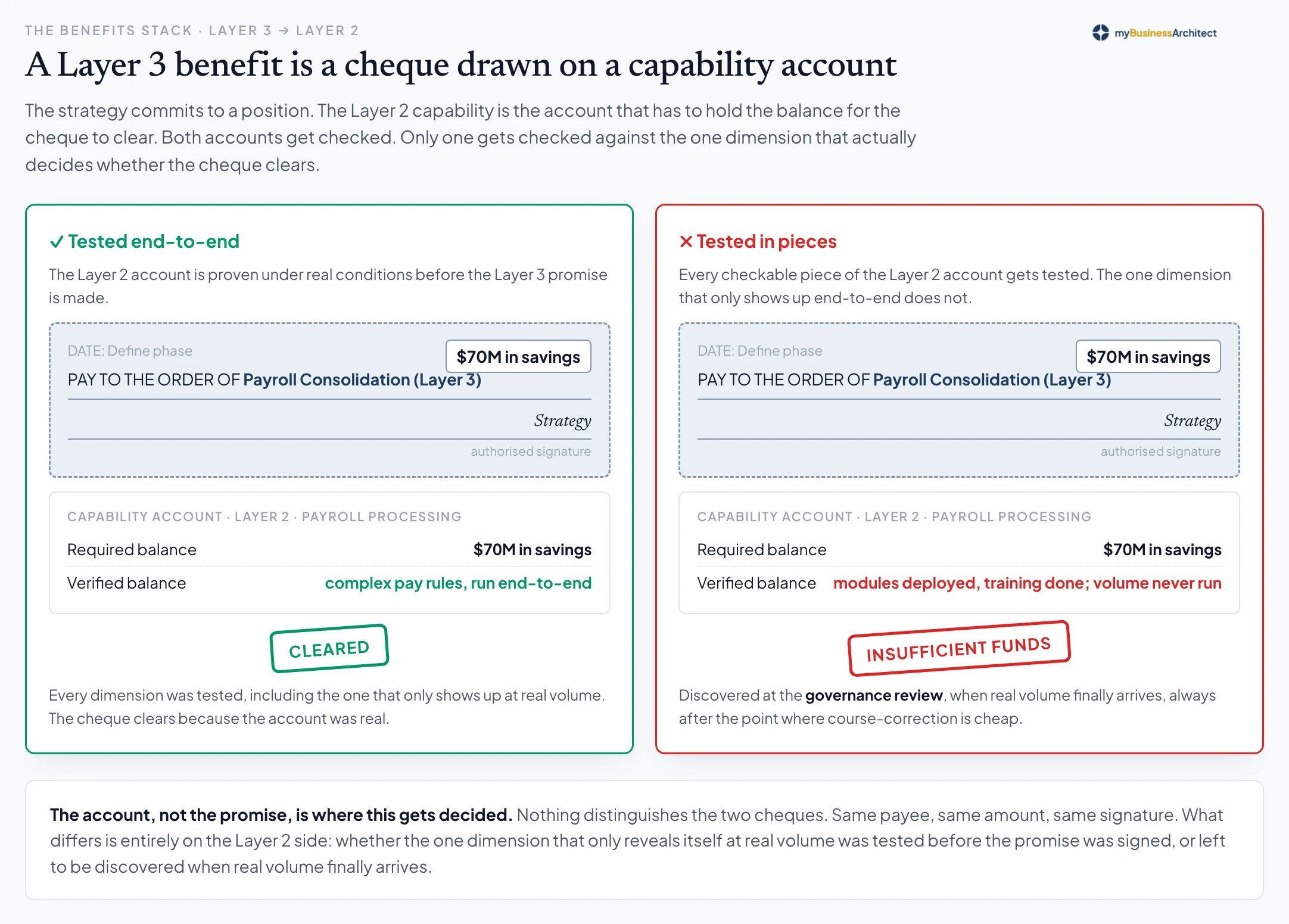
This is the layer most programs aspire to but don't reach. Reaching it requires that the benefits were anchored in the Define phase choices, and that those choices were actually made, explicitly, in writing, with criteria. If the organisation's strategy is a list of priorities rather than a set of integrated choices, there's no Layer 3 to anchor to. The benefit has nowhere to live above Layer 2.
The instrument for building those integrated choices is the Strategic Choice Cascade: winning aspiration, where to play, how to win, required capabilities, and management systems. A practitioner who cannot name the organisation's where-to-play and how-to-win positions is working in an organisation without a Layer 3, regardless of what its strategy document says. The Benefits Stack doesn't create Layer 3; it maps to it. If the cascade hasn't been run, the anchor point the Benefits Stack prescribes does not yet exist. The first move for a practitioner in that position is to surface it explicitly before benefit definition proceeds: the Design4 pillar covers how to initiate that Define phase work from inside a running program.
Layer 4: Purpose Benefits
This is what the board is actually asking about.
In the Design4 framework, the purpose governance question is the first question in the governance cycle, not the last: are we getting the benefits? It asks whether the people the organisation exists to serve are materially better off. Not whether the system is deployed. Not whether the capability exists. Whether the purpose is being fulfilled.
A board isn't a delivery oversight function. It's a purpose stewardship function. When a board asks "what value is being delivered?", it's asking a Layer 4 question. When the answer is a workstream completion dashboard, the board has received a project-control answer, below even Layer 1. The mismatch isn't a communication failure. It's a definition failure that surfaced at governance, and governance is the most expensive place to discover it.
Layer 4 is also where a program's reach runs out. A benefits register is bounded by the thing it was built to govern: when the program closes, the register closes with it, and the purpose question it was finally starting to answer becomes nobody's. Answering that question permanently, for services that will still be running in ten years, is a standing discipline rather than a program one.
The Benefits Definition Gap
The Benefits Definition Gap is the distance between the layer where benefits were defined and the layer that governance is asking about.
In most transformation programs, the gap is two or three layers. Benefits defined at Layer 1 against a board asking Layer 4 questions. Benefits defined at Layer 2 against a CFO asking Layer 3 questions. The measurement is rigorous. The definition is three layers below the question.
Closing the Benefits Definition Gap isn't a measurement problem. You can't measure your way from Layer 1 to Layer 4. The only path is definitional: identify the stakeholders the organisation exists to serve, define what "better off" looks like for them in specific and measurable terms, and work backwards through the layers. Which capabilities must improve (Layer 2)? Which strategic choices do those improvements advance (Layer 3)? Which deliverables will build those capabilities (Layer 1)?
Top-down benefits definition, bottom-up measurement.
That sequence is exactly what most benefits realization programs reverse.
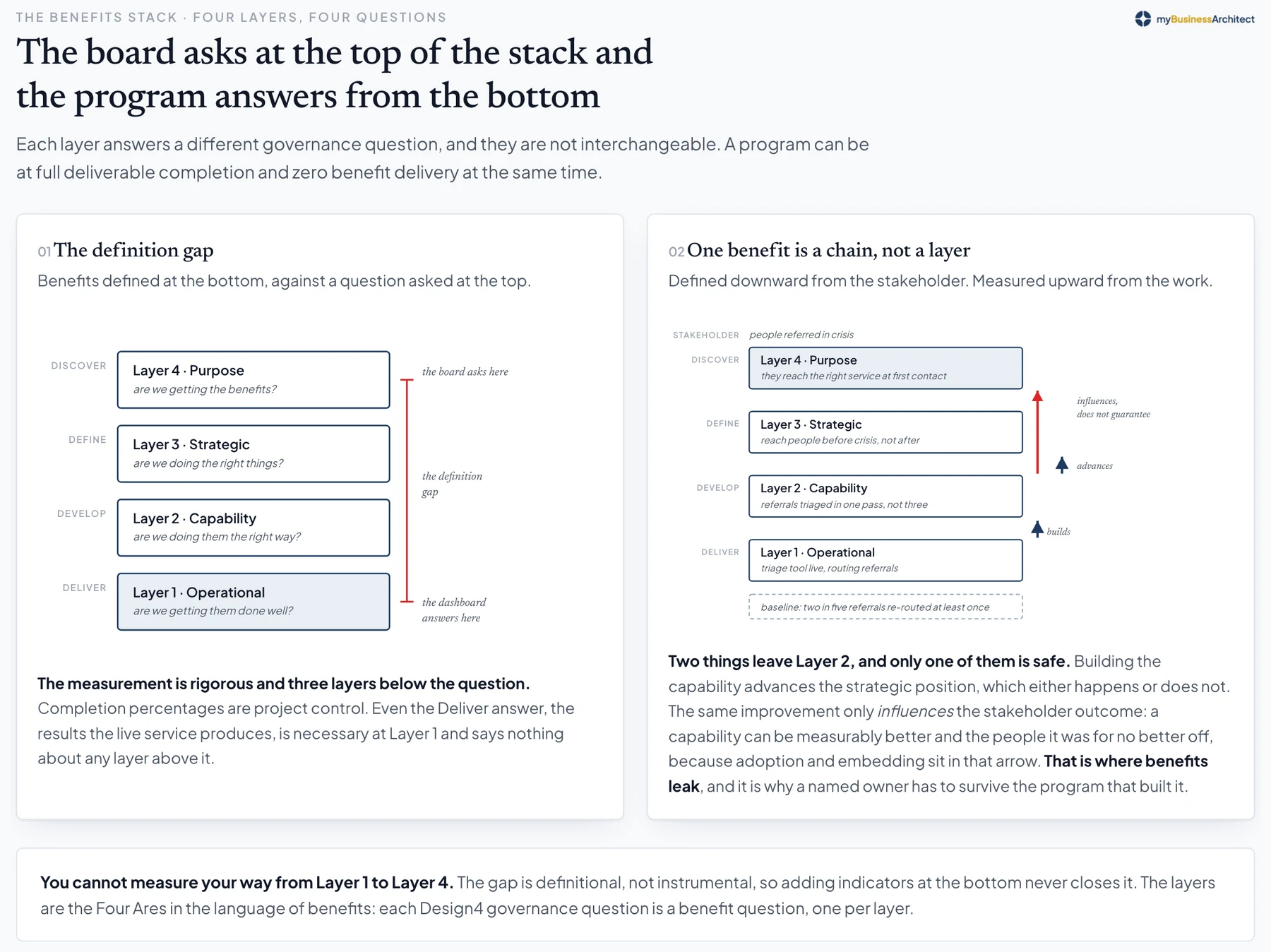
The unit is the chain, not the layer. A benefit runs from a deliverable through a capability to a stakeholder who is measurably better off, and only one arrow in it can fail on its own: the one where adoption and embedding live.
The Other Failure, and Where It Lives
The Definition Gap is one way benefits fail. There is a second, and it happens to programs that got the definition right.
Look at what connects the layers. A deliverable builds a capability, and that capability improvement advances a strategic position. Both either happen or they do not, and both are observable while the program is still running. But the same capability improvement does not produce a Layer 4 outcome. It influences one.
That link is the only one in the stack that can fail while everything beneath it succeeds. The system is deployed, the capability is measurably better, the strategic position is genuinely advanced, and the people the organisation exists to serve are no better off, because the capability is not being used in the value stream that reaches them. Adoption and embedding live in that arrow. So does benefit leakage.
Which locates the problem usefully. Leakage is not a measurement failure and it is not a delivery failure. It is the one link in the chain that requires somebody to keep behaving differently after the program that built it has gone. A benefit owner named during delivery and disbanded at program close leaves exactly when the only vulnerable link becomes vulnerable.
Benefits Realization and the Four Ares
The Benefits Stack isn't a new framework. It's the Four Ares, stated in the language of benefits realization management (BRM).
If you're already running the Four Ares as your governance cycle, you're already doing four-layer benefits management. The question isn't whether to adopt a new framework. It's whether you're answering the questions you're already asking at the layer they were designed for.
Each Design4 governance question is a benefit measurement question, and each layer sets its own standard of evidence.
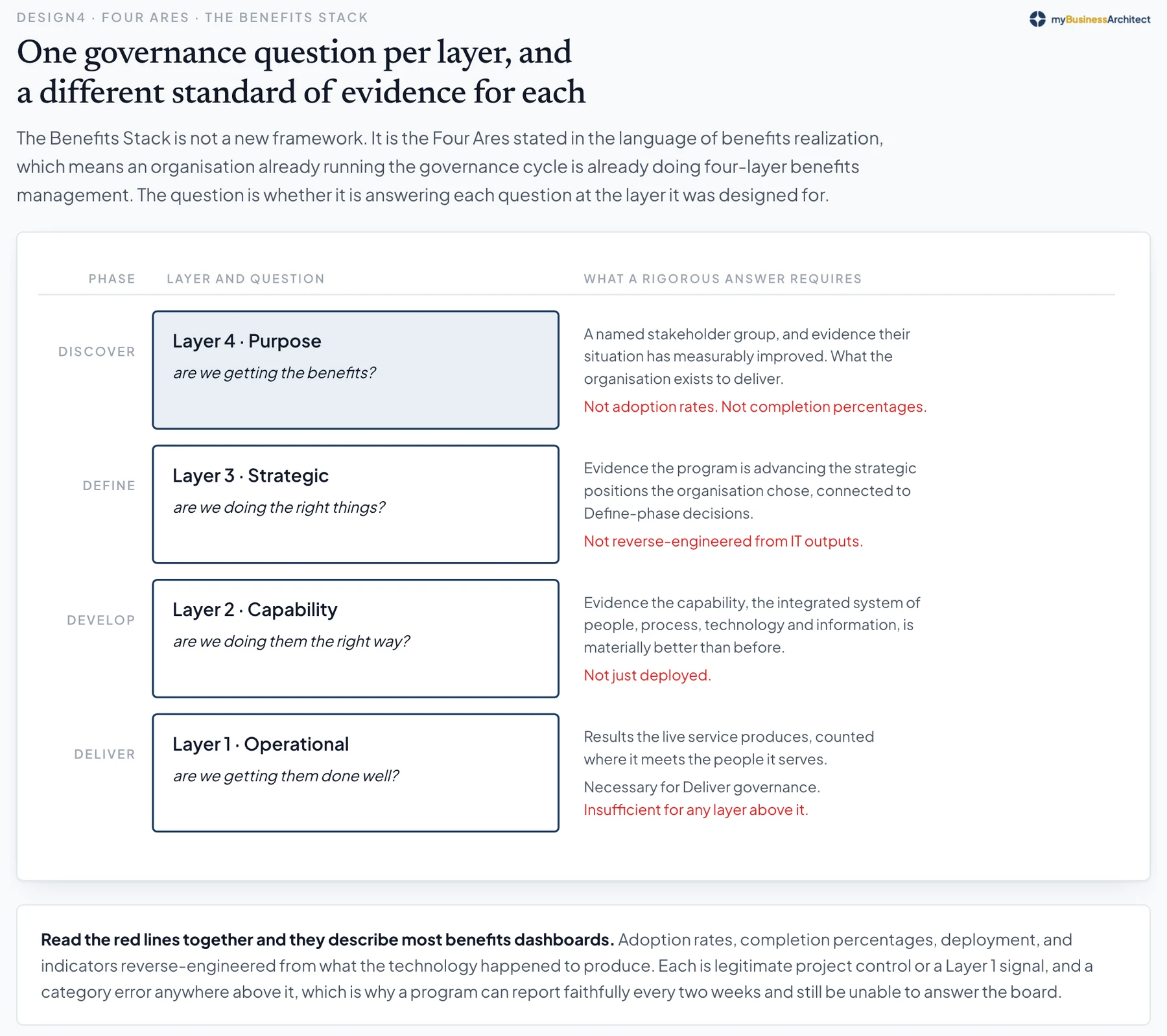
Read the four refusals down the right-hand side and they describe most benefits dashboards: adoption rates, completion percentages, deployment, and indicators reverse-engineered from whatever the technology happened to produce. Each is legitimate project control or a Layer 1 signal, and a category error anywhere above it, which is why a program can report faithfully every two weeks and still be unable to answer the board.
The implication for program governance is that a benefits dashboard that reports only Layer 1 metrics is a Deliver dashboard. It tells leadership whether execution, and then the service, is running. It tells them nothing about whether the program is creating value at the layer where the board is asking.
A full-stack benefits dashboard reports one or two indicators per layer, with honest acknowledgment of timing. Layer 1 and 2 metrics are visible early. Layer 3 metrics emerge mid-program. Layer 4 metrics often lag the program by a full operating cycle. The answer to the board's question isn't "87% deliverables complete". It's: here's what we're tracking at each layer, here's what's visible now, here's what we expect to see by when, and here's the baseline we established before the program began so we know what movement looks like.
What This Looks Like in Practice
The program that couldn't answer
A higher education institution is eight months into a digital transformation program. Eight workstreams. Full PMO. Benefits register created at program initiation. The board's quarterly briefing includes a slide showing overall deliverable completion at 73%, with a breakdown by workstream. Two workstreams are amber. One is green and ahead of schedule.
The board chair asks what value the program is delivering to students and staff.
The program manager can't answer. Not because no work has been done, but because every metric on the dashboard measures activity inside the program. Nothing measures whether a student's experience has changed, whether staff can do their work differently, whether the institution is better positioned for its purpose.
The fix requires going backwards before it can go forward. Convene a working session with the Registrar, the VP Academic, and the director of student services (not the delivery team). Ask one question: what does "better" look like for the students this institution exists to serve, stated in terms that can be measured? From that answer, identify the Layer 4 indicators to baseline and track. Connect those to the Layer 3 strategic positions the program was supposed to advance. Map which workstream capabilities are the Layer 2 prerequisites. The existing deliverable metrics become leading indicators for the capability build, not the benefits themselves.
The dashboard gets a second tier. The board gets a question it can engage with. The program manager gets an answer.
The same move works in other sectors. A regional hospital integrating patient intake across legacy systems uses the same sequence: name what "better" looks like for patients at Layer 4, anchor it to the strategic position the integration was meant to advance at Layer 3 (shorter time-to-treatment than any alternative in the region, say), connect that to the scheduling and triage capabilities at Layer 2, and let the go-live milestones become leading indicators rather than the answer.
The strategy that wrote cheques it couldn't cash
The Phoenix payroll system is the cleanest public record of a strategy writing cheques it couldn't cash.
In 2009, the Government of Canada decided to replace more than forty departmental payroll systems with a single SAP-based platform. The business case was built on Layer 3 benefits: projected annual savings of $70 million from consolidating and reducing the workforce of compensation advisors. The system would, in its own framing, pay the right people, the right amount, at the right time.
The cheque was written at Layer 3. The Layer 2 account was never verified. The complexity of public-sector pay rules (collective agreements, acting appointments, retroactive pay, hundreds of job classifications) was treated as an implementation detail, not as a capability prerequisite. More precisely, it was an information architecture failure: that complexity couldn't be represented in the system's information structures, and nobody tested whether it could before go-live.
This is the Layer 2 pattern in its purest form: the last dimension tested, the first to fail in production. The software was installed. The training was delivered. The processes were documented. Every dimension of the capability that could be checked off in pieces was checked off. The one dimension that only reveals itself when a real case runs end to end (can the system's information structures carry an actual public servant's actual pay situation?) was never exercised until launch day, when 150,000 real cases arrived at once.
Governance tracked delivery metrics throughout: modules deployed, training completed, go-live milestones hit. Nobody in governance had a mechanism to ask the Layer 2 question before launch: can this system produce correct pay under real conditions?
When Phoenix launched in 2016, it couldn't. Think of a single compensation advisor in a federal department in the spring of 2016, trying to explain to a colleague why their paycheque was wrong, and discovering they had no way to find out, let alone fix it. That scenario, multiplied across roughly 150,000 public servants who were underpaid, overpaid, or not paid at all, is what Layer 4 failure looks like at scale. The Layer 2 capability was missing. The Layer 4 outcome (the purpose the government exists to fulfil toward its employees) was the direct inverse of what the benefit case promised.
By 2020, remediation costs had exceeded $2.2 billion. The projected savings: $70 million.
A definition gap that cost more than thirty times the benefit it was supposed to deliver. Delivery metrics were green while Layer 4 was catastrophically negative.
The dashboard was working. The question it was answering was the wrong one.
Phoenix is the Benefits Stack failure in its most complete form. It's also an unusually clear case of what the Trust Protocol pillar calls Rationale Collapse: the stated rationale was pay modernisation, a Layer 4 purpose argument; the actual driver was cost reduction, a Layer 3 benefit; and the Layer 2 capability required to connect those two was never tested. The program committed to all four layers in its business case and built a governance structure that could only see one.
The flywheel that compounds
The regional health authority case in the Design4 pillar shows what the full stack looks like when it's working. Patient outcome data (Layer 4, purpose) drove the governance question. Operational metrics sat underneath it, subordinated to the purpose question rather than substituting for it. The second cycle was faster because the organisation knew what it was measuring and why.
That compounding effect only happens when Layer 4 is in the picture. An organisation that only tracks Layer 1 resets to zero at each cycle boundary. There's no foundation to build on. The flywheel spins; it doesn't accelerate.
The Four Ares Are Already a BRM Framework
Here's what this means if you're already working inside the Design4 cycle.
Organisations that use the Four Ares as their governance model are running four-layer benefits management whether they call it BRM or not. Every governance review that cycles through the Four Ares is asking a Layer 4 question (Discover), a Layer 3 question (Define), a Layer 2 question (Develop), and a Layer 1 question (Deliver). The structure is already there. The difference between this and conventional BRM is sequencing: Design4 starts with the purpose question and works down. Conventional BRM starts with the delivery question and rarely works up.
That sequence isn't cosmetic. It determines what gets defined, what gets measured, and whether the board's question is answerable when it arrives.
Go Deeper
The Benefits Stack diagnostic gets you to the right layer. What it doesn't solve is the moment six months into delivery when the project manager needs scope clarity, the vendor wants sign-off, and the steering committee wants to know if the program is on track. At that point, the pull toward Layer 1 measurement isn't intellectual. It's institutional. Every person in the room wanting a simpler answer pulls in the same direction. Understanding the definition architecture and holding it under that pressure are different things.
That's what Shaping What Gets Built covers directly. How to govern what gets built when you're no longer the person defining it. How to trace delivery decisions back to the strategic and purpose commitments that authorised them. How to maintain the definitional anchor under delivery pressure.
If the diagnostic has told you where your definition gap is, the course gives you the governance discipline to close it before the next governance cycle arrives.
Frequently Asked Questions
Isn't this just 'measure outcomes, not outputs'?
The outputs/outcomes distinction is necessary but not sufficient. Between what was built and what changes for the people it serves, a benefit can live at any of the four layers. "Students contacted within a week of a warning sign" is a result, a reading of how well the live service produces its output, and it's Layer 1. "Improved advisor throughput" is Layer 2. "Improved competitive position" is Layer 3. "Students making better-informed decisions about their education" is an outcome at Layer 4. The outputs/outcomes distinction tells you to move up at least one layer. The Benefits Stack tells you which layer you need to reach and whether you're there yet.
Our PMO already has a benefits register. What's missing?
Probably nothing structural. The question is who authored the benefits, at which phase, in conversation with which stakeholders. Audit the register against three tests: Can you name the specific stakeholder group that's better off, and the observable indicator that tells you they're better off? Was each benefit defined before the program was approved, or after? Is the person accountable for delivering each benefit a business executive or a delivery team member? Benefits that fail two or more of these tests are defined at Layer 1 or 2, regardless of how they're labelled.
The board wants a dashboard. How do I give them something that isn't deliverable completion?
The Four Ares provide the structure: one or two indicators per layer, with honest acknowledgment of timing. Layer 1 metrics (the results: how well the live service produces its output) stay: they answer "are we getting them done well?" Deliverable completion stays too, as project control. But they sit alongside Layer 2 indicators (capacity or quality metrics the capabilities are supposed to improve), Layer 3 indicators (strategic position metrics the program is designed to advance), and Layer 4 indicators (purpose-level outcomes, which may not be visible yet but should be baselined from the start). "Outreach within a week for 81% of flagged students, advisor caseload down 18%, application conversion up 12% from baseline, first-year retention being monitored from an established baseline for cycle 2 reporting" is a four-layer answer. Each number has a layer label. The board can see which layers have evidence and which are still emerging.
What if the program is already running and the benefits were defined at Layer 1?
Redefine. It's never too late to ask the Discover question. Convene a working session with the business executives whose area the program affects (not the delivery team). Ask: what does "better" look like for the people this organisation exists to serve? Work backwards from that answer to which workstreams are most likely to move that needle. The Layer 1 metrics don't disappear; they become leading indicators for the Layer 4 outcome that's just been named. The dashboard gets a second tier, not a replacement. The program manager gets an answer to the board's question, including an honest acknowledgment that some Layer 4 indicators will only move after the capabilities are fully operational.
Doesn't this require the organisation to have done Discover properly?
Yes. If the organisation can't articulate what "better off for stakeholders" looks like in specific terms, every BRM effort will default to the highest layer it can reach, usually Layer 1 or 2. The Discover phase isn't a philosophical warm-up. It's the precondition for every benefit definition that follows. The further up the Design4 cycle the definition work was done, the higher the layer where benefits can be defined, and the more answerable the board's question becomes.
We defined benefits correctly and tracked them. They still didn't materialise after go-live. What happened?
Benefit leakage, in the Layer 2 to Layer 4 link described above. Diagnostic Question 5 points at it: if measurement stops when the program closes, the metrics were program metrics rather than benefit metrics. But sustained measurement does not prevent leakage on its own, because the thing that leaks is behaviour. The fix is a governance structure that outlasts the PMO: a named operational owner accountable for the embedding, a review cadence, and an explicit link between the Layer 2 capability and the Layer 4 outcome it was supposed to produce.
What about benefits that are genuinely hard to measure: culture change, staff morale, strategic agility?
Hard to measure isn't the same as impossible to define. Define the observable indicator at the highest feasible layer, even when assessing it requires judgment. "Staff are using the new system without reverting to workarounds" is a behavioural Layer 2 indicator; Layer 4 outcomes in public-sector contexts often need proxies like patient readmission rates or citizen service resolution rates. An imperfect indicator connected to purpose beats a precise one that isn't. Define the best available per layer and acknowledge its limitations. That's an honest account of what the organisation actually knows.
The Question That Changes Everything
The board's question, "are we getting the benefits?", isn't a governance formality. It's a diagnostic.
When the program manager can't answer it, the gap usually isn't in the measurement. It's three layers below the question, in a definition that was never connected to purpose. The measurement apparatus is working. It's measuring the wrong floor.
Practitioners who fix this don't redesign their dashboards first. They go back to the definition. They name the stakeholders, define what "better off" looks like at the purpose layer, and build the measurement structure up from there. The dashboard changes as a consequence: a second tier appears, one that the board's question can finally reach.
You become the person in the room who can answer it.
In most programs, that is not a small distinction.