Ask five leaders why the organisation exists and you will get five answers. The standard reading is that the team needs aligning. The better reading is that the question does not work, and a room that agreed would still have had nothing to reject with. So put the question away and ask a different one: name a costly decision this organisation has made, and tell me whether your purpose accounts for it.
The organisations that fix this do not write a better statement. They go looking for the one they already have, in what they have already done, and then find out what it costs them to mean it.
What Is Organizational Purpose?
Organisational purpose is the standard that decides between two reasonable proposals, and the standard the results are judged against afterwards. It names why the organisation exists and who is better off because it does, specifically enough that some genuinely attractive options are wrong. A purpose that cannot reject anything is not a purpose; it is a caption.
That definition does more work than it looks like it does, because almost everything that sits near purpose fails it:
| Artifact | What it answers | What it cannot do |
|---|---|---|
| Mission statement | What we do, for whom, roughly how | Operational by design; describes activity, decides nothing above it |
| Vision | What the future should look like | A destination is not a reason; both sides of a hard call can claim it |
| Values | How we behave while deciding | Governs conduct, not choice; tells you to be truthful about the numbers, not which number to choose |
| Winning aspiration | What winning means in the strategy | Belongs to Define; assumes the identity question is already answered |
| Purpose | Why we exist, and who is better off | The one that can say no |
The discipline's own standards confirm the gap by omission. The Business Motivation Model gives you Ends and Means, Vision, Goals, Mission, Influencers and Assessments; ArchiMate's motivation layer gives you stakeholders, drivers, goals, outcomes and value. An architect can build a complete, formally valid motivation view in either and never state why the organisation exists, because neither notation has an element in which to say it. The hole in the standards is exactly the job a tested purpose does.
A Four-Question Diagnostic
Run this in a leadership meeting without preparation.
- Ask three leaders separately why the organisation exists. Do the answers name different beneficiaries, or the same one?
- Name a costly or counterintuitive decision the organisation has made, and ask whether your purpose accounts for it. Not rationalises it afterwards. Accounts for it. If no such decision exists at all, that is the finding, and the Receipts Test below is the full treatment.
- For your three most important stakeholder groups, what outcome does each need, and what evidence do you have that they are getting it? Count the groups with none.
- Who owns the question of whether the purpose still holds? Name a person, not a committee.
Fail two or more and the purpose is decoration, however good the sentence is. The strategy-execution diagnostic places this result against the other three phases of the cycle; purpose failures rarely travel alone.
You Cannot Ask an Organisation Why It Exists
The five-answers scene is not a portrait of misalignment. It is five people improvising under social pressure, because the direct question invites composition, and composition under an executive's gaze produces the answer the room seems to want. No amount of facilitation turns improvisation into evidence.
The repair is not new: ask for stories instead. Find Your Why (Sinek, Mead and Docker) built a whole discovery process on it, starting from the moments people felt the organisation mattered and working back to the pattern underneath them. That move, stories rather than the question, is Sinek's, and it is right. Peak stories show the purpose operating; valley stories show what its absence cost. The pattern across them is evidence of a purpose being held, which is something a drafted sentence can never be.
Two structural limits remain, and they are limits of the room rather than the method. A facilitated workshop holds ten to fifteen stories before fatigue and recency take over, and it ends by presenting one answer as the discovered truth. And the process ends at a drafted statement: nothing in it tests whether that statement would survive a hard decision. Discovery tells you where the purpose might be. It does not tell you whether you found it. For that, you need a test that can fail.
The Receipts Test
Name the costliest or most counterintuitive decision your organisation has made. Now ask two questions, in order. Would your purpose have told you which way to go at the time? And then: did you go that way? A decision the purpose accounts for is a receipt. A yes to the first question followed by a no to the second is not a receipt; it is a breach wearing a receipt's clothes, and the gap between the two answers is the single most revealing thing this test produces.
The test works because of what a costly decision is: evidence that a stance was actually held. You cannot sustain "we serve this population even when it costs us" without leaving receipts. So before you polish the sentence, run the screen the sentence has to pass anyway. The three criteria published on the business architecture framework page (is it specific enough to reject a proposal, can it say no to something reasonable, would the people you serve recognise themselves in it) tell you whether a sentence is bad. They cannot tell you whether it is true, because all three can be satisfied by good drafting. The Receipts Test asks the question drafting cannot reach: does a purpose exist to test?
Four devices do the work, each separating something the one before it lets through. We put the same four to the public record of 28 organisations across three sectors and four countries, 23 in the full study and five in its pilot pass; the full evidence is in the companion research report, and the shape of it is below.
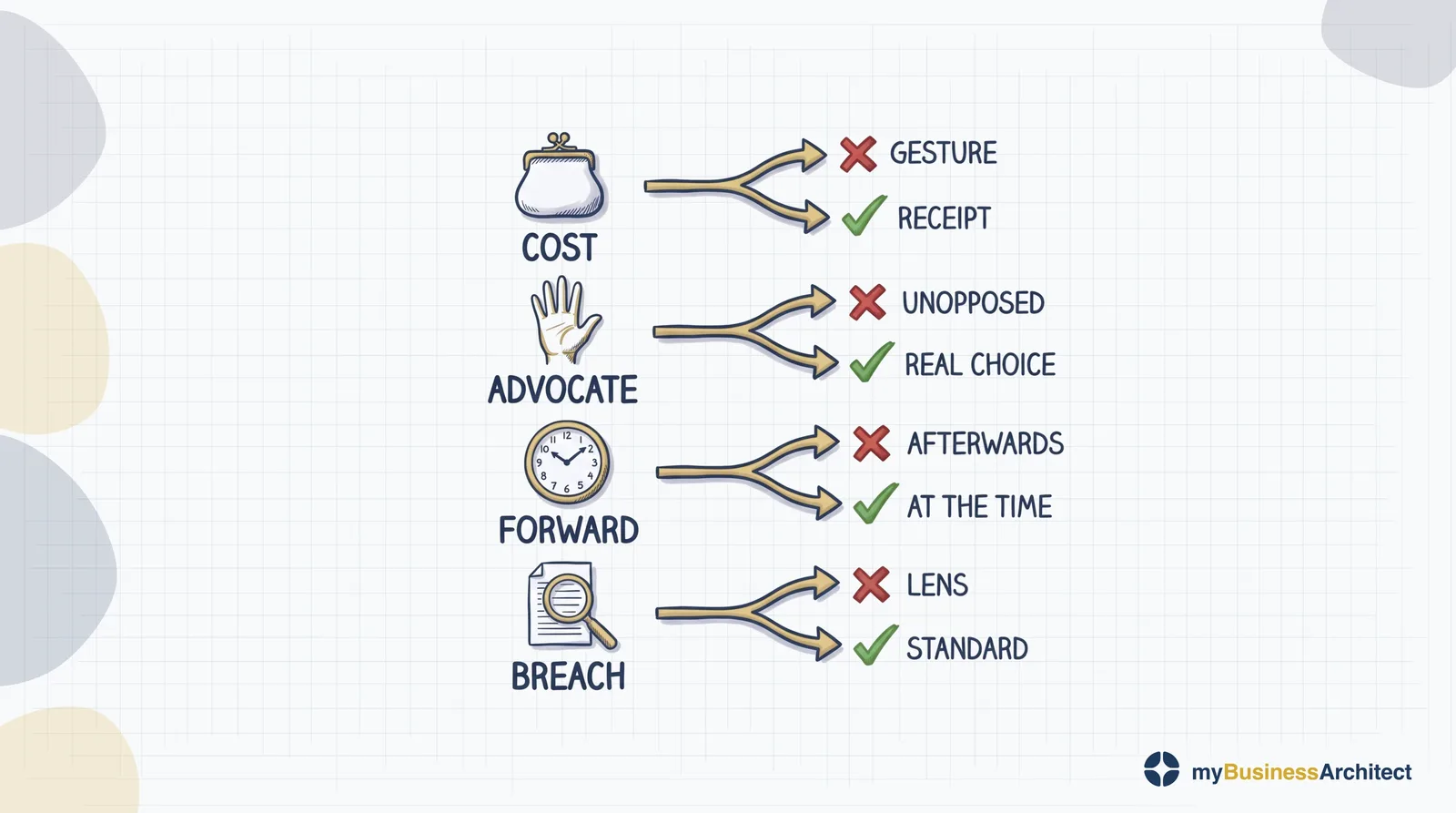 Each device separates something the one before it lets through: the gesture from the receipt, the unopposed decision from the real choice, the lens applied afterwards from the standard applied at the time.
Cost: did the decision actually cost them anything, and can they say what, in units? A cost is the only thing that shows the purpose overrode something. What this device separates out is the gesture: an act that served the purpose, gained the organisation something, and is remembered as a sacrifice. Patagonia's 2011 "Don't Buy This Jacket" advertisement is retold as a company forgoing sales for its values; sales rose by about a third the following year, so the advertisement cannot show the purpose beat anything. The same company's 2022 transfer of ownership passes cleanly, because the family gave up the company and paid tax to do it. Same purpose, two decisions, one receipt.
Advocate: did anyone credible argue against it at the time, and what was their case? A decision nobody opposed did not need a purpose to decide it. This is also the device that finds breaches: in nine of the ten organisations whose purpose did not account for its costliest decision, someone credible argued the other way on the record, and in five the dissent was inside the house, among them the bank whose board found its own ethics line had been answered with dismissals, the carmaker whose engineers settled their disagreement about an emissions standard by deciding to cheat and were ordered to destroy the document that showed how, the hospital trust whose nurse was told the senior staff were in charge, and the aircraft manufacturer whose safety representative was discounted by colleagues and never heard by the regulator. A postal company's own postmasters were disbelieved for twenty years. The purpose was on the wall in every one of them. The advocate was on the record. The purpose could not protect them.
Forward: was the purpose part of the decision while it was being made, or attached afterwards to explain a result? This is the line between a standard and a lens. A lens colours what you see and rules nothing out, so every outcome looks as if it fits. A standard is applied before the outcome is known, and it can be failed; it leaves a mark in the record, a filing, a letter, a minute. Johnson & Johnson's legend has the Credo deciding the 1982 Tylenol recall within a day; the record shows a week of deliberation and a chief executive describing the Credo as the ammunition he needed to persuade shareholders. The decision went where the Credo points, eventually. That is the weak pass, and most organisations' best story is one.
Breach: can they name a decision they now think was wrong, and would the purpose have flagged it at the time? A purpose that accounts for every good decision and no bad one is a lens. A standard catches you, and an organisation that has never been caught has either never been tested or is not using one. This device runs last because self-criticism and self-flattery cannot operate at the same time, which makes it the one a rationalisation survives least often. CVS's account of itself passes the first three devices on its tobacco decision and fails only here, because the purpose is never applied to the opioid settlement it does not treat as a wrong. Patagonia passes: its own audits found forced labour in its suppliers' mills, and it names that as a failure its purpose should have caught.
On the record, a genuine receipt had three properties: the cost was named in units at the time, not reconstructed later; the purpose was connected to the decision while it was being made; and someone credible argued the other way and was overruled. All three in each of the three clean cases, no control with them together, and the well-drafted statements did no better than the generic ones, which is the quiet verdict on drafting as a discipline. That pattern is read across three receipts, six partials and four controls: a synthesis rather than a measurement, and the hypothesis the live version of the test now carries into the room.
Two observations from the same exercise, offered as observations. Scoring the published statements of nineteen of the largest organisations in three sectors, sixteen could be claimed by a peer unchanged. And one FTSE 100 company publishes no purpose statement on any page we could reach, which at least has the virtue of honesty.
What the test catches has a name: Purpose Theatre. A statement everyone approved that cannot reject anything, failing invisibly, because a purpose that decides nothing produces no argument, no gap, and no red dashboard. The failure is not that the words are wrong. It is that nobody is holding a stance in which refusal is possible, and a costly past decision is the evidence that somebody once did. If the test comes back empty, tell absence apart from drift: an organisation that has never had to pay for what it stands for may not have a discoverable purpose yet, only a preference. That is a legitimate finding, and it is the honest starting point the workshop never produces. In the sectors business architects mostly work in, it is also the common case that the record cannot help you with at all: a commissioned provider whose single funder defines the work leaves no public trail, so there the Receipts Test is a live instrument run on a leadership team, not a documentary one.
One disclosure, in the spirit of the test itself. The test has been run against the public record, where it discriminated: the advocate device found the breaches, the breach device found the flattering self-accounts, and no control passed. The claim is as modest as the sample: the sharpest comparison rests on a handful of organisations, and three of the four controls offered the devices nothing to grip. And what the test meets in a live room, memory under social pressure, a team telling you a story, is a harder opponent that the record cannot simulate; the device order above, strongest last, exists for exactly that encounter.
Purpose Is Four Artifacts, Not a Sentence
A tested purpose anchors the Discovery Synthesis, the four-artifact package a completed Discover hands to strategy. It does not travel alone.
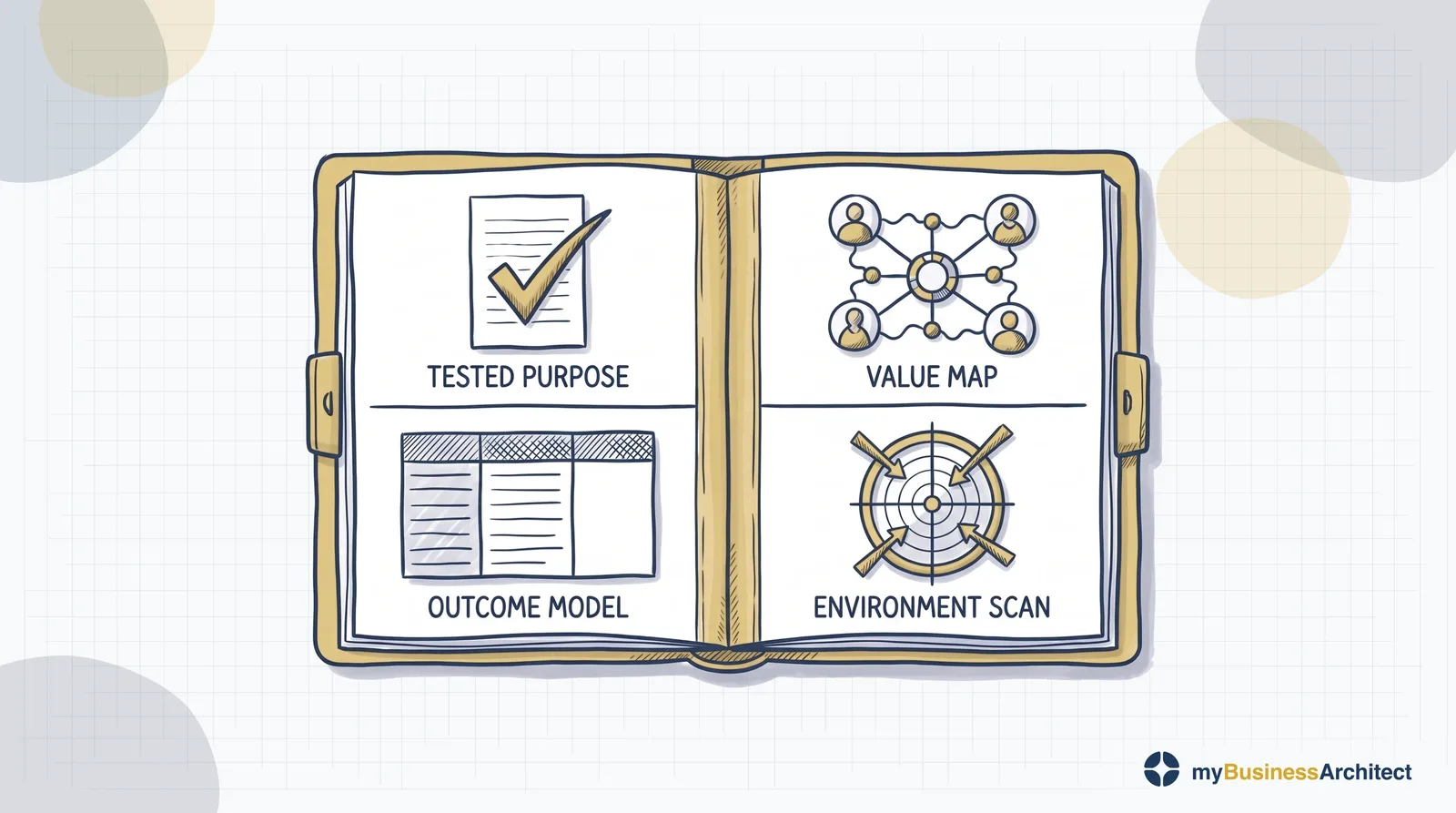 The Discovery Synthesis. In most organisations the outcome model's evidence column is the empty one.
What each artifact captures, and what its absence costs:
| Artifact | What it captures | What its absence costs |
|---|---|---|
| Tested purpose statement | The standard, survived by evidence | Every later phase argues from preference |
| Stakeholder Value Map | Who must be better off, and the outcome each needs | Stakeholders served by assumption; the quiet ones invisibly dropped |
| Outcome Model, with evidence | Whether each stakeholder is actually receiving the value | Activity evidence everywhere, outcome evidence nowhere |
| Environmental scan | Which external forces bear on the purpose, filtered for strategic impact | Strategy reacts to whatever shouted last |
The map earns its place through one discipline: outcomes each group needs, not products they want, because value is defined by the receiver and the gap between stated wants and actual needs is where discovered purposes live. The scan earns its place through another: an external force is not inherently a threat or an opportunity, it becomes one only when assessed against a stated end, so until the purpose is stated the scan is formally undecidable. That is why the scan sits inside Discover rather than in front of it.
Purpose Runs Twice
Every other phase of the Design4 cycle is judged by the phase after it. Strategy is tested by whether capabilities can be built for it, capability by whether services run on it, operations by whether the outputs land. Purpose is tested by nothing downstream, because it is what everything downstream is tested against. Then it comes around again: of John Thorp's Four Ares, the fourth, "are we getting the benefits?", maps back to Discover, not to Deliver. Purpose sets the standard on the way out and applies it on the way back, and the return pass needs the two things nobody builds: something to arrive at, and someone who owns arriving. The measurement design that makes arrival checkable belongs to the performance measurement framework; Discover's job is the standard it measures against.
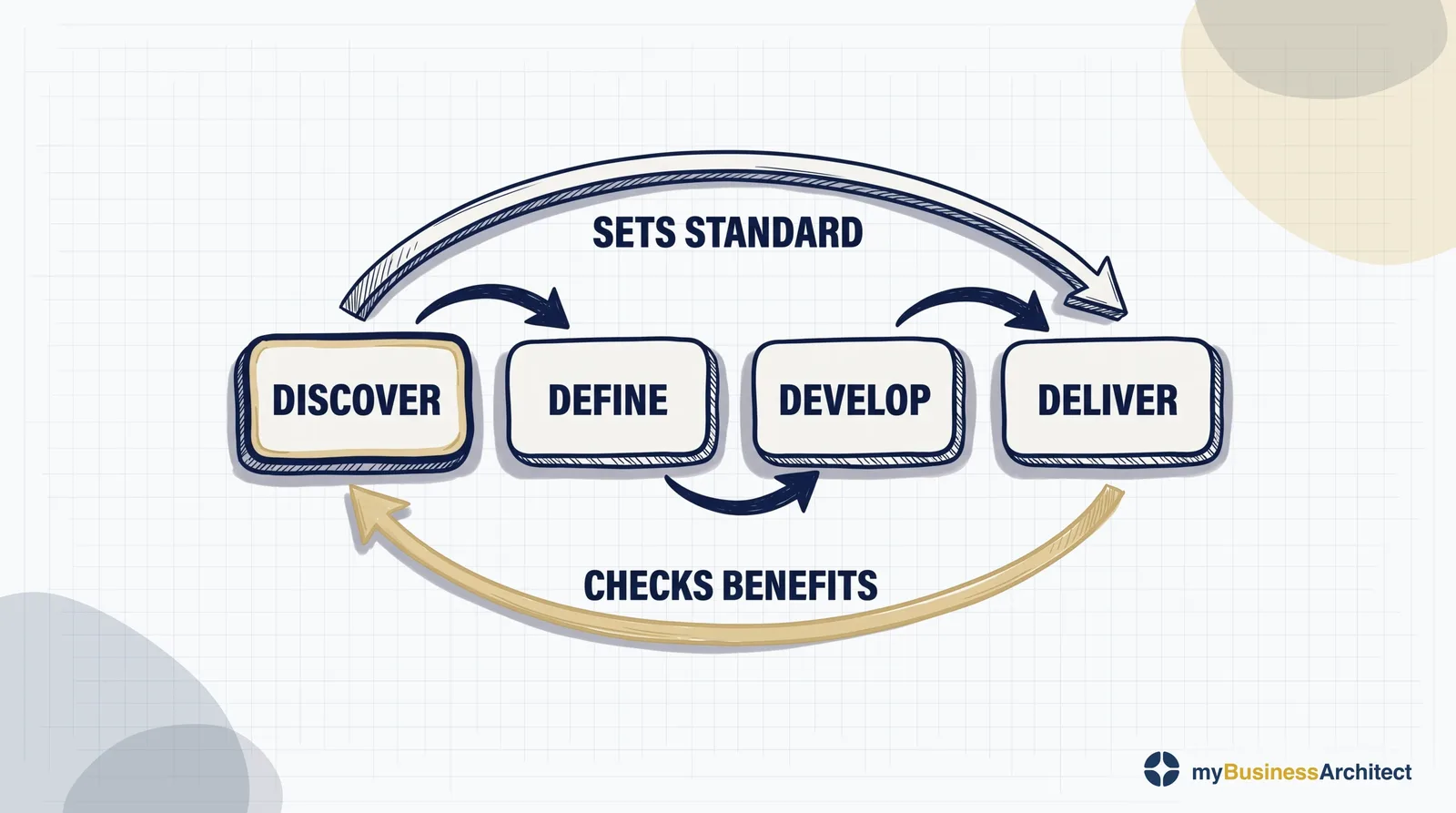 Purpose sets the standard on the way out and checks the benefits on the way back. The return leg is the one nobody builds.
The return leg is also where granted purposes need a second question. A statute, a charter or a set of charitable objects does not remove the receipts; it moves them to wherever the mandate leaves room, and every decision about means is a real choice the test can read. Two cautions travel with that. Where the mandate itself specifies the costly act, the test has nothing to grip, because the required act and the held purpose are the same act, so ask separately whether anything outside the organisation required the decision. And where a mandate names several ends and leaves the trade-off open, it will claim any costly choice afterwards. So a mandated organisation adds a second line of questioning to the test: beyond whether your purpose accounts for what you have done, is the beneficiary it names the one actually being served? Those can have opposite answers, and a mandate insulates its holder from the second question, because compliance is success by definition. A purpose granted by public choice deserves the same scrutiny as the private failure it replaced; that is a governance standard, not a politics.
Purpose Is Not the Winning Aspiration, and Not the Mission Either
The boundary with strategy is best drawn in the plainest available words: purpose is an identity anchor, not a competitive strategy. It does not answer where to play or how to win. It is the foundation for strategy work, not a substitute for it. The strategy choice cascade starts where Discover ends, and a winning aspiration written without a tested purpose under it inherits every weakness described above.
The mission boundary is already drawn inside the standards. In the Business Motivation Model, Mission is a Means: the ongoing operational activity, deliberately generic, that makes the Vision real. It describes the doing. Purpose is prior to both, the why that neither element holds, which is exactly why a formally complete motivation model can still leave a leadership team with nothing to reject a proposal with.
One Discover, End to End
A polytechnic, generalised. Five leaders gave five answers naming five different stakeholders, which was the tell: the disagreement was about whose outcomes count. The official statement, written by a committee eight years earlier, could have described any polytechnic in the country; it failed specificity, failed decision power, and nobody had ever asked whether the community it named would recognise itself.
So the team gathered evidence instead of drafting. Purpose conversations with faculty, students, employer committees and community partners surfaced the pattern in what employers said about specific programs: your graduates can do the job on day one, nobody else's can, and about others, they're fine, there are lots of options. That is a discovered purpose; nobody drafted it. The stakeholder map then produced two findings nobody expected: international students had been treated as a revenue source that happened to need education, their actual outcome needs mostly unmeasured, and the rural campus the finance case said to close was the only post-secondary presence in its catchment. The Outcome Model's evidence column was mostly blank, a 78 per cent graduation rate and a healthy exit survey alongside employer data, already collected and rarely analysed, showing barely half of graduates judged well prepared. The scan separated what could not be changed, visa caps, frozen tuition, from what could: which stakeholders to serve, and with what.
Then the part the example exists for. The tested purpose concentrated on three things, none of which was international tuition, and it made two decisions a spreadsheet had made differently: programs launched because they attracted enrolment rather than met an unmet need were no longer defensible, and the campus closure was no longer a straightforward saving. The financial calculation and the stakeholder calculation pointed in opposite directions, and the purpose adjudicated. It cost something. Someone's program went; a stakeholder was disappointed. A purpose with decision power always does, which is why most organisations quietly prefer one without.
The same failure arrives from the other end of the cycle too. A regional health authority with every departmental dashboard green, every handoff technically complete, and a diabetic patient's journey that did not work, is the Deliver-side version of the blank evidence column, and it is why the return leg exists.
Running Discovery at Scale
The method above runs in rooms, and rooms have the two limits already named: a dozen stories, one answer. The WHY discovery tool now in build runs the same evidence discipline at scale: fifty to two hundred stories without fatigue, recency bias or a political stake in the answer, candidate purposes with their evidence trails attached rather than one statement presented as truth, and then the tests. The Receipts Test is one of its five rejection tests; the tool runs four more alongside it, with the organisation's own stories behind all five. Of those four, one you can run yourself today, asking whether a capable competitor could claim your statement unchanged; three need a scenario built from story data.
The version that matters on Monday costs nothing and fits in one meeting. Name the costliest decision you have made. Ask whether your purpose would have told you which way to go. Ask whether you went that way. Most organisations have never asked, and the ones with a purpose worth having can answer.
The craft underneath both halves of the method is taught in the curriculum: Closing the Strategy-Execution Gap anchors a full Discover phase, from the five answers to the tested purpose, before a single strategic choice is made.
Frequently Asked Questions
What is organizational purpose?
Organisational purpose is the standard that decides between two reasonable proposals, and the standard results are judged against afterwards. It names why the organisation exists and who is better off because it does, specifically enough that some attractive options are wrong. If it cannot reject anything, it is a caption, not a purpose.
What is the difference between purpose and mission?
Mission describes the doing: the ongoing operational activity, what you do and for whom. Purpose is the why underneath it, and it is the one that can say no to a proposal the mission comfortably accommodates. The two are routinely conflated, and the companion piece on purpose versus mission statements takes that confusion apart in full.
How do you discover an organisation's purpose?
Not by asking. Collect stories of the moments the organisation demonstrably mattered to the people it serves, and of the moments it failed them, then find the pattern across them. The story method is Sinek's and it works; what it does not include is a test, so finish by running the Receipts Test on the candidate the stories produce.
What if we cannot name a single costly decision?
Then you have found the finding, not failed the exercise. Ask one more question: has there been a moment where holding to what this organisation stands for would have cost something, and you did not have to pay? An organisation that has never had to pay may have a preference rather than a discoverable purpose, and knowing that is worth more than a drafted statement.
Does the Receipts Test work for public sector and mandated organisations?
Yes, with one adjustment. A mandate moves the receipts to wherever it leaves room, so the test reads decisions about means. Ask separately whether anything outside the organisation required each decision, and ask the second question a mandate never forces: whether the beneficiary the purpose names is the one actually being served.
Is purpose the same as the winning aspiration in strategy?
No. The winning aspiration belongs to strategy and answers what winning means; purpose is the identity anchor underneath it, and it does not answer where to play or how to win. Write the aspiration without a tested purpose and both sides of the next hard trade-off will quote it with equal confidence.
Who should own organisational purpose?
A person, not a committee, and specifically the person who owns the question of whether the purpose still holds: whether the organisation's costly decisions still leave receipts the purpose accounts for, and whether the named beneficiaries are still better off. In Design4 terms that is the person who answers for the return leg, the fourth Are.
Continue Learning
The evidence base: Does Your Purpose Account for What You Actually Did? puts 28 organisations to the Receipts Test on the public record. The method lives here; the proof lives there.
Sibling pillars: Design4 is the four-phase cycle the Discover work above anchors. Performance measurement covers the return leg. The strategy choice cascade is where a tested purpose goes next.
In the cluster: Your Organization Doesn't Have a Strategy Problem owns the purpose-versus-mission question. Forty-Seven Ideas on a Whiteboard is the failure the four-question diagnostic catches in the wild. The Same Force Is a Threat and an Opportunity expands the environmental scan compressed above.
Closing the Strategy-Execution Gap teaches the full Discover discipline, from the five answers to the tested purpose, through one institution's complete cycle.