Your capability heat map was accurate. You had a real sponsor: a provost, a deputy minister, someone whose authority crossed every boundary the gap crossed. The analysis was right. The room still rejected the work.
It wasn't the analysis. It was the work itself. The union newsletter called it a layoff exercise. The staff session went sideways in the first ten minutes. Somebody asked who had already seen the data, and the question wasn't curious. It was forensic: not "who has context?" but "was this already decided before we were invited in?"
Nothing in your business architecture training explains this, because your training assumes the organisation is an audience. The Strategy to Execution pillar names the gap this creates as a Political Reality; the Trust Protocol is what it takes to actually operate inside one. In ratifier environments (senates, bargaining units, governance bodies with formal veto power), the organisation doesn't just receive the architecture. It votes on it. A sponsor can protect the work. A sponsor cannot make the organisation accept it. In ratifier environments, acceptance is the harder problem. Disability rights advocates named this discipline decades ago: nothing about us without us. What's missing is the Trust Protocol, and sometimes that protocol doesn't just change how the architecture lands: it changes the architecture itself, because the community knows things the capability map doesn't.
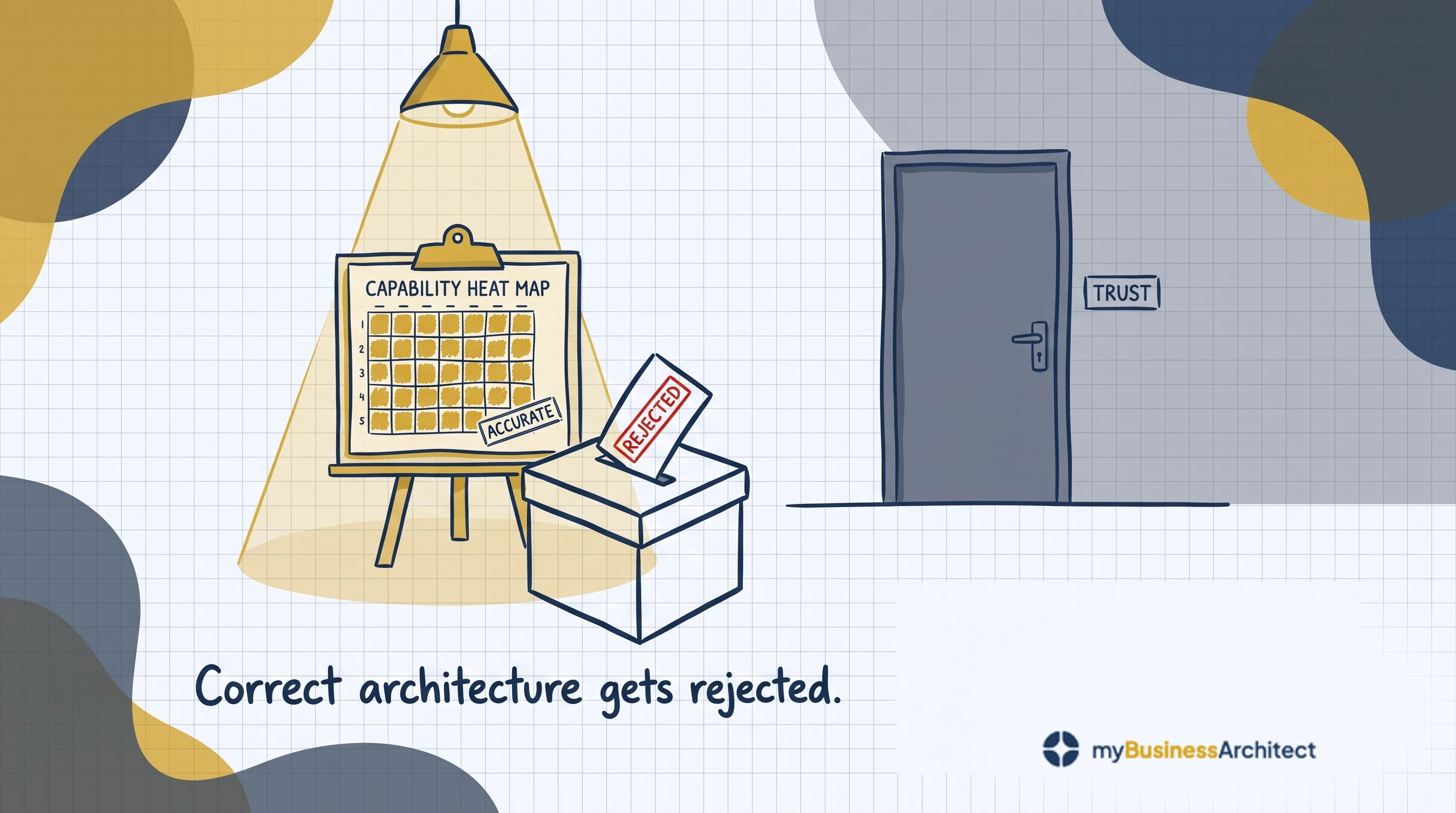
In a low-trust room, the capability map is perceived as a threat assessment. A maturity level 1 doesn't mean "needs investment": it means "first on the list". The workshop becomes a performance. Staff go through the motions. Nobody believes the outcome is still open. The sponsor's protection runs out before the community's resistance does. The protocol is what changes that: five commitments, each producing an artifact, each preventing a specific failure mode.
The Trust Debt Diagnostic
Before the protocol, there's the diagnostic: five questions. You can run them in under ten minutes, and the most telling answer to any of them is the one you already know: "we think so, but we don't have evidence."
1. Can people trace decisions to rationales? Pick your organisation's last significant structural change. Can a mid-level employee say what drove it, and does their answer match the official one? If the official rationale and the believed rationale differ, you are carrying Trust Debt from a specific event, and it has a name (we'll get to it).
2. What happened after the last consultation? Was there a visible account of what it changed? A consultation with no traceable consequence doesn't produce neutrality. It produces evidence of concealment (in the participants' reading, if not in fact). In one recent institutional consultation, participants read even workshop absences as evidence of institutional concealment rather than logistical oversight. That is what accumulated distrust does to interpretation: it converts noise into signal, and every gap into a cover-up.
3. Is financial information shared as evidence or as summaries? Summary charts that require interpretation are read as curated. The ask from the field is specific: actual numbers, not summary charts. If unit costs can't be compared like-for-like across departments, every structural comparison is contestable; in a low-trust environment, everything contestable gets contested.
4. What does "pilot" mean in your organisation? If temporary things turn out to be permanent, and evaluated things are never evaluated, the vocabulary of experimentation is burned. A faculty member put it plainly: the word "pilot" had become the scariest word on campus: not an experiment, but "a way of ramming something through". When the language of learning becomes the language of imposition, every future initiative inherits the suspicion.
5. How does work actually get done? If the honest answer is workarounds and personal relationships (one staff member estimated that 95% of her job was negotiating and maintaining relationships, "the only thing keeping us functional"), then the organisation runs on individually-held trust while organisationally-held trust is depleted. Note who is carrying that load: the people holding the place together informally are simultaneously your most essential informants and your most exhausted, most sceptical audience.
Three or more flags: your next architecture engagement will be received as a threat regardless of its quality. The protocol below isn't optional preparation. It's the work.
Take the full diagnostic: Find Your Gap: 4-minute assessment →
Trust Debt, and How Organisations Accumulate It
Technical debt is the future cost of past shortcuts. Trust Debt is the future cost of past broken commitments; it behaves the same way. It's invisible on every dashboard. It compounds. And it's paid by whoever attempts the next change, which is why the practitioner walking into their first engagement at an institution often inherits a liability they had no part in creating.
Three events generate most of it.
Rationale Collapse. It's the single largest generator. A decision is presented as driven by one rationale (pedagogy, service quality, strategic direction) when it is actually driven by another, usually cost. One institution introduced a new curriculum structure, presenting it publicly as a pedagogical evolution. Staff knew it was a cost-saving measure "branded differently in different meetings". The direct consequence, in a staff member's words: "nobody trusts what the actual impetus for any activity is." Read that carefully. It wasn't that decision. It was any activity. One collapsed rationale doesn't discredit one decision. It discredits the institution's entire rationale-issuing function, retroactively and going forward. Communities are pattern-matchers, and the pattern they learn is: the stated reason is not the reason.
Consultation without consequence. Input gathered, then silence, then an announcement that shows no trace of the input. Each round teaches the community that participation is ceremonial. The next facilitator inherits a room that has already decided the outcome is predetermined, reading every pre-built slide as proof.
The permanent pilot. These are experiments that were never experiments: changes introduced as temporary and reversible that were neither, with no evaluation ever published. This burns the one vocabulary an adaptive organisation cannot afford to lose: the language of trying things.
Trust Debt explains a pattern every experienced practitioner has seen and few frameworks account for: why correct work intensifies resistance. A capability heat map showing a function at maturity level 1 is architectural evidence. In a room carrying Trust Debt, it is a threat assessment; the question underneath every question is the one a staff cohort at one institution carried into a workshop that subsequently fell apart: what is going to happen to my job?
That condition has a name too: Anticipatory Exposure, when participants can't engage with a design question because a survival question is running underneath it. No workshop design survives contact with unaddressed Anticipatory Exposure. The facilitators in that session did the right thing: they abandoned the designed exercise and let the room name what it needed the process to get right before any structural design could feel credible. The protocol treats Anticipatory Exposure as a design constraint to architect around, not an attitude problem to manage.
Architecting around it means three concrete changes to session design, not just a different attitude in the room. The language changes first, from a judgment about the person to a property of the system, out loud, in the room, at the moment the finding is presented, not just in the write-up: "this capability", not "your team"; "what's missing here", not "what you got wrong". The room composition changes too: whoever is affected by a low-maturity finding is in the room when it's named, not informed of it afterward by someone else. And the finding reaches the capability owner as a private conversation before it reaches the public wall: the owner hears it first and can add context to how it's framed, but can't change the finding itself before it posts, so this isn't private vetting of the model, which stays open (more on that under Commitment 2 below). Skip any one of the three and the workshop design survives on paper while the room quietly decides the outcome was predetermined.
The Trust Protocol: Five Commitments
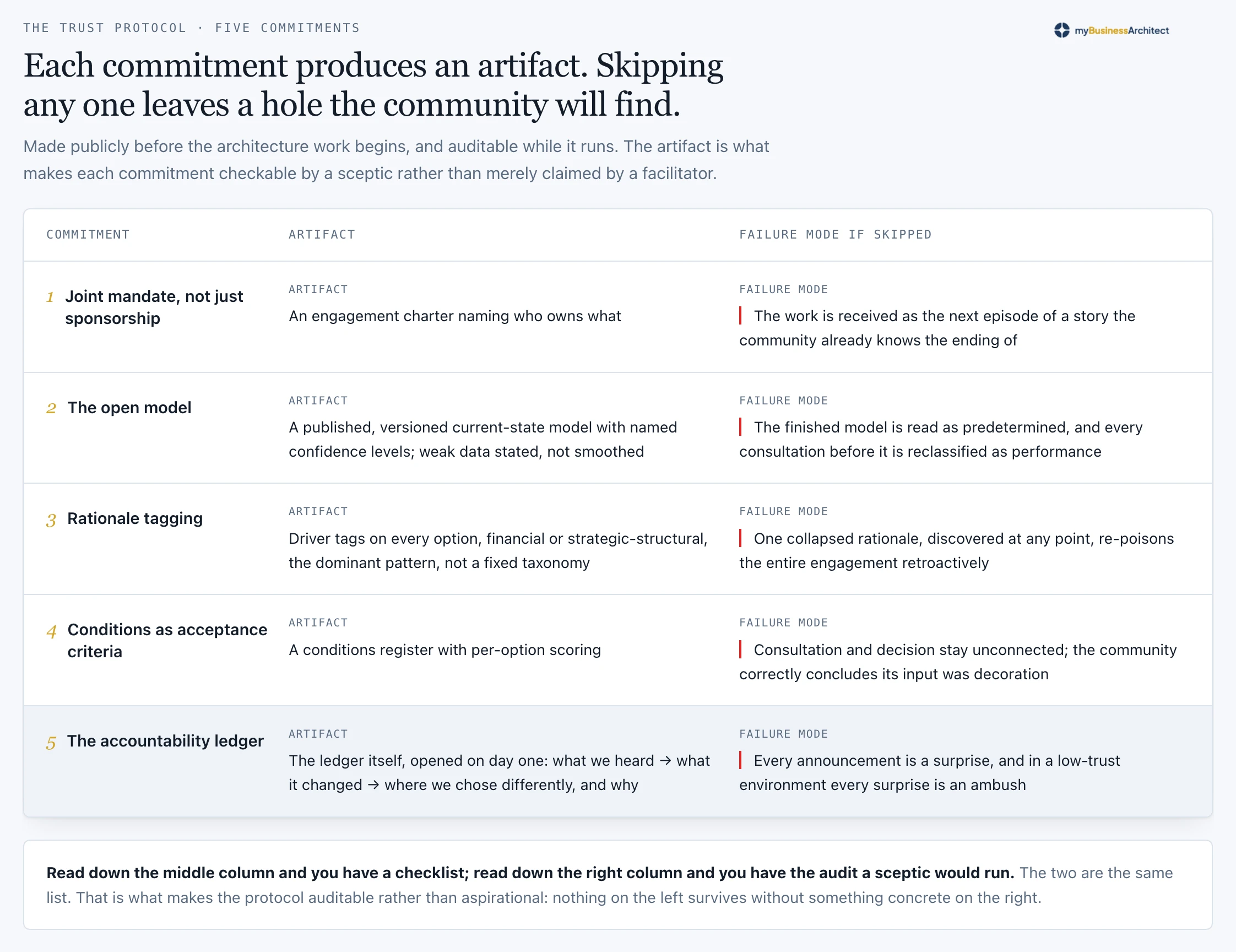
The protocol is a set of five commitments, made publicly before the architecture work begins, and auditable while it runs. Each produces an artifact. Each prevents a specific failure mode. Skipping any one of them leaves a hole the community will find.
Commitment 1: Joint mandate, not just sponsorship
The work arrives through a channel. In most institutions, that channel belongs to management, which means it inherits every previous cost exercise that arrived the same way, including the ones that were presented as something else. The community doesn't evaluate the architecture on its merits alone. They evaluate it through the reputation of the channel that delivered it.
The sponsor protects the work. The mandate legitimises it. They are different instruments, and ratifier environments require both.
Extend formal co-ownership to the governance bodies that can veto the outcome: the senate working group, the faculty and staff associations (observer status at minimum), student representation where students are stakeholders in the result. This is not a courtesy. It is the difference between architecture arriving as management's instrument (through the same channel as every previous cost exercise, inheriting its reputation) and architecture arriving as the institution's instrument.
Artifact: an engagement charter naming who owns what. Failure mode if skipped: the work is received as the next episode of a story the community already knows the ending of.
A note on bootstrapping. You were almost certainly brought in by management, which is the same channel this commitment asks you to widen. That's the first test of the protocol, run on yourself before it's run on the engagement. Make the ask itself an artifact: a short, public memo proposing co-ownership, addressed to the governance bodies directly rather than routed through management. This requires the sponsor's active, informed consent, not just their silence: a sponsor who brought you in specifically to control how governance gets involved has an obvious reason to block an independent overture to the senate before it happens, not after. Raise it with the sponsor directly, in those terms, before drafting the memo. If the sponsor withholds consent, that's your first Trust Debt Audit flag for this engagement, on record. If the sponsor consents and the governance body still declines, that decline becomes the opening entry in the accountability ledger once Commitment 5 opens it: a finding to act on, not a failed launch.
Commitment 2: The open model
When the model first appears complete, the community's first question is: who built this, and when? A model that arrives fully formed is a model built without them, and therefore without what they know. The open model answers that question before it becomes the forensic one.
The architecture is built in public. The capability map lives where the community can see and interrogate it: the institutional equivalent of the studio wall or the shop-floor board, not the steering-committee deck.
This does more than signal good faith. The model is built in public because the community has earned that, full stop, not because it's a clever way to extract better answers. It also happens to make the model better, and there's a plausible reason why: a rough draft is easy to correct and a blank page is hard to fill, so showing someone an unfinished model and asking have I got this right, I'm not sure tends to invite a more precise answer than asking what should this look like. It also costs the room nothing, because correcting a guess feels like contributing, not like being tested. People validate the parts they know: staff confirm what they actually do, which is the direct corrective to the wound one staff group named as "you don't know what we do and the value we bring." Faculty confirm how decisions actually flow, as opposed to how the org chart says they flow. In most institutions those are different diagrams, and only the community knows the real one.
Artifact: a published, versioned current-state model with named confidence levels, including where the data is weak, stated rather than smoothed. Failure mode if skipped: the first time the model appears finished, it is read as predetermined, and every consultation that preceded it is reclassified as performance.
Commitment 3: Rationale tagging
The community has done this math before. Pedagogy turned out to be cost. Strategy turned out to be restructuring. Service quality turned out to be headcount reduction. The pattern, once learned, applies to every future proposal, including the true ones. Rationale tagging is the commitment that makes the pattern detectable before it calcifies, by forcing the institution to say, in writing, which pressure is actually driving each change.
Every proposed change carries an explicit driver tag: financial, or strategic/structural. Those two are the dominant pattern in the field evidence here, not a fixed taxonomy: a government engagement might need a third tag, regulatory, and the mechanism survives the swap. What matters is that the pressures get named separately, in writing, before the trade-offs get made, never folded into a single story.
A provost, responding to a consultation that had surfaced exactly this distrust, publicly separated the two pressures facing the institution (the financial one and the structural-pedagogical one) and committed that "when we propose a change, we will be clear about which of them is driving it." That sentence is the commitment. The tag is what makes it auditable. Anyone can check any proposal against its stated driver, which means the institution has made Rationale Collapse detectable; an organisation that makes its own dishonesty detectable has made a materially stronger promise than one that asks to be believed.
Artifact: driver tags on every option in every options paper. Failure mode if skipped: one collapsed rationale, discovered at any point, re-poisons the entire engagement retroactively.
Commitment 4: Conditions as acceptance criteria
This community has been consulted before. They attended the session, filled the survey, wrote the submission. If they cannot point to a single thing their input changed, they have no reason to participate again; they know it. The protocol converts that history from a barrier into an instrument.
If the community has been consulted (and in most ratifier environments it has, repeatedly), it has produced requirements. Usually they are phrased as grievances and shelved as sentiment. The protocol converts them into governance: the community's own "what would have to be true" conditions become the formal test harness against which every candidate structure is scored, publicly: which conditions each option satisfies, which it cannot, and what the trade-offs are either way.
This binds in both directions, and saying so out loud is part of the commitment. The institution is bound to test its options against the community's conditions. The community is bound to accept that scoring as the shared basis for debate: objections must name a condition or propose a new one. And if the condition set turns out to be one that no feasible option can satisfy, that is a finding to surface, not to hide: it means the community's requirements and the institution's constraints are in genuine conflict, which is a purpose-level discovery, not a process failure.
Artifact: a conditions register with per-option scoring. Failure mode if skipped: consultation and decision remain unconnected activities, and the community correctly concludes that its input was decoration.
Commitment 5: The accountability ledger
The accountability ledger is the protocol's signature artifact: a standing public record, updated at every decision point rather than assembled at the end. It follows a fixed format: what we heard → what it changed → where we chose differently, and why.
The field evidence for this one is almost verbatim. At the close of a difficult institutional consultation, the facilitators observed that participants were not asking for the institution to act on everything they said. They were asking for something more specific: a visible, honest account of what was heard, what it changed, and where the institution chose a different direction and why. Accountability, in other words, does not require agreement. It requires traceability.
The ledger's real function is to occupy the most dangerous space in any change process: the silence between consultation and announcement. That silence is where Trust Debt does its compounding. A correct decision announced without lineage reads as a decision that ignored everyone. The same decision, arriving with its lineage visible in a ledger the community has been reading all along, is a decision the community watched being made. That is a different event, even when the outcome is identical.
Artifact: the ledger itself, opened on day one. Failure mode if skipped: every announcement is a surprise, and in a low-trust environment every surprise is an ambush.
A note on boundaries
Transparency has legitimate limits: salaries, personal data, legally privileged material. The protocol move is to name the boundary and the reason, not to let the boundary silently truncate what's shared. The field precedent again, from the same provost: "There is one boundary I cannot move: the full books contain confidential information... Short of that, my commitment is to put the cost information you need to participate meaningfully in front of you." A named boundary builds trust. A silent one destroys it. If nothing can be named, the engagement isn't ready, and no artifact will save it.
Where the Protocol Meets Design4
The Trust Protocol is not a fifth phase of the Design4 cycle. It is the ground the cycle turns on: the covenant underneath all four phases.
Each phase has a trust move, three drawn directly from the five commitments and two extending their logic into territory the commitments don't cover on their own. The cascade's trade-off disclosures and the maturity / resource / integration gap taxonomy both feed the practice column below.
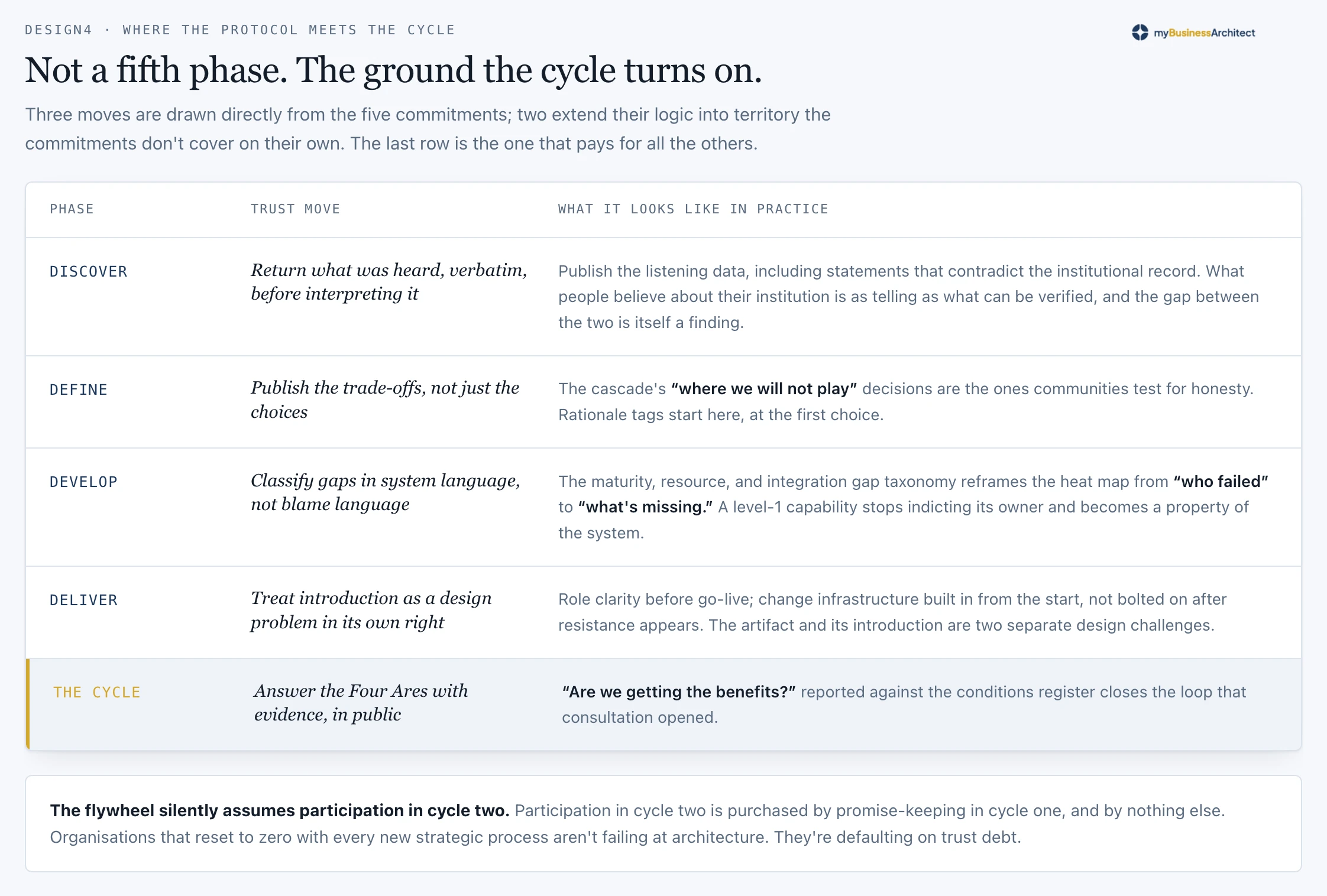
The last row is the one that pays for all the others. The Design4 flywheel (each cycle faster than the last) silently assumes participation in cycle two. Participation in cycle two is purchased by promise-keeping in cycle one, and by nothing else. Organisations that reset to zero with every new strategic process aren't failing at architecture. They're defaulting on Trust Debt.
Two Institutions, Two Endings
The anti-pattern, at full scale
In 2021, Laurentian University became the first Canadian public university to seek creditor protection under the CCAA, an insolvency statute built for corporations. The process was steered by external financial advisors. A third of academic programs were eliminated and 195 faculty and staff terminated, through court process rather than collegial process. The stated diagnosis was faculty costs.
Ontario's Auditor General subsequently found the stated diagnosis was wrong. Faculty salaries were below comparable universities, and academic programs had contributed positively; the actual driver was debt-financed capital expansion that had never been honestly surfaced to the community. Rationale Collapse, at institutional scale, under court seal.
The bill came to $30.1 million in restructuring fees, a federal legislative amendment barring public institutions from ever using the CCAA route again, and a trust crater so deep that every structural conversation in the province's higher education sector now happens inside it.
Then came the payback arc: Trust Debt can be paid down, just slowly and only in public. A successor administration implemented more than 80% of the Auditor General's recommendations and, five years on, the president is running an institution-wide listening tour, publishing what was heard. Enrolment is recovering. The rebuild is, in effect, an unnamed trust protocol: joint process, published findings, visible accounts. What it cannot recover is the five years. The same term, the same pattern, shows up again in a different institution entirely: the Phoenix payroll system's collapse gets the same diagnosis in the Benefits Realization pillar.
The pattern, emerging on its own
A specialised university (anonymised here, but real, and recent) facing the same sector pressures took a different route. It commissioned genuine design-research consultation on its academic structures. The community produced not just grievances but conditions: dozens of specific "what would have to be true" statements, with trust named explicitly as the ground condition under all of them.
The provost's response is the closest thing to the protocol appearing in the wild, one commitment at a time. The process slowed down rather than accelerating toward a predetermined structure. The two pressures (financial, structural-pedagogical) were named separately, with a commitment to tag every future proposal with its driver. The provost committed to program-level cost transparency, naming the confidentiality boundary rather than hiding it. And before any decision reaches governance, the provost commits to a visible account of what was heard and what it changed.
No architecture has been designed yet at that institution. But the conditions for architecture to survive have been. That is the point. The market is discovering the protocol on its own, from the demand side. Practitioners who arrive with it already in hand will recognise the moment; practitioners who arrive with only a heat map will become its next cautionary tale.
(Readers of the Lakeshore Polytechnic narrative will recognise the connective tissue: the forty-seven-ideas room was also a low-trust room. The purpose filter worked because it was built jointly. That was the protocol, before we named it.)
The Cost Objection, Inverted
The instinct is that all of this slows the work down. It does: in the first cycle, by weeks. The Strategic Planning pillar calls shared governance a structural brake on planning; this protocol is the constructive answer to that brake, not a way around it.
Now price the alternative. The schedule risk of proceeding without the protocol is not a few weeks. It is unbounded: a grievance, a senate revolt, a failed ratification vote, a vote of non-confidence, a leadership exit, a unionised workforce that complies precisely and enthusiastically with nothing. Laurentian's fast-looking route took longer than any consultation would have, cost $30.1 million in fees, and destroyed in six months what has taken five years to partially rebuild.
The protocol converts an unbounded political risk into a bounded process cost. Any practitioner who has ever traded a known, fixed cost against an unknown, unlimited one knows which side of that trade to be on. Slow is smooth. Smooth is fast. That's not soft skills. That's architecture.
Frequently Asked Questions
Isn't this just change management?
The best change management already tries to do this: co-design, participatory methods, genuine listening. The protocol's difference is that it makes co-design auditable rather than assumed. Change management, even done well, moves people toward a decision; the protocol changes how the decision itself gets made and evidenced, so every commitment produces an artifact a sceptic can check, not just a process a facilitator can vouch for. The ledger is closer to an audit trail than a newsletter. It's governance, not communication; that's why it belongs to the architect, not the comms team.
What if leadership won't share financial data?
Then that's your first finding, and it precedes every other finding. Share what can be shared; name what can't and why. A named boundary builds trust; a silent one destroys it. If nothing can be named, the engagement isn't ready, and no artifact will save it.
Doesn't the open model invite endless relitigation?
The conditions register cuts both ways. It binds the institution to test options against the community's conditions; it also binds the community to accept that scoring as the shared basis for debate. Objections must name a condition or propose one. That's not an invitation to relitigate. It's the discipline the strategy needed anyway.
We're mid-crisis. There's no time for this.
The protocol is what speed looks like in a low-trust environment. The Laurentian route (the fast-looking one) took longer, cost $30.1 million in fees, triggered federal legislation, and the institution spent the next five years rebuilding what six months of process destroyed.
Does this apply outside shared governance?
Yes, though the ratifier case above is where the mechanism is sharpest: a body with formal veto power, deciding in public. Outside shared governance, the same shape shows up wherever the workforce can effectively veto execution even without a formal vote. In a hospital redesigning patient flow, nurses simply continue routing the way they always have. In a federal department, program delivery staff work around every policy that ignores what they know about clients. In a professional partnership restructuring its equity model, senior partners quietly tank the new structure by not directing work to it. In each case, the architecture needed the people it described in order to become real; the people had the power to make it theoretical instead.
The test is simple: if your architecture needs the people it describes in order to become real, they are ratifiers, and the protocol applies.
What if we run the protocol and the community still says no?
Then you've learned the true state of the organisation earlier and more cheaply than any failed implementation would have taught it. The ledger records an honest impasse. An honest impasse between what the community requires and what the institution can offer is not a process failure; it's a Discover finding about purpose. The cycle turns.
The Practitioners Who Do This Work
The practitioners who carry the protocol don't become better facilitators. They become the people whose architecture survives contact with the organisation it describes.
There is a version of this discipline that treats the community as an obstacle to route around: better messaging, tighter rooms, fewer drafts in circulation. It fails, predictably, and it deserves to. The version that works starts from the structural fact everything above has been circling: in ratifier environments, the community's trust is not a nice-to-have on top of the architecture. It is a component of the architecture, with the same standing as the capability map or the cost model. It can be assessed. It can be designed. It compounds when maintained and defaults when ignored.
Structural interventions cannot take hold in soil that has not been examined. You already know whether yours has been.
Understanding the protocol is not the same as running it. The moment in a real engagement when the accountability ledger surfaces genuine incompatibility between what the community requires and what the institution can offer (and you need to hold that finding without flinching) is what the courses below prepare you for.
Continue Learning
Pillar pages
- Strategy to Execution: How to Close the Gap: where the chain breaks, and the Political Reality the Trust Protocol extends
- Business Architecture Framework: The Design4 Approach: the cycle the protocol runs beneath
- Why Strategic Planning Is Structurally Obsolete: shared governance as structural brake; the Trust Protocol is its constructive answer
- Building a Higher Education Data Architecture That Actually Works: the evidence layer the open model depends on
Courses
- Communicating Business Architecture: audience-first translation for the rooms the Trust Protocol describes
- Closing the Strategy-Execution Gap: the Lakeshore Polytechnic narrative, where the protocol runs unnamed
Resources