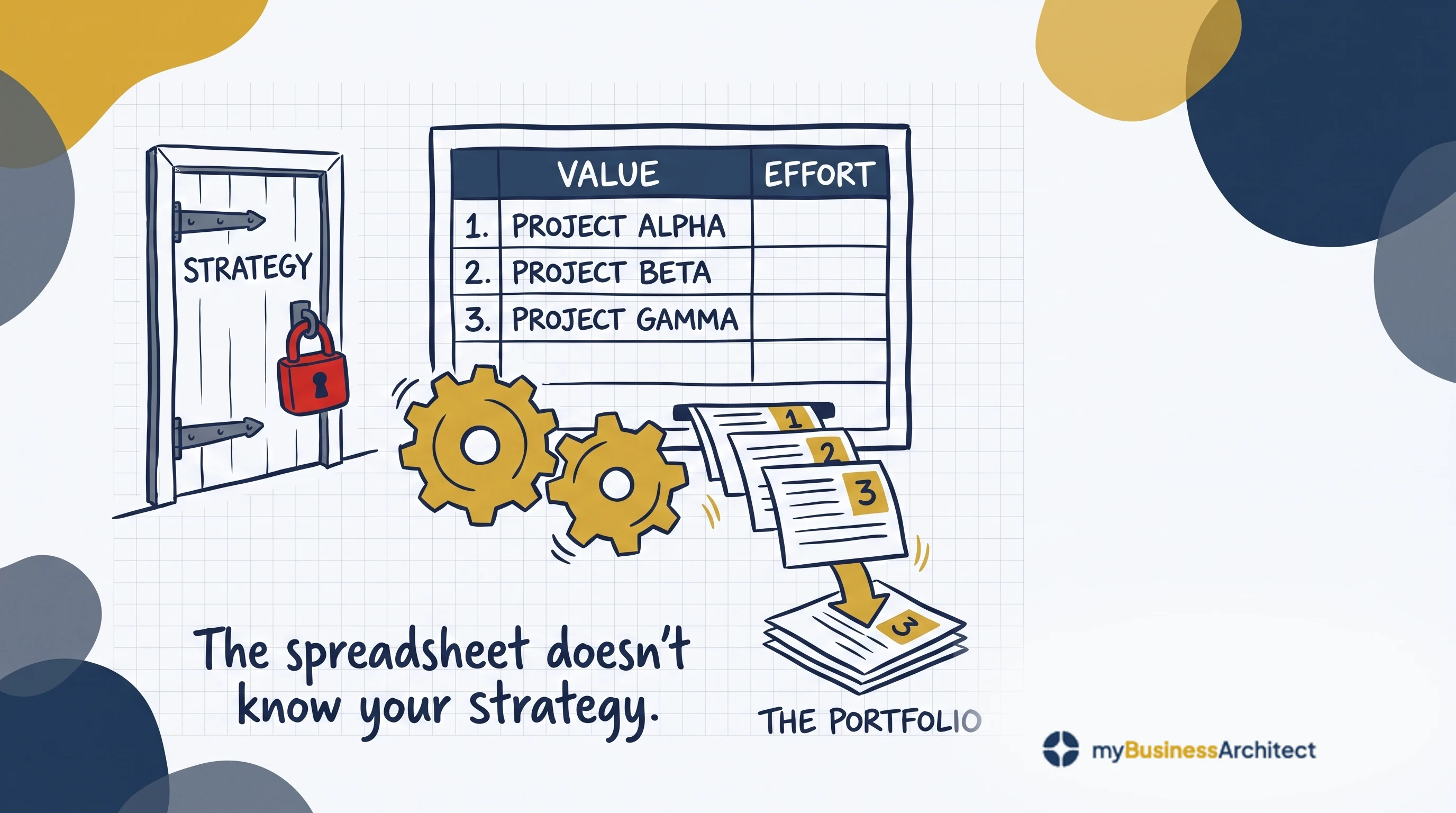
You have seen the spreadsheet. Every proposed project scored on value and effort, sorted into a single ranked list, and a line drawn horizontally across the middle. Everything above the line is funded for the year. It is disciplined, it is defensible, and the room approves it through, because objecting to a ranked list feels like objecting to arithmetic.
Then two years pass. Almost every project ships close to time and budget, the status reports stay green from end to end, and the strategy is exactly where it started.
That is not a failure of delivery. The projects were delivered. It is a failure of what the portfolio was pointed at, and it is structural, not a lapse of effort or discipline. The scoring was rigorous. That is the uncomfortable part. You did the disciplined thing, and the disciplined thing handed your strategy to a spreadsheet that has never read it.
Here is the short version. Your project portfolio is your real strategy: the funded, sequenced list of what you are actually building is where strategic choice happens, because it is where the money and the people go. Most project prioritization frameworks rank that list on value over effort, estimated payoff against estimated cost. That is a fair way to size a project. It is not what a strategy is made of. A strategy is a set of choices about which capabilities will let you win, and a value-over-effort score is blind to every one of them.
None of which is news to anyone who does capability-based planning. Most of these organisations have a capability model. Some have a good one: mapped to value streams, maintained, presented at the annual planning session. And it still loses, because the capability model and the funding decision meet in different rooms, at different moments, in different formats. The model is a reference artifact. The scored list is a decision artifact. When only one of them has a line drawn against it, only one of them is the strategy.
So the argument here is not that capabilities matter. You have been making that argument for years. It is that capability contribution has to be the ranking criterion itself, sitting in the column the funding line is drawn against, not folded in as an input to the value score and not applied afterward as a lens to explain the portfolio you already have.
Rank the list on how far each initiative moves a capability your strategy depends on, and the portfolio starts to look like the strategy again.
A Five-Question Portfolio Check
Run this on your current portfolio in about ten minutes. Each "no" is a symptom of Portfolio Theatre.
- Can you name the handful of capabilities your strategy has to build, and point to where each one is scored in your prioritization?
- For your top few funded initiatives, can you say which capability each one moves, and roughly how much?
- Is your largest, most foundational capability investment near the top of the list, or near the bottom, deferred again?
- Are the value and effort estimates you rank on checked against what similar past initiatives actually cost and delivered, or taken on trust from the sponsor's business case?
- When you review the portfolio, do you ask whether the target capabilities are maturing, or only whether the projects are green?
Two or more "no" answers, and your portfolio is being ranked on value and effort, not on capability contribution. The fix is not a new tool or a reorganisation; it is a change to the one question your ranking asks. Make that change and you stop being the person who administers the scoring model and become the one who takes the strategic choice back from the spreadsheet, and hands the organisation a portfolio that is, once again, its strategy.
Take the full diagnostic: Find Your Gap: 4-minute assessment →
What project prioritization is, and why most of it is theatre
Project prioritization is the act of deciding which initiatives to fund, in what order, given more demand than capacity. That is a strategic decision. In practice it is delegated to a scoring model, and the scoring model asks the wrong question.
Watch what almost every model computes. It rates each project on the value it will produce and the effort it will cost, then ranks by some form of value over effort. That answers "which projects give the most bang for the buck?" It never answers "which capabilities does our strategy actually need, and does this build one of them?" So the portfolio optimises the parts and drifts from the whole. Every project can be individually worth doing while the set of them adds up to no strategic movement at all.
There is a name for the pattern this belongs to. OKR Theatre, Measurement Theatre, and Maturity Theatre are the same failure in different costumes: rigorous apparatus, missing anchor. This is the fourth. Call it Portfolio Theatre: the stage-gates, the scoring, the steering committee, all performed with real discipline, over a portfolio that has quietly come loose from the strategic choices it exists to enact. The tell is the one you have already seen: everything green, nothing moved.
The standard project prioritization frameworks, and where they break
The common frameworks are not wrong. Each is good at something, and you should keep using them for what they are good at. The problem is what they are all silent on.
| Framework | What it is good at | The blind spot |
|---|---|---|
| Value vs Effort (2×2 matrix) | Fast triage; surfacing obvious quick wins and money pits | Ranks projects in isolation; no line of sight to strategy or capability |
| RICE (reach, impact, confidence, effort) | Disciplined estimate of a single initiative's payoff | Reach and impact are feature-level; nothing ties to a target capability |
| MoSCoW (must / should / could / won't) | Scoping one release against a deadline | "Must" is asserted, not derived from strategic choice |
| Eisenhower (urgent / important) | Personal and team triage of tasks | Importance is undefined; it imports no strategy |
| WSJF (weighted shortest job first) | Sequencing a backlog against scarce capacity | Cost of delay is a benefit measure; it orders work, it does not choose the right work |
| Weighted scoring models | Making criteria and trade-offs explicit | Only as good as the criteria, which almost never include capability contribution |
Notice the shape they share. Strip any of them down and you find a benefit term over a cost term. That is the whole engine. It is genuinely useful for sequencing a set of already-right things against capacity. It is useless for deciding whether they are the right things, because neither term knows anything about your strategy.
WSJF is perhaps the most sophisticated of them. Weighted shortest job first is the correct rule when you already know the work is worth doing and you are ordering it against limited capacity: do the high-value, low-cost, time-sensitive work first. Keep it for that. It simply operates one layer too late. It sequences the portfolio; it does not select it.
Why the value-versus-effort matrix quietly misallocates the portfolio
The 2×2 is the default, so it is worth seeing its failure mode in detail, because it is not obvious. It looks like the most rational thing in the room.
It systematically favours small work. Value over effort rewards a high numerator and a low denominator, so a modest improvement that is cheap and quick out-scores a foundational capability that is valuable but large. Quick wins float to the top; the big, enabling investments the strategy actually depends on sink to the bottom, deferred another year, every year. This is the exploitation bias James March named: predictable, short-payback optimisation crowds out the exploratory, long-horizon work that changes what the organisation can do.

Its inputs are not trustworthy. Bent Flyvbjerg's study of thousands of large initiatives found an "Iron Law": over budget, over time, under benefits, over and over again. Two mechanisms drive it. Optimism bias makes sponsors sincerely underestimate cost and overestimate benefit. Strategic misrepresentation makes them do it deliberately, because in a competition for a fixed budget the project with the rosiest business case wins. So the value and effort numbers you are ranking are the most gamed numbers in the building. A framework that trusts them ranks fiction.
It measures the wrong end afterward, too. When these projects deliver, success is judged on the Iron Triangle: on time, on budget, in scope. Flyvbjerg's data is brutal here: about 0.5% of projects hit all three and deliver the benefit they promised. A further 8.5% or so hit time and budget alone and still get logged as governance wins, the benefit unaccounted for. Most projects clear neither bar. The value-versus-effort portfolio measures Deliver and calls it strategy.
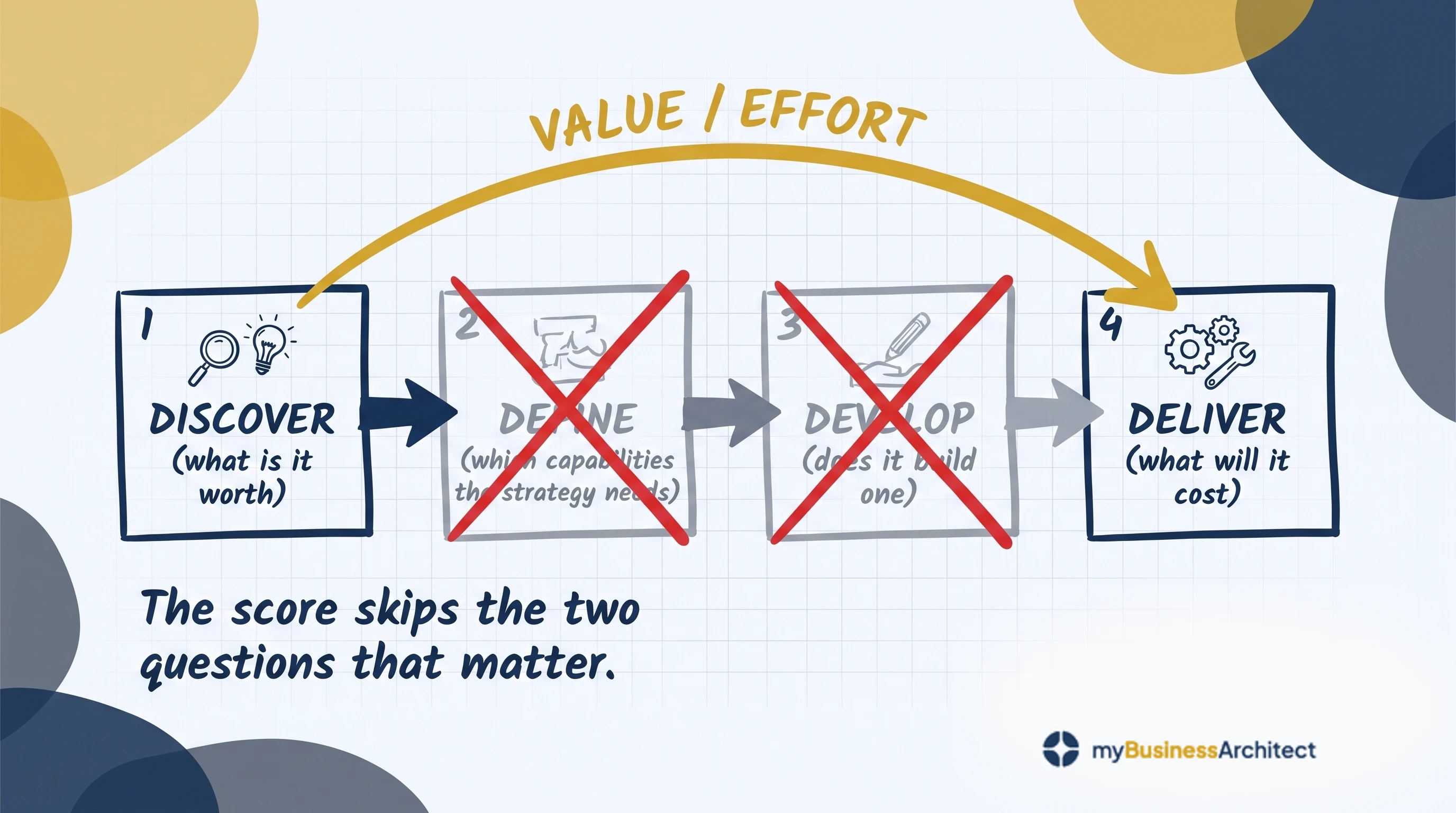
That last point is the giveaway, and it connects this to a bigger pattern. Rank on value over effort and you jump straight from "what is it worth?" to "what will it cost?", skipping the two questions in between: what are we choosing to compete on, and what capability does that choice require? Those two skipped questions are the strategic core of the Design4 cycle, its Define and Develop phases, and leaving them out is the Missing Middle: the same structural gap that makes OKRs fail, showing up one layer down in the investment decision. The instruments keep skipping the same phase.
A better unit of analysis: capability contribution
Here is the shift. Stop ranking projects by their standalone value. Start ranking them by how much they build a capability your strategy depends on.
A capability is what your organisation can do, independent of any project or org chart: underwrite a loan, resolve a complaint, onboard a student, get a subsidy to a family. Strategy, when it is real, is a bet that a particular set of capabilities will let you win, and an honest account of which of those you do not yet have. A useful way to see it: the capability map is the business "at rest," and the portfolio is the business "in motion." The portfolio's whole job is to move the organisation from the capabilities it has to the capabilities its strategy needs.
Which gives you the missing prioritization question. Not "how valuable is this project?" but "which capability gap does this close, and how much does it close it?" This is capability-based planning, and it is not a new or fringe idea; it exists in the enterprise-architecture literature and in BIZBOK. It is simply almost never how portfolios are actually scored. The value-versus-effort model asks about the project. Capability contribution asks about the strategy the project is supposed to serve.
The difference is not academic. It flips which projects rise. An initiative can be low value-density and still be the single most important thing in the portfolio, because it is the capability everything else depends on. And a high value-density quick win can be a distraction, because it moves a capability the strategy does not care about.
The capability-contribution prioritization framework, step by step
This is the reusable method, in five steps. It doesn't replace your value-versus-effort scoring nor your delivery gates; it puts the strategic choice back above them.
- Map each initiative to the capabilities it changes. For every candidate, name the one or two capabilities it actually moves. If an initiative cannot be tied to a capability, that is a finding: it is a want, not a strategic investment, and it should compete in a different, smaller pool.
- Weight the capabilities by strategic contribution, drawn from the strategic choice. The weights are not a fresh opinion formed in the prioritization meeting. They come straight from the Where to Play and How to Win choices, which name the handful of capabilities the organisation must do better than its rivals to win where it has chosen to compete. Weight those highest, scored against the gap between current and target maturity on each. A capability that cannot be traced to the strategic choice gets no weight. These weights are the strategy made explicit, set once a cycle by the people who own the strategy, not by the project sponsors.
- Score contribution, not just value and effort. For each initiative, score how far it closes a weighted capability gap. Keep value and effort in the model, but as inputs to sequencing, not as the ranking itself. The ranking is led by capability contribution.
- Sequence for capability build-up, and respect dependencies as hard constraints. Now bring value, effort, and capacity back in to order the work, using something like WSJF within the ranking. But dependencies override the score: if the customer portal needs the data foundation, the foundation is sequenced first no matter how its value-density scores. Enablers get pulled forward by the dependency graph, not left to float on density.
- Govern the portfolio against capability targets. Review progress by asking whether the target capabilities are actually maturing, not whether projects are green. That is the benefits realization question, asked at the portfolio level: are we getting the capability, and is the capability producing the outcome?
A one-page scoring template captures steps 1 to 3; a spreadsheet that scores capability contribution alongside value and effort is enough to change the conversation in the room.
Worked example: the same portfolio, ranked two ways
Take a mid-size public-service organisation whose strategy is to become digital-first. Its Where to Play and How to Win choices weight two capabilities: trusted core data (weight 5, the foundation) and customer self-service (weight 4). Everything else weights zero. Contribution is the capability weight times how far the initiative closes that capability's gap. Here are five initiatives, scored both ways.
| Initiative | Value | Effort | Value ÷ effort (rank) | Capability it moves | Contribution = weight × gap closed (rank) |
|---|---|---|---|---|---|
| Team productivity dashboard (one unit) | 4 | 1 | 4.0 (1) | none on the strategy | 0 (5) |
| Invoice automation (back office) | 3 | 2 | 1.5 (2) | none on the strategy | 0 (4) |
| Public website refresh | 3 | 3 | 1.0 (3) | self-service, partially | 4 × 0.25 = 1.0 (3) |
| Customer self-service portal | 5 | 6 | 0.83 (4) | self-service | 4 × 0.75 = 3.0 (2) |
| Core data integration platform | 4 | 8 | 0.5 (5) | trusted core data (enables the portal) | 5 × 0.9 = 4.5 (1) |
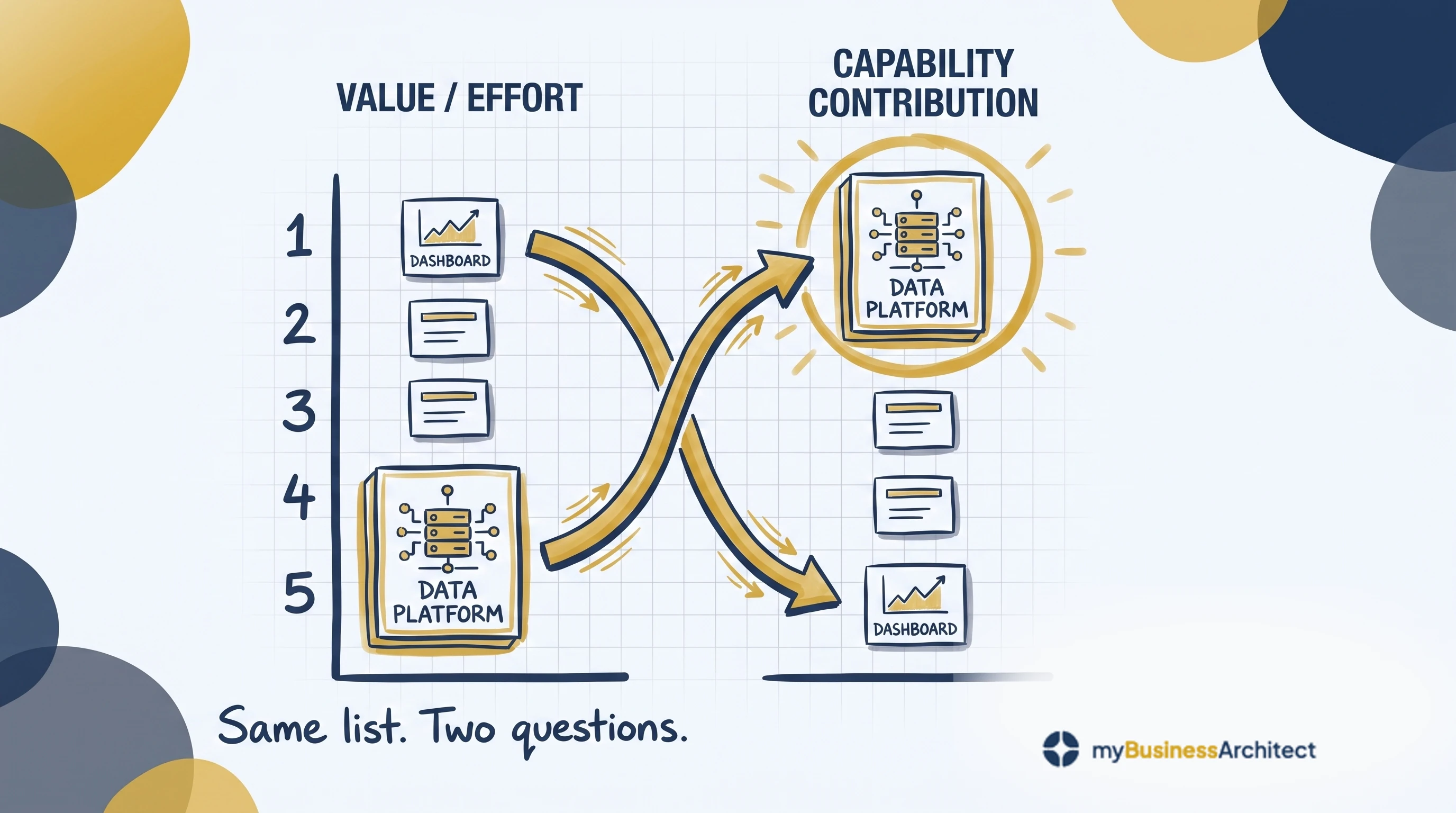
Look at what flips. Under value over effort, the data platform ranks last, being big, slow, and low-density, so it is deferred another year. The dashboard ranks first, being small, cheap, and visible. Fund the top of that list and you spend the year on a dashboard and some automation, both of which move no capability the strategy named, while the foundation the whole digital-first strategy rests on waits. Every choice is locally rational. The portfolio is Portfolio Theatre.
Under capability contribution, the data platform ranks first, because it closes the foundational gap and, by the dependency rule, must precede the self-service portal that ranks second. The dashboard and the automation fall to the bottom, correctly: they are fine, cheap improvements that the strategy does not need this year. Same initiatives, same facts: the foundation and the dashboard trade ends of the list. The only thing that changed is the question the ranking asked.
One honest caveat. Capability contribution is only as good as the strategic choice it inherits. If the Where to Play and How to Win are wrong, this framework will build the wrong capabilities faster and more coherently than value-versus-effort ever could. It does not rescue a bad strategy; it makes a real one executable. That is exactly why step two carries the most weight: the capability weights are the strategy, so they deserve the hardest scrutiny in the room.
How this fits strategic portfolio management
Zoom out and this is the heart of strategic portfolio management: the discipline of making the portfolio the operational form of the strategy. Two clarifications matter, because the market is noisy here.
Capability-based prioritization is not the same as tool-led "strategic portfolio management." The category is dominated by platforms that give you dashboards, gates, and roadmaps. Those manage the portfolio; they do not tell you what belongs in it. The selection logic is the part no tool ships, because it comes from your strategy and your capability map, not from software.
It also completes, rather than competes with, Lean Portfolio Management. LPM is the strongest modern answer, and it fixes two real problems: it funds persistent value streams instead of temporary projects, and it plans on a rolling cadence instead of a rigid annual lock. Keep both moves; they are right. But notice what LPM leaves open. Once you fund value streams and flow work to them, you still have to decide which value streams and which epics deserve the capacity, and against what. LPM does prioritise here; it ranks epics by weighted cost of delay against its Strategic Themes. But that is the value-over-effort axis again, one level up. What it does not supply is the capability logic that says which themes and epics actually build the strategy. That is the capability-contribution decision. Run it inside LPM, or inside a traditional stage-gate; it is agnostic to the plumbing.
The through-line is the one from the top. Prioritization is a strategic choice. The moment you let it become a value-over-effort calculation, you have outsourced your strategy to a spreadsheet that does not know what your strategy is.
Frequently Asked Questions
What is a project prioritization framework?
A method for deciding which projects to fund and in what order when demand exceeds capacity. Most frameworks (value vs effort, RICE, MoSCoW, WSJF, weighted scoring) rank initiatives by a benefit estimate over a cost estimate. That is useful for sequencing work you have already decided is worth doing, but it does not decide whether the work is strategically right, because neither term reflects your strategy.
What is the best way to prioritize projects?
Rank by capability contribution: how much each initiative closes a gap in a capability your strategy depends on, with capability gaps weighted by strategic importance. Keep value and effort in the model to sequence the work against capacity, but let capability contribution lead the ranking, and treat dependencies as hard constraints so foundational enablers are sequenced first.
What are the four quadrants of prioritization, and why are they not enough?
The value-versus-effort matrix sorts projects into quick wins (high value, low effort), big bets (high value, high effort), fill-ins (low value, low effort), and money pits (low value, high effort). It is a fast triage, but it ranks projects in isolation and favours small, cheap work, so it systematically defers the large foundational capabilities a strategy needs. It has no line of sight to strategy.
How is capability-based prioritization different from a scoring model?
It is a scoring model, but with a different spine, not just a "strategic alignment" column added beside reach and confidence. A standard model scores the project's value and cost and, at best, bolts on an alignment rating that competes with the other columns. Capability contribution leads the whole ranking: contribution to a weighted capability gap drawn from the strategy comes first, and value and effort drop to inputs for sequencing beneath it. The criteria come from what the organisation must be able to do, not from the project's own business case.
What is the difference between strategic portfolio management and project portfolio management?
Project portfolio management governs the selection, funding, and delivery of projects. Strategic portfolio management is the wider discipline of keeping that portfolio aligned to strategy over time, through capability targets, value streams, and rolling reprioritization. The distinction only matters if the alignment is real; a strategically-labelled portfolio still prioritized on value versus effort is just project portfolio management with a better name.
Continue Learning
Pillar pages
- OKRs Are Not a Strategy: the same Missing Middle one layer up, in goal-setting rather than investment
- Capability Maturity: how to read the capability gaps that drive this prioritization
- The Design4 framework: the four-phase cycle, and why prioritization is the Define decision
- The Service Operating Model: capabilities and value streams as the currency of the portfolio
- Strategy to Execution: the four points where the chain from strategy to outcomes breaks; project prioritization is one of them
Blogs
- Prioritize by Capability, Not by Project: the core fix, ranking initiatives by the capability gap they close
- WSJF Is Benefit Over Effort, and Both Are the Wrong Half: why the popular scores sequence the work but never select it
- The Quick-Win Trap: how value-density starves the foundation, and the capacity buckets that stop it
- Your Steering Committee Is a Symptom: portfolio governance, and the missing criterion politics rushes in to fill
- Gate 0: Admit Work Without Committing to It: a front door that admits demand for assessment without committing capacity
- Emergencies Are Not Exceptions: designing the fast lane with the displacement rule
- The Phase Every Management System Skips: OKR, Measurement, and Maturity Theatre, and now Portfolio Theatre, as one failure in several costumes
Resources
- Capability-Contribution Scoring Template: the free one-page template for steps 1 to 3
Courses
- Closing the Strategy-Execution Gap: the full chain from strategic choice to capability to the portfolio that builds it