You've been handed four different systems in the last decade, and each one arrived as the answer.
OKRs, to finally connect strategy to execution. A benefits register, to prove the transformation was worth the money. A capability maturity assessment, to know where to invest next. A project prioritization scoring model, to fund the right work when demand outstrips capacity. Each was rigorous. Each was adopted with genuine discipline, a steering group, a cadence, a dashboard. And each produced the same strange result: a great deal of well-governed activity that never quite added up to the thing it was supposed to deliver.
That isn't four separate disappointments. It's one, wearing four costumes.
They fail in the same place
These look like unrelated tools for unrelated problems: goal-setting, value measurement, capability planning. Line them up against the same frame, though, and they break at the identical point.
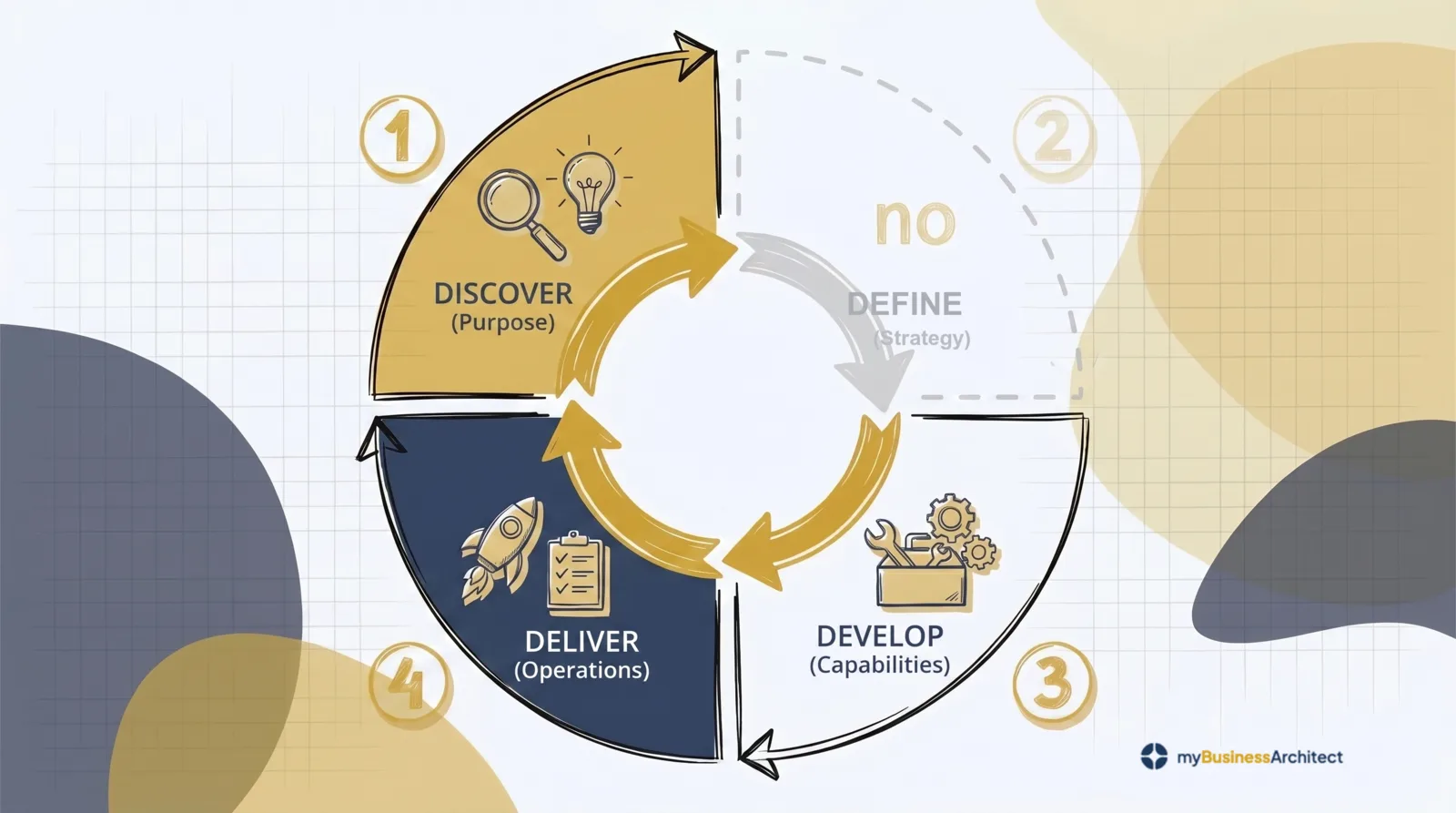
The frame is business architecture, which describes the work of connecting intent to operations as four phases. Discover asks who the organisation serves and whether they're actually better off. Define is the strategic choice: where the organisation will compete, how it will win, and what it will refuse to do. Develop builds the capabilities those choices require. Deliver gets the result to the people it was for. The four turn as a cycle, and a break in any one of them shows up as effort that doesn't land.
Now watch where each of the four famous instruments sits.
OKRs wire an Objective straight to a set of Key Results. The Objective is an aspiration, close to purpose; the Key Results are operational tracking. What sits between them, the Missing Middle, is simply absent. There's nothing that says this is the ground we chose to win on, so any objective that sounds ambitious qualifies, down to a task list with a headline. That gap has a name: OKR Theatre.
Benefits realization defines the benefits a program will deliver and tracks them with real rigour, but it tends to define them at the delivery layer, where they're easy to measure, and never grounds them in the purpose or the strategic choices the program was meant to serve. The tracking is immaculate. The board asks what value was delivered and the answer is a progress report. That's Measurement Theatre.
Capability maturity scores every capability on a ladder and builds a roadmap to climb it, toward target levels that no strategic choice ever set. Everything to Level 3 in three years. The apparatus is flawless and the ladder leans against no particular wall. Maturity Theatre.
Project prioritization ranks the portfolio on value over effort, a project's estimated payoff against its estimated cost, and calls the ranked list a strategy. Both terms are generic: value and effort could describe any initiative in any organisation pursuing any strategy at all, which is exactly the tell. That's Portfolio Theatre. There is a fifth in the family, Purpose Theatre, a purpose statement everyone approved that cannot reject anything. It fails one phase earlier, at Discover, which is why it isn't in this line-up: the four here all skip Define.
Line them up and the coverage is almost complete, except for the one that never shows up at all. OKRs work the two ends, Discover and Deliver, and skip the Missing Middle. Benefits tracking and maturity models reach further in, as far as Develop, and still stop short of the same place. Project prioritization doesn't reach even that far: value and effort aren't phase-specific, so a value-over-effort ranking doesn't drift into the wrong phase, it skips the whole four-phase frame and asks a narrower question instead, is this worth doing on its own terms? That's a starker failure than the other three, not a milder one. The one phase none of the four does is Define.
Define is the phase every popular management system skips.
Why it's always Define
This isn't an accident of design. It's the reason these tools got adopted in the first place.
Define is the phase where the organisation has to choose, and choosing is the hardest work there is, because a real choice means saying no to reasonable things and living with what you gave up. The most important word in the whole discipline is no, and it's the one word no instrument will say for you. Software can set an objective, track a benefit, or score a capability. It cannot make your tradeoffs, because it has no stake in them. Every tool that routes around Define is offering the same quiet bargain: the feeling of rigour without the discomfort of choice.
And a system that skips a phase doesn't leave the space empty. It fills it with a default. OKRs default to whatever objectives sound ambitious this quarter. Benefits default to whatever is convenient to count. Maturity defaults to "everything to Level 3." Prioritization defaults to whatever scores best on value over effort, whatever it actually builds. The default always points at motion, because motion is safe and choice is exposed. So all four arrive at the identical signature: rigorous apparatus, missing anchor. Funded, governed, measured, and pointed at nothing in particular.
That's why adding another tool never helps. The problem was never a shortage of instruments. It's that the instruments are built to spare you the one thing that would make them work.
Putting the phase back
The fix isn't another framework. It's the missing phase itself, done deliberately, by someone whose job is to refuse to route around it.
That's what business architecture is for. Not diagrams for their own sake: the discipline that holds an organisation to its strategic choices and connects them, in both directions, to the capabilities and operations that have to honour them. Its practice framework, Design4, is built so that Define cannot be skipped, because every other phase depends on it. The Strategic Choice Cascade is the instrument that does the choosing: where to play, how to win, which capabilities that requires.
Underneath all of it is a single capability, the one that decides: the capacity to make the strategic choices and then hold them while everything downstream tries to erode them. Mature that capability, and your OKRs finally have something to derive from, your benefits have something real to be grounded in, and your maturity targets have a reason to exist. Leave it immature, and you'll keep buying tools that let you leave it immature.
The next framework will arrive the way the last four did: rigorous, disciplined, and quietly engineered to spare you the one decision that matters. You'll know it by what it leaves out.
This is the pattern the Closing the Strategy-Execution Gap course exists to break: it teaches the Define-phase work, the strategic choices and the discipline of holding them, that every popular instrument assumes you've already done.