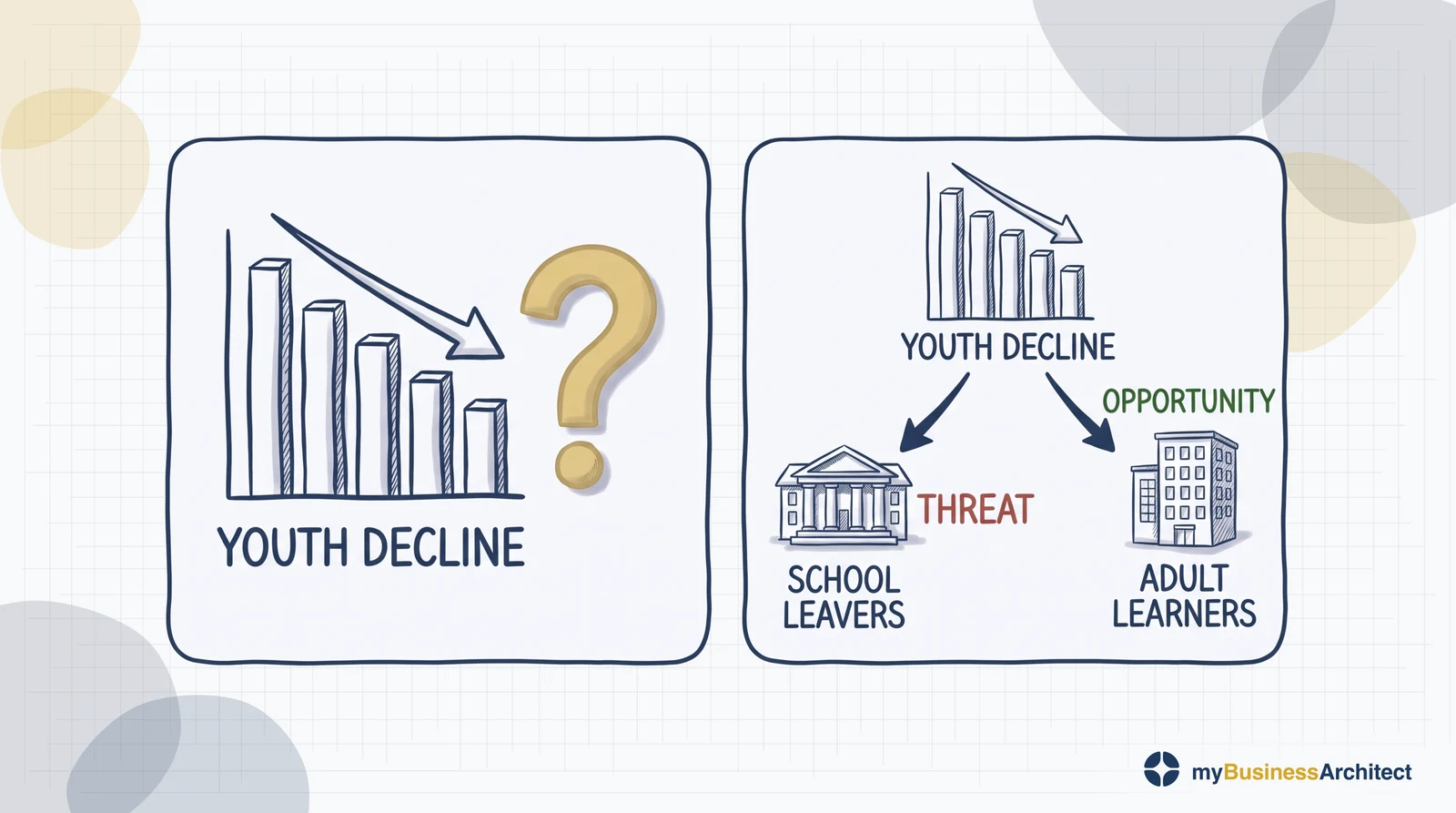
Two institutions in the same province were looking at the same number.
The eighteen-year-old population in their catchment will fall by roughly 20 percent over the next decade. Same demographic projection, same data source, same week.
The first institution correctly read it as the defining threat of its next planning cycle. It recruits school leavers, it competes for them against four other institutions within driving distance, and a fifth of the pool is about to disappear.
The second read it as the clearest opportunity it had seen in years, and it was also right. It serves adult learners returning to work, mostly in their thirties and forties. A smaller youth cohort means employers across the region will be competing harder for exactly the mid-career reskilling it already does well, and paying for it.
It was the same force with the opposite valence. Neither analysis was wrong, and no amount of better environmental scanning would have reconciled them.
A force has no valence of its own
Environmental scanning is the practice of tracking the external forces that could change what an organisation needs to do: demographic, technological, economic, environmental, political and legal. Most scanning practice skips one step, and there is a standard that says so plainly.
The Business Motivation Model, the Object Management Group's specification for how organisations record what motivates them, treats external and internal forces as influencers. Then it asks the question directly: "is an Influencer inherently a Strength or Weakness, is it always a Threat or Opportunity?" Its answer: "That determination comes from an Assessment of the impact of an Influencer on the stated Ends and Means."
Read that again with the two institutions in mind. The demographic decline is not a threat. It becomes one when you relate it to a stated end that depends on school leavers. Relate it to a different end and it becomes an opportunity, with no change to the underlying fact.
Which produces an uncomfortable conclusion for the way scans are usually sequenced. A scan cannot tell you what matters. It has no way to, until you have said what you are trying to be.
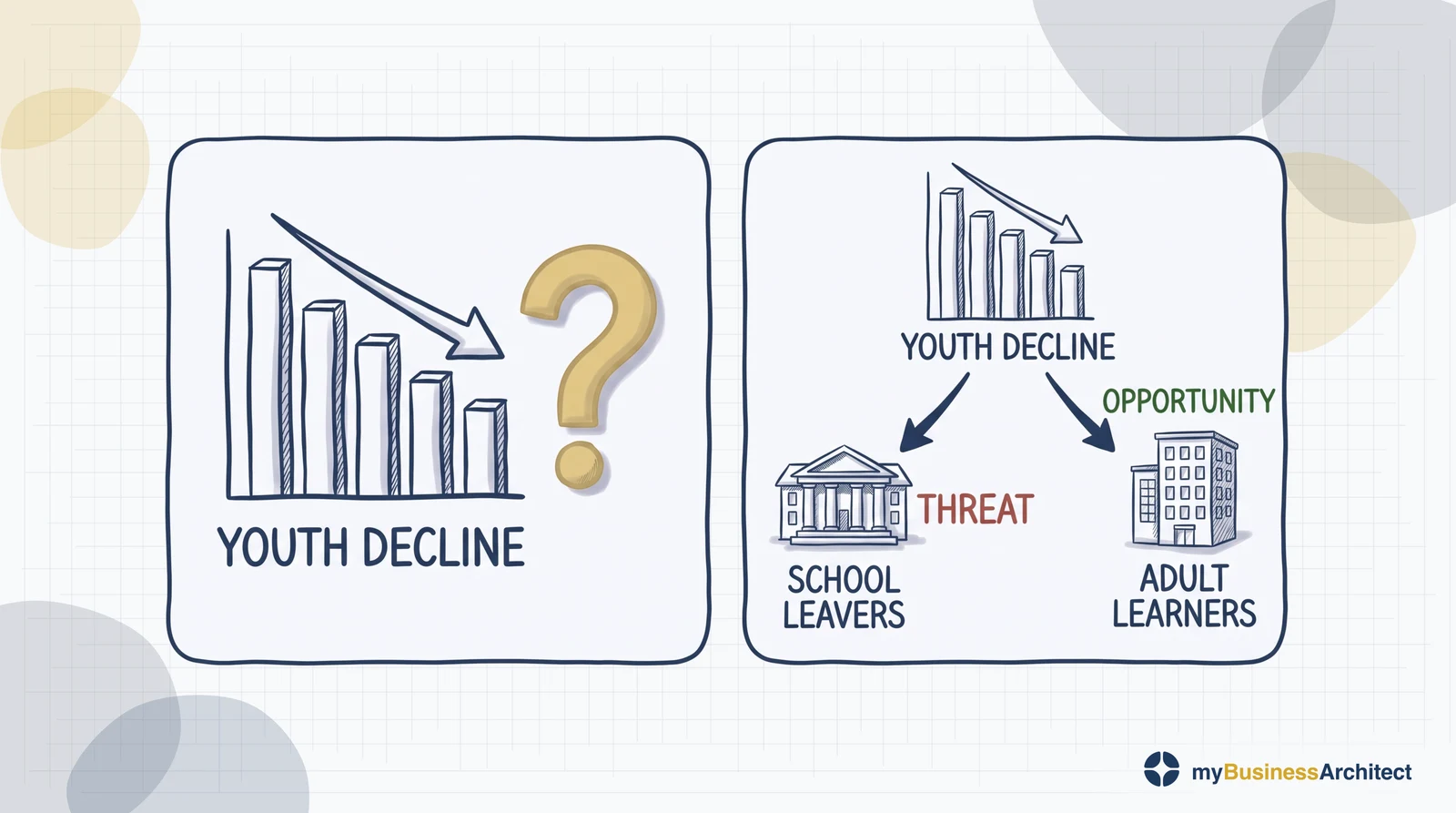
The force is the same object in both panels. What changes is the purpose it is being related to, and that is where the label comes from.
So is PESTLE analysis outdated?
It is a fair question and people ask it often. The honest answer is no, and the framework is not the problem.
The problem is that it is usually run backwards. A scan gets commissioned as an input to strategy, early, before anyone has committed to what the organisation is for. What comes back is a list of forces with no stated end to assess them against, which means nothing in it can be ranked, and nothing that cannot be ranked can be acted on.
That is how you get the artifact everyone recognises: forty trends on a slide, all true, none decisive. The scan was competent. It was just asked to do a job that is impossible in that order.
PESTLE, STEEP, STEEPL, STEEPLE: the acronyms differ by a factor or two and the choice between them matters far less than the sequence they sit in. Run after purpose is stated, a scan becomes a test. Run before it, a scan is a reading list.
What a scan factor has to do to be worth writing down
There are four tests, and most entries on most scans fail at least one.
Specific. "Technology is changing everything" tells you nothing. "Platform-based delivery models are reducing the cost of competitor entry in our segment" tells you what to worry about and where.
Evidence-based. Grounded in data, not in the confidence of whoever raised it at the workshop.
Connected to stakeholder impact. You can trace it to a consequence for someone you serve. If you cannot, you have found an interesting fact rather than a strategic one.
Actionable. The organisation can respond to it, or must account for it in its plans.
Anything that fails these belongs on a whiteboard during brainstorming, not in a synthesis that is about to drive investment decisions.
The six dimensions, briefly
STEEPL, often written STEEPLE with a seventh factor for Ethical, covers the ground in six:
- Social: demographics, workforce trends, public expectations
- Technological: not just new tools, but the expectations they create. When people can track a parcel to the doorstep, they wonder why a benefits claim goes dark for eight weeks
- Economic: funding landscape, cost pressure, what is affordable rather than merely sensible
- Environmental: sustainability requirements and climate exposure, increasingly material rather than reputational
- Political: government priorities, mandate, the cycle
- Legal: compliance, privacy, the boundaries all design sits inside
The most interesting forces do both jobs at once. Digital delivery is an opportunity and a constraint simultaneously, and holding both at the same time is what keeps a scan out of naive optimism at one end and defensive pessimism at the other.
The environmental scanning process: the split that makes it decision-useful
Here is the move that turns a scan from a document into an instrument, and it takes one pass.
Separate the forces you can influence from the ones you cannot.
One institution ran this split during a genuine funding crisis. Visa policy, a tuition freeze and a per-student funding formula among the lowest in the country: three forces, all decisive, none of them theirs to change. The scan did not solve anything. What it did was end the search for a clever way to reverse them.
What remained was the part that was still a choice: which stakeholders to serve, how to serve them, and what to build given the constraints. The constraints set the boundaries. The purpose set the direction inside them.
Skip that split and you get one of two failures. Either the organisation spends its planning cycle charging at forces it cannot move, which is heroic and accomplishes nothing, or it treats every constraint as total and concludes it has no choices left, which is also untrue and considerably more expensive.
On the four modes, and on SWOT
Two questions that come up whenever scanning does.
How much attention should a scan get? Francis Aguilar's 1967 study of how managers scan distinguished four modes: undirected viewing, conditioned viewing, informal search and formal search. Daft and Weick, and later Chun Wei Choo, built on them. The useful point is that they are a resourcing choice rather than a maturity ladder. You do not need a formal search on every dimension. You need one on the dimensions where a shift would break a claim your purpose depends on, and peripheral awareness everywhere else. Which, again, you cannot allocate until the purpose is stated.
Where does SWOT fit? It is downstream, and BMM is explicit that SWOT is the technique that does the assessing rather than the scanning. Internal influencers assessed against your ends become strengths and weaknesses; external ones become opportunities and threats. So a scan produces influencers, and SWOT is where they acquire a sign. Running SWOT without a stated end is the same error one step later: four quadrants filled in by whoever is most confident in the room.
What this comes down to
A scan is not reconnaissance. It is a test.
The two institutions reading the same projection did not need better data, a longer trend list or a more current framework. They needed what they already had: a clear enough statement of what they were for that the same number could be read correctly, and differently, by each of them.
If a scan has ever landed on your desk and left you with more to think about and nothing to decide, that is worth knowing: the reading was probably fine. It arrived in the wrong order.
Purpose is the Discover phase of the Design4 framework, and it is what makes a scan interpretable. Organisational purpose is discovered, not invented sets out how to recover one from evidence and test it before you build on it. Once it is stated, the strategy choice cascade is where the constraints and the direction turn into actual choices.
This post is drawn from Closing the Strategy-Execution Gap, a self-paced course that follows one institution through anchoring in purpose, scanning its environment, and only then making a single strategic choice.