Findings from 28 organisations put to the Receipts Test
Almost everything written about organisational purpose starts from the purpose statement and works forward: how to write one, how to make it inspiring, how to get the leadership team to agree. Nobody checks the statement against the record. This study did. It took 28 organisations across three sectors and four countries. For each one it wrote down what the purpose said and predicted what that purpose should forbid. Then it went to the annual reports, court judgments, inquiries and board minutes, found the costliest decision the organisation had actually made, and asked one question: would the purpose have told them which way to go at the time?
The test has a name in the companion pillar on organisational purpose (https://www.mybusinessarchitect.com/organizational-purpose): the Receipts Test. Name the costliest decision the organisation has made, and ask whether its purpose accounts for it. A decision the purpose accounts for is a receipt. The pillar says what the results mean for how an organisation finds its purpose and holds to it. What follows is the evidence.
Each coded organisation was given one of three verdicts.
- Accounts. The record shows that the decision actually taken is the one the purpose pointed to at the time, and that it was a real decision: something was given up, and someone credible argued for going the other way. That is a receipt. A decision is merely consistent with the purpose, not accounted for by it, when it matches the purpose with nothing given up and nobody opposed.
- Partially accounts. The purpose explains the direction, but the record does not show it decided, or it decided late.
- Does not account. Either the purpose is silent on the decision, or the organisation went against it. That second kind is a breach: the purpose pointed one way and the organisation went the other.
What follows refers to these as the "accounts", "partially" and "does not account" cases, and to breaches of purpose simply as breaches.
Five findings that matter the most
- Most stated purposes could not be shown to account for the organisation's costliest decision. Of the 28 organisations read, 23 were coded in the full study (19 cases and 4 controls) and five in its pilot pass. Nineteen of the 23 had a real, costly decision on the record. The purpose accounted for it in 3, partially in 6, and not at all in 10. For those 10, the purpose was not missing. Eight had written their own, and two had one granted by statute or a governing document. Several had campaigned on it. Six of the ten later admitted, under regulatory or legal compulsion, that they had breached it.
- Specificity does not separate the passes from the failures. A generic purpose passed and a specific one failed. CVS Health's purpose, "Helping people on their path to better health", could be claimed by any pharmacy chain. It accounted cleanly for a decision that cost about $2 billion a year, because the company named the cost first and tied the decision to the purpose at the time. A university's mission spoke of "sustainable social and economic development". It accounted for nothing, because the minutes on closing two departments never mentioned it.
- Four control organisations, chosen for generic purposes alone, produced no receipts at all. None had tied a costly decision to its purpose at the time it was made, which is what CVS did. Three were silent: one, a bank, had a genuinely costly decision on the record and never invoked its purpose for it, and two had no costed, contested decision the devices could grip. The fourth attached its purpose to a decision that cost nothing and that nobody opposed: a receipt only in its own telling.
- When a purpose was breached, someone had usually said so first. Ten organisations had a purpose that did not account for the decision. In nine of them, the record shows a credible voice arguing the other way, and in five that voice was inside the organisation. Those people were overruled, fired, or told to destroy the evidence. The people were present. The purpose could not protect them.
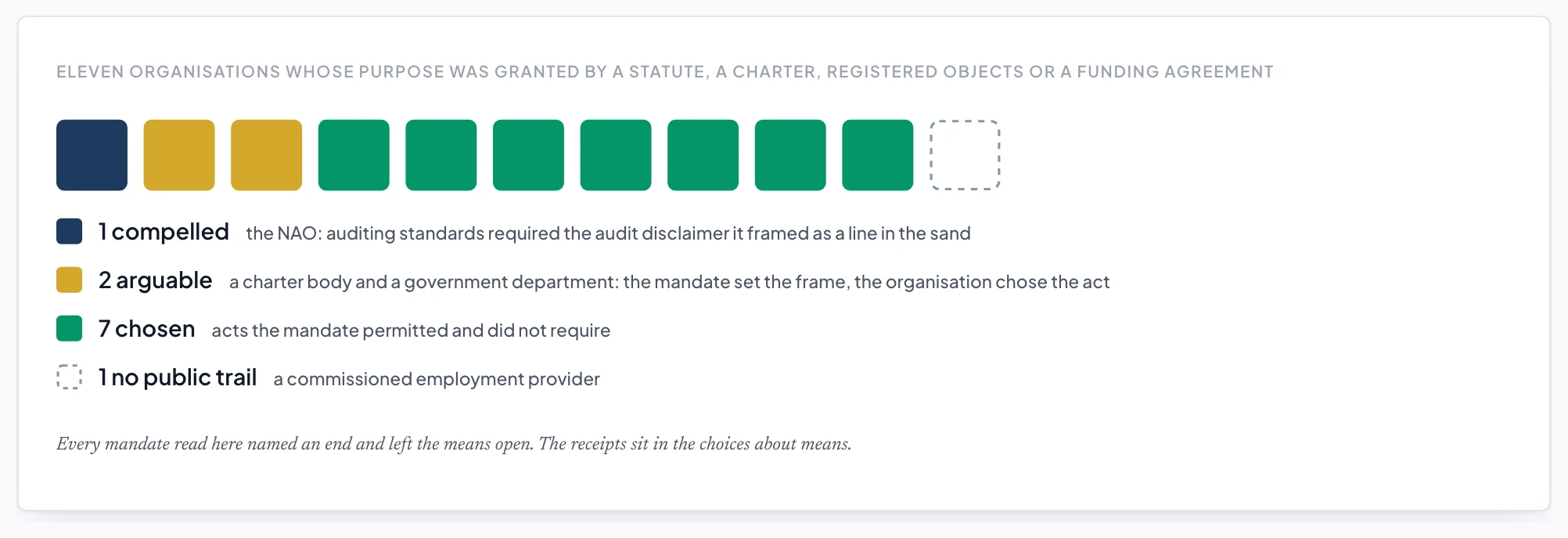
- A mandate does not do the choosing. The study expected that organisations whose purpose was handed to them, by a statute, a charter, registered objects or a funding agreement, would have no receipts to find, because the mandate would have made the costly decisions for them. It had not. Of eleven such organisations, only one had its costly act compelled by the mandate. Seven chose an act the mandate permitted and did not require, two were arguable, and one left no record to read. Mandates name an end and leave the means open, and the choices about means are where a handed-down purpose leaves its receipts. The one place the test cannot work is where the mandate specifies the act itself.
What the purposes accounted for, by sector
Every organisation was assigned in advance to a cell: purpose expected to account, expected not to, or a control. The prediction was made before the decision was searched, for two reasons. It stops the coder from fitting the verdict to the case once the record is open, and the reader can check that here. And filling both expected outcomes in every sector shows the test can return either answer, rather than one it was built to give.
| Cell | Organisations | Accounts | Partially | Does not account |
|---|---|---|---|---|
| Private, expected to account | 3 | 2 | 1 | 0 |
| Private, expected not to account | 3 | 0 | 0 | 3 |
| The deliberately awkward case: Johnson & Johnson's 1982 Tylenol recall | 1 | 0 | 1 | 0 |
| Public, expected to account | 2 of 3 slots filled | 0 | 1 | 1 |
| Public, expected not to account | 4 | 0 | 0 | 4 |
| Nonprofit, expected to account | 3 | 1 | 2 | 0 |
| Nonprofit, expected not to account | 3 | 0 | 1 | 2 |
| Controls: generic purpose, no decision chosen in advance | 4 | 0 | 0 | 3, plus 1 a receipt only in its own telling |
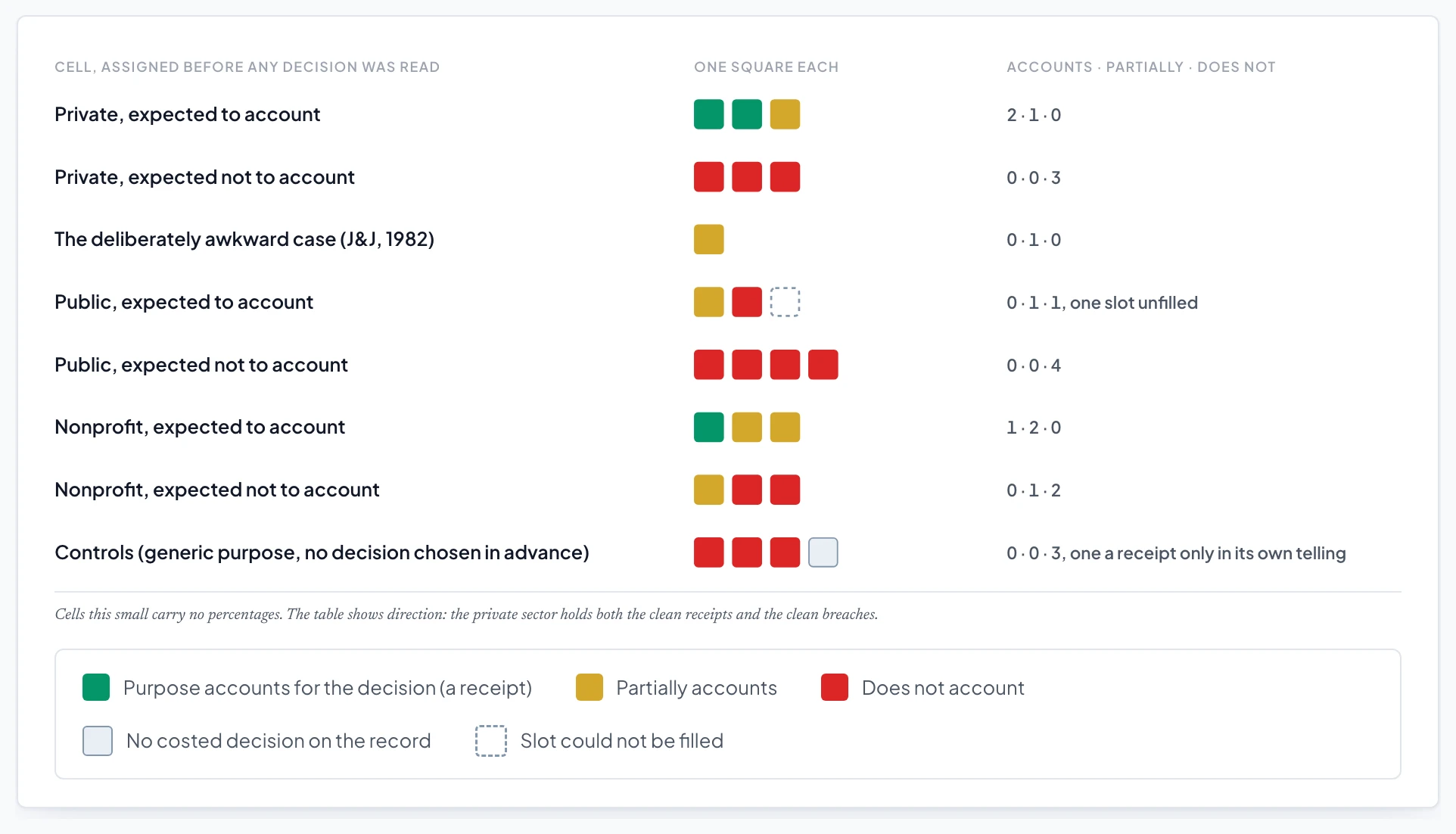
The table shows direction. The private sector produced both the clearest receipts, decisions the purpose plainly accounted for, and the clearest breaches. On the receipt side are CVS Health, which stopped selling tobacco, and Patagonia, which in 2022 transferred its ownership to a trust and a climate-focused collective. On the breach side are Wells Fargo, whose own board concluded that for fourteen years its sales goals had overridden its stated vision, and Volkswagen, which admitted in court to deceiving regulators for nine years while its strategy listed environmental leadership as one of its equal goals. The nonprofit sector produced the most "partially" verdicts, because charities' purpose statements name who they serve but rarely name the trade-offs they will make. A purpose statement like that can explain what the organisation did, but it can't show whether it should have.
The public expected-to-account cell is the study's weak point, and it was predicted to be. One of its three slots could not be filled from the public record, after two searches and a walk through a published index of referred cases. A public body that protects a service beyond what its mandate requires, at a cost, rarely writes that up as a choice. That is a fact about what gets documented, not about public bodies.
Controls against cases: does the Receipts Test discriminate?
The study set one check on itself before coding began. If organisations with generic purpose statements passed the Receipts Test as readily as the case organisations, the Receipts Test would be a Rorschach: a reader would see in any purpose whatever they came looking for. The controls were chosen before any decision was looked at. A separate pool of purpose statements was assembled by rule from the largest UK companies, charities and universities: 21 organisations, of which 19 had a reachable statement to score. That these 19 match the 19 case organisations in number is coincidence; none overlaps. Each statement was scored on one question: could a peer organisation claim it unchanged? Sixteen of the 19 scored fully generic, which is a finding on its own. The four most generic became the controls. Imperial College London's purpose is "To be useful". Nuffield Health's is "to build a healthier nation". HSBC's is "Opening up a world of opportunity". King's College London's is "In service of society through academic excellence".
| Purpose accounts | Partially | Does not account | |
|---|---|---|---|
| 19 case organisations | 3 | 6 | 10 |
| 4 controls | 0 | 0 | 3, and 1 a receipt only in its own telling |
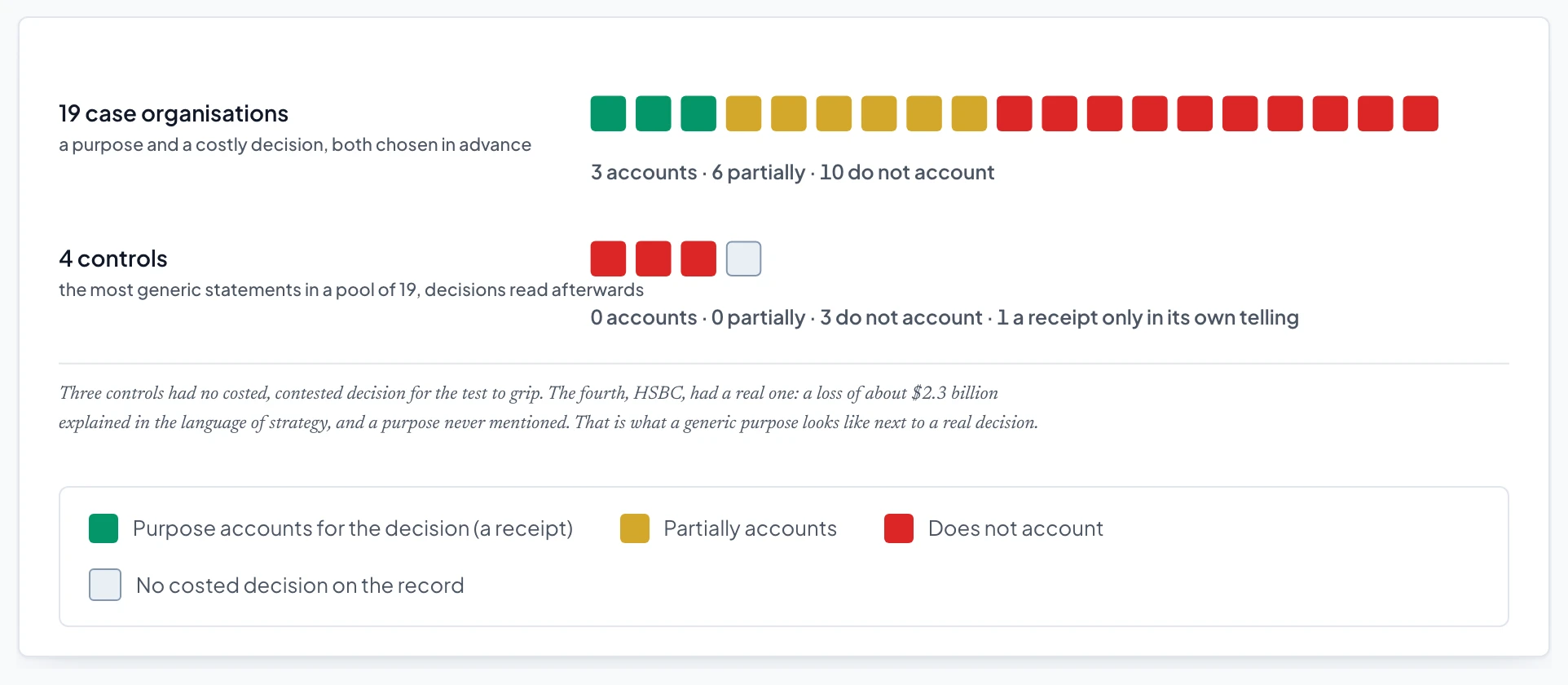
The controls did not pass as readily as the cases. None of the controls produced a receipt, so the Receipts Test is not a Rorschach. The reason is more useful than the pass itself, and it sits on a different axis from the verdicts above: three of the four controls had no costed, contested decision in the record, so the Receipts Test had nothing to grip. That is a limit of the design, and the obvious fix would have been the wrong one. The controls were chosen on their statements alone, before any decision was looked at, and the decision for each was then whatever the record held. Swapping in four organisations known to have a costed decision would mean choosing controls by their decisions, which is the bias the controls exist to rule out. So the three empty controls say less than the design hoped, and what they do say is modest: a generic statement and no costed, contested decision on the public record often go together. HSBC had a real one. It left French retail banking at a loss before tax of about $2.3 billion, and it explained the decision in the language of strategy, focus and scale. Its purpose was never mentioned. That is what a generic purpose looks like next to a real decision: not needed, and not invoked. King's College London shows the other failure mode. It divested from fossil fuels and called the decision "all part of our mission of being in service to society". The decision had no stated cost and no recorded opposition. The organisation's account said the purpose accounted for it. The record said there was nothing to account for: nothing given up, and nobody to argue with.
A disclosure on what this comparison can say. The verdicts, whether a purpose accounts for a decision, are judgements, not measurements. The costs were measured; the verdicts were reasoned. A second reader scored six cases blind, without seeing the coder's verdicts. Four of the six verdicts matched. One differed by a step, "partially" against "does not account". One differed by two steps, "accounts" against "does not account", for a reason that was about the wording of the question rather than the evidence; the next section explains it. The control cell also held fewer costly decisions than the design intended. So the claim that the Receipts Test can tell a real receipt from a generic statement rests on four organisations: the three whose purpose accounted for a costly decision, and HSBC, the one control with a costed decision for a generic purpose to fail on. It does not rest on a wide gap between two large groups and the table above should not be read as one.
The four devices, and which ones did the work
The Receipts Test does not stop at "does the purpose explain the decision?", because a good communications team can make a purpose explain anything after the fact. Four further devices were applied to every organisation's own account. Each has a pass and a fail. The counts below are the organisations, out of 23, whose own account passed the device.
| Device | The question | Passed it | Tells apart |
|---|---|---|---|
| Cost | Did the decision actually cost them anything, and can they say what, in units? A gesture serves the purpose, gains the organisation something, and is remembered as a sacrifice | 11 of 23 | A real receipt from a gesture |
| Advocate | Did anyone credible argue against the decision at the time, and what was their case? If nobody did, there was no real choice for the purpose to make | 13 of 23 had one on record | A breach of purpose from everything else |
| Forward | Was the purpose part of the decision while it was being made, on the record before the outcome was known, or was it attached afterwards to explain a result? | 16 of 23; 4 more passed weakly, 3 controls had nothing to test | "Decided by the purpose" from "consistent with the purpose" |
| Breach | Can the organisation name a decision it now thinks was wrong, and would the purpose have flagged it at the time? A purpose that explains every good decision and no bad one is not being used as a standard | 12 of 23 | A purpose that is a standard from one that is a lens |
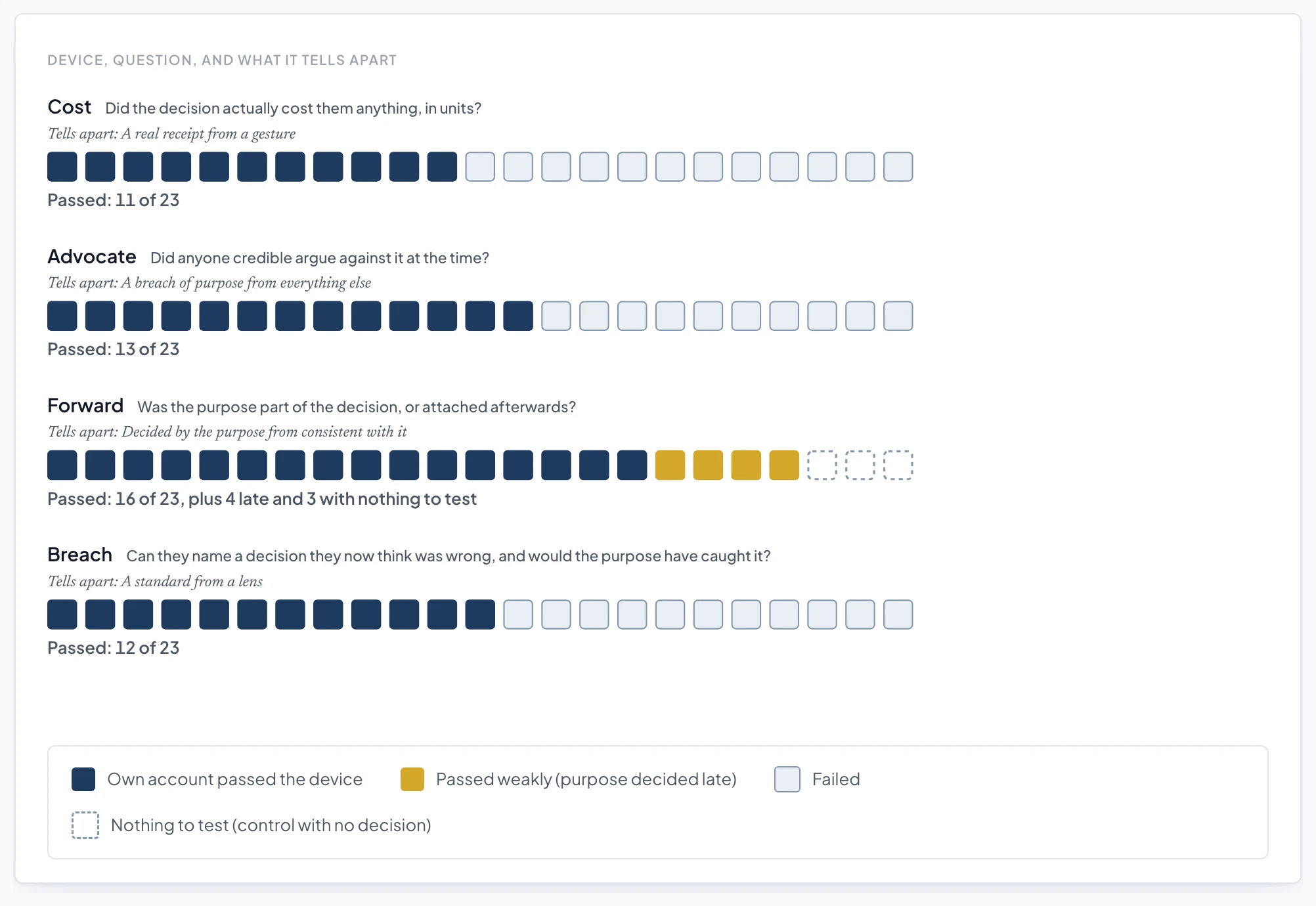
Cost. Eleven of the twenty-three accounts named a cost in units. The three where the purpose accounted for the decision all did so in advance. CVS named the revenue it would lose in a securities filing before the tobacco left the shelves. Patagonia's founders named what they were giving up in their own letter. Ben & Jerry's cost was named by its owner's shareholders, in divestments and litigation. The twelve that did not split three ways. Gestures: Patagonia's 2011 "Don't Buy This Jacket" advertisement is retold as a sacrifice, and sales rose by about a third the following year. Breaches where only an inquiry named the cost afterwards, six of them. And honest programs that never had to pay: Interface reported its sustainability work to investors as savings from the first filing, $50 million of them in its first three years, never as a cost, which is why its verdict is "partially" rather than "accounts".
Advocate. Thirteen of the organisations' own accounts carry a credible advocate; the record itself holds more, and the gap between what the record shows and what the tellings admit is the rationalisation finding in miniature. In five the advocate was inside the organisation and lost, and every one of the five is a case where the purpose did not account for the decision. Wells Fargo's board found that ethics-line concerns were answered by firing about 5,300 of the people raising them. Volkswagen's emissions engineers disagreed in 2007, the disagreement was settled by deciding to cheat, and the document that illustrated how was ordered destroyed. A nurse at a hospital trust raised falsified waiting times and was told the senior staff were in charge. An aircraft manufacturer's safety representative raised concerns about a flight control system in 2016, and the concerns were discounted and never relayed to the regulator. Advocates outside the organisation did the same work and met the same wall: a postal company's own postmasters, forensic accountants, members of Parliament and a trial judge were disbelieved for twenty years, and officials warned about Kids Company's finances at least six times over thirteen years while the funding continued. In the three cases where the purpose accounted for the decision the advocate was also there and also lost: Wall Street on CVS, the sale and flotation rejected in Patagonia's letter, the owner and two directors at Ben & Jerry's. Where nobody argued, the three controls with no costed decision and the National Portrait Gallery, there was no receipt either. Ten accounts had no advocate on record, or none whose case could be found.
Forward. Sixteen accounts had the purpose on the record before the outcome was known. Four more had it late, and three controls had no decision to test. The three accounts cases were early: CVS filed before the shelves were cleared, Patagonia's letter set out the reasoning as the transfer happened, and Ben & Jerry's standard was in a contract twenty-one years before the decision it governed. The four late cases: Johnson & Johnson's Credo is said to have decided the 1982 Tylenol recall within a day, and the record shows a week of deliberation, a local recall first, and the chief executive calling the Credo the ammunition he needed to persuade shareholders. Devon County Council's library decisions went the way its priorities point, after consultation had run its course. A homelessness charity left a government data-sharing scheme within days of a journalist asking about its 85 referrals. HSBC's purpose fits leaving France and fits staying, so it decided nothing. A purpose that arrives after the decision is a lens, held up to a result; the device separates that from a purpose that decided.
Breach. Twelve accounts named a decision the organisation now treats as wrong and that its purpose would have caught. CVS Health fails only this device: its account applies the purpose to tobacco and never to its $5 billion opioid settlement, which the company does not treat as a wrong. Patagonia passes, naming forced labour in its Taiwanese suppliers' mills as a failure that "cause no unnecessary harm" should have caught. Interface passes, judging its failed technologies by its mission's own measure. Oxfam GB says in one sentence that a charity campaigning on women's rights had the standard and breached it. Two results are neither pass nor fail. Ben & Jerry's board treats no decision as wrong and has litigated three times to say so. Kids Company's breach is contested between two public authorities, because its purpose does not rank keeping the service alive against turning no child away. Of the eleven that failed, nine were later confirmed by an admission, apology or plea.
Six organisations' accounts at the time failed cost, advocate and breach together. All six were later forced by a regulator, an inquiry or a court to give an account that passed all three. Rationalisation, followed by its own exposure, is what the live version of the test is built to provoke in a room without waiting for the inquiry.
The question the script did not ask. The blind second reader scored one organisation as having a purpose that "would clearly have told them the right thing to do". The organisation is an aircraft manufacturer whose values named safety and integrity. Its own safety representative raised the concern in 2016, and it was discounted by colleagues and never relayed to the regulator. The reader's answer is truthful. The test asks "would your purpose have told you which way to go?", and this purpose would have. It is also a breach, not a receipt. A purpose that was right and ignored passes the first question and fails a second one the script did not ask: "and did you go that way?" The study's one correction to the instrument is to ask both.
What receipts cost, by sector
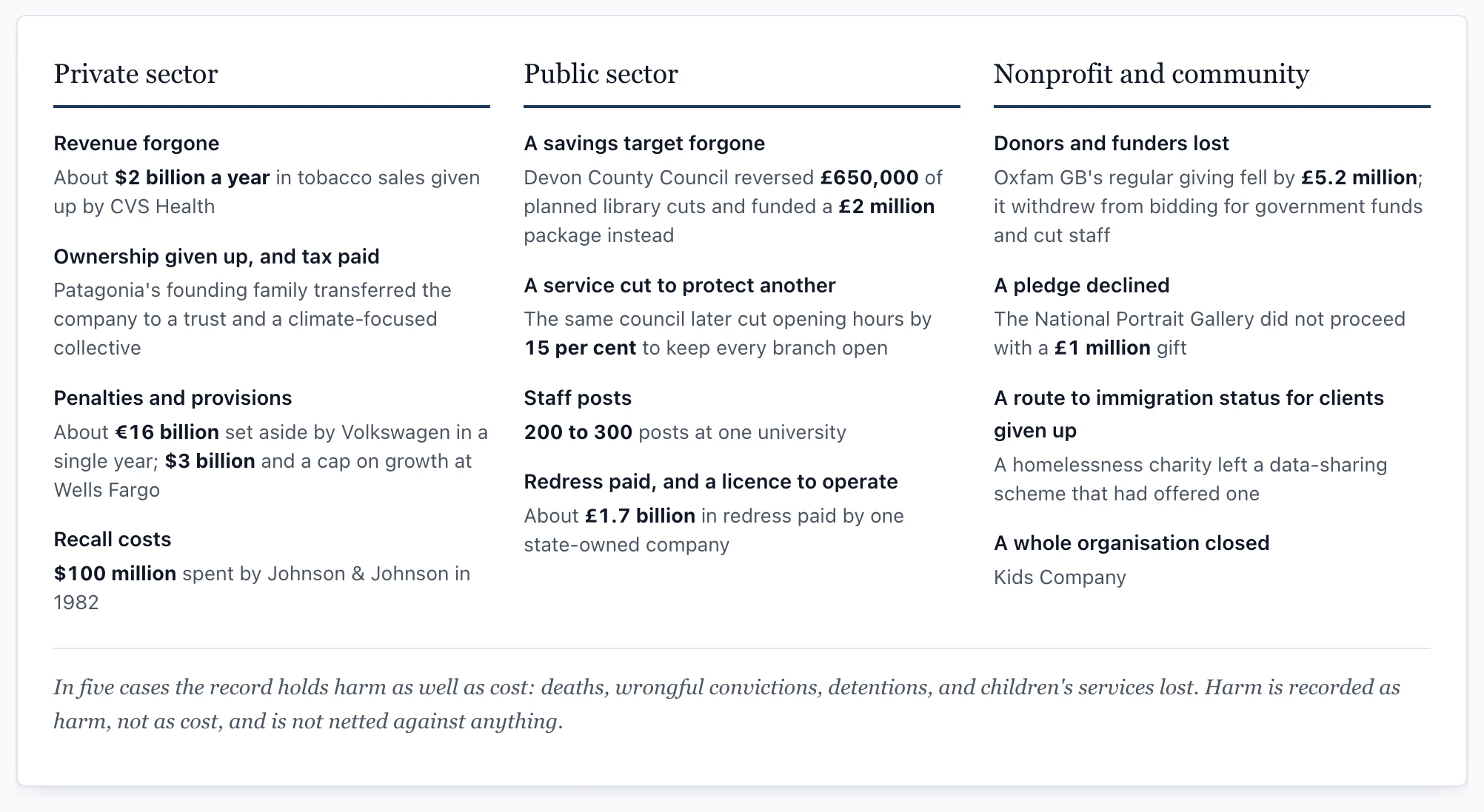
The cost test only works if cost is measured in the sector's own units. A public body does not forgo revenue. It withdraws a service, takes on a political fight, or accepts a legal risk. These are the units in which the 23 organisations paid for their costliest decisions.
Private sector. Revenue forgone: CVS gave up about $2 billion a year in tobacco sales. Ownership given up and tax paid: Patagonia's founding family transferred the company. Penalties and provisions: Volkswagen set aside about €16 billion in a single year, and Wells Fargo paid $3 billion and accepted a cap on its growth. Recall costs: Johnson & Johnson spent $100 million in 1982.
Public sector. A service cut to protect another: Devon County Council cut opening hours by 15 per cent to keep every branch open. A savings target forgone: a decade later the same council reversed £650,000 of planned library cuts and funded a £2 million package instead. Staff posts: one university cut 200 to 300. Redress paid, and a licence to operate: one state-owned company has paid about £1.7 billion in redress.
Nonprofit and community. Donors and funders lost: Oxfam GB's regular giving fell by £5.2 million, it withdrew from bidding for government funds, and it cut staff. A pledge declined: the National Portrait Gallery did not proceed with a £1 million gift. A route to immigration status for clients given up: a homelessness charity left a data-sharing scheme that had offered one. A whole organisation closed: Kids Company.
In five cases the record holds harm as well as cost: deaths, wrongful convictions, detentions, and children's services lost. Harm is recorded as harm, not as cost, and it is not netted against anything.
What a receipt looks like: the archetype, reasoned from the coding
What follows is synthesis, not measurement. It sets the three cases where the purpose accounted for the decision against the six where it partially did, and both against the four controls, and reads a pattern across the coded fields. Nothing in the schema measures an archetype.
| Feature | The 3 "accounts" | The 6 "partially" | The 4 controls |
|---|---|---|---|
| Cost named in units by the organisation, before or at the time | All 3 | 1 of 6 | 1 of 4 |
| Decision tied to the purpose at the time, in the organisation's own words | All 3 | 3 of 6 | 1 of 4 |
| Someone credible on record arguing the other way | All 3 | 4 of 6 | 0 of 4 |
| A specific purpose statement | 1 of 3 | 3 of 6 | 0 of 4 |
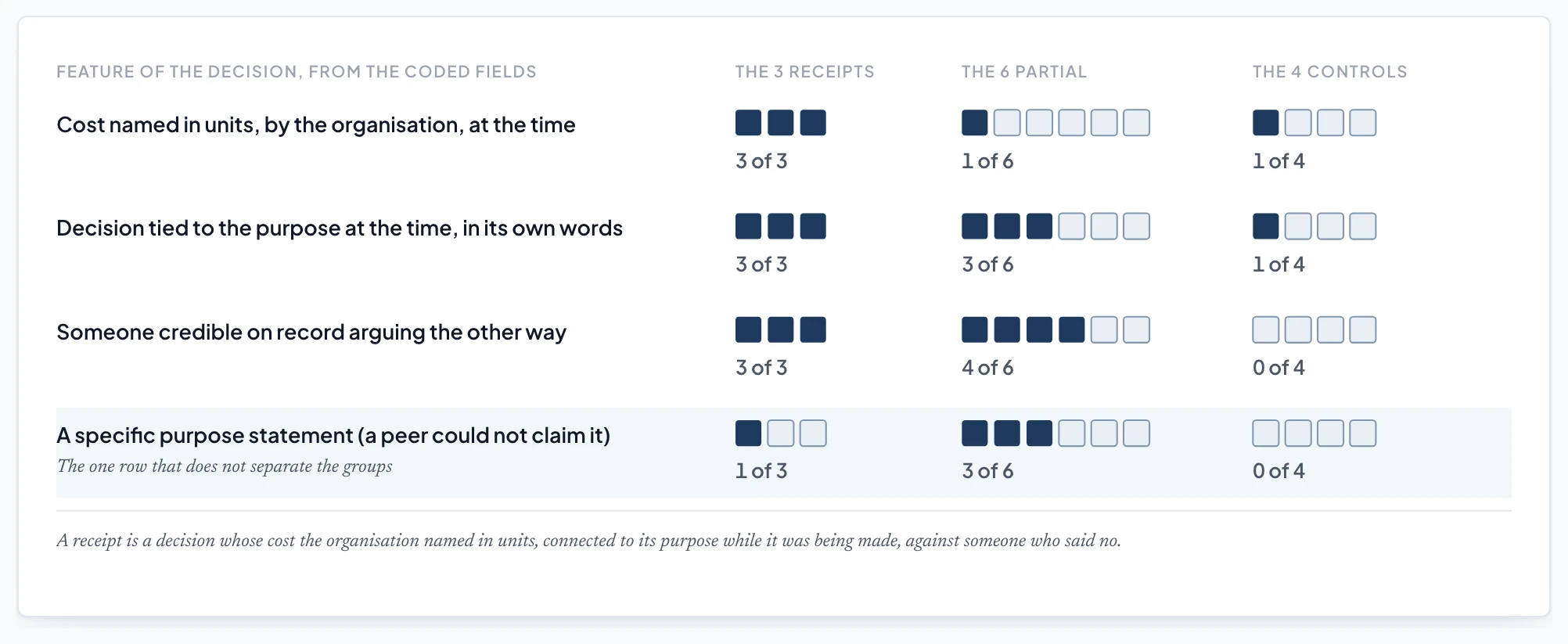
In the three "accounts" cases the organisation named the cost itself. CVS named it in its SEC filing. Patagonia named it in its ownership letter. Ben & Jerry's cost was named by the shareholders of its owner. Each also had a credible opponent on record: Wall Street analysts for CVS, a sale or a flotation as the alternatives Patagonia rejected, and the owner plus two dissenting directors for Ben & Jerry's. The one control that named a cost was HSBC. The one control that tied a decision to its purpose was King's, and the decision was costless.
The last row is the one that does not separate the groups: specificity. The first three do. A receipt is a decision whose cost the organisation named in units, connected to its purpose while it was being made, against someone who said no. Ben & Jerry's is the limiting case. Its independent board's authority over the social mission was written into the 2000 merger agreement with its owner, Unilever. When the board defied the owner in 2021, and sued to enforce the mission in 2022 and again in 2024, the standard had been fixed twenty-one years before the decision it governed. A held stance, in the form of a contract.
The "partially" group is where the instrument refuses to flatter. Johnson & Johnson's Credo explains the 1982 Tylenol recall, and the cost was real. The record also shows a week of deliberation and a local recall before the national one, and it has the chief executive calling the Credo "the ammunition I needed to persuade shareholders". Kids Company's purpose, "never turn a child away", fully explains a demand-led model with no reserves. Two public authorities still disagree about whether that model was defensible. The National Portrait Gallery declined a £1 million Sackler pledge in 2019. Its statutory purpose is about the collection and says nothing about donors, and its own annual report never mentions the decision. An ethics policy decided it, not the purpose.
Granted purposes: the hypothesis that mostly failed
The study began with a first pass of five UK organisations whose purpose was given to them rather than written by them. The question was whether a mandated organisation might have no receipts because the mandate had chosen for it. The five were a statutory regulator, the General Medical Council; a charter body, the BBC; an oversight body, the National Audit Office; a charity with narrow registered objects, World Horse Welfare; and a commissioned employment provider.
The hypothesis held for one. The NAO's costliest act was to disclaim an audit opinion. Auditing standards compelled that act, even though the organisation framed it as a line in the sand. It failed for two. The GMC took an appeal that the statute permitted and did not require, and its executive took it without the Council ever discussing it. World Horse Welfare spent its reserves to take in seized horses, which its objects permit and nowhere require. It was arguable for the BBC. Its Board decided, at an extraordinary meeting, to commission a judge to investigate the corporation itself. Nothing in the Charter required that, and a Mission to act in the public interest explains it after the fact, as it would explain almost anything. The provider left no public trail to read.
The full study added six more mandated organisations. None had its costly act compelled. One was arguable: a government department whose measures Parliament had legislated, and whose application of them was its own. Across all eleven, then: one compelled, two arguable, seven chosen, one unreadable. Counting any outside rule rather than the mandate alone adds two more arguable cases and still no compelled act. A granted purpose leaves the receipts wherever the mandate leaves room, and every mandate read here named an end and left the means open. Where a mandate specifies the act itself, as auditing standards do, the test has nothing to grip. The question then becomes whether the mandate required the act, asked separately from whether the purpose explains it.
Methodology, in brief
Twenty-eight organisations were read across two passes. For each, the purpose text was recorded verbatim from a primary document. A written prediction was then saved, before any decision was searched: what the purpose should forbid, what it should require, and what would count as a breach. The sample design was fixed in advance: three sectors, two expected outcomes in each, three cases per cell, and four controls chosen on genericness alone. Where a slot had no organisation named in advance, it was filled by a stated rule, and every skip was recorded. Sources were the organisations' own reports and filings, court judgments, regulator and inquiry reports, and governing-body minutes where public. Press was used only where it reported the organisation's own words. Every case records which classes of source were reached and which were not.
Limits, stated. The sample is purposive. It supports no claim about how common purpose-driven decisions are anywhere. For most named cases the headline of the decision was known before the prediction was written, so 18 correct predictions out of 23 overstates what cold prediction achieves. The five predictions that were wrong on shape are the informative ones. Verdicts are judgements, and a second reader agreed on four of six blind cases. A verdict of "does not account" means the record and the logic do not connect the purpose to the decision. It says nothing about what the people involved believed or intended, which the study did not measure and could not. One public slot could not be filled. Seven organisations were coded on a provisional purpose text. Five of those texts were verified afterwards, three could not be, and none changed a verdict. Four organisations whose cases involve deaths, wrongful convictions or unlawful detentions appear by mechanism rather than name, and one client-adjacent case is withheld. Both decisions were taken before coding began. Three working documents sit behind the findings: the pre-registered protocol with its dated amendments, the case-by-case coding with every source named, and the analysis written against the protocol's plan. The findings above summarise them and do not replace them.
What this means, depending on who's reading it
If you run a leadership team in a mandated organisation. Your mandate doesn't excuse you from the test. It tells you where to look. Find the decision where the statute, the objects or the funding agreement left the means open and you chose the expensive one. If you can't find one, don't conclude you have no purpose. Conclude that the record doesn't hold it, and run the test live on the people in the room. Nine of the ten decisions the purpose did not account for had a witness on the record, and five had one in that room.
If you lead a company with a purpose statement on the wall. Name a costly decision your purpose explains. Then check three things against your own filings. Did you name the cost before you paid it? Did anyone credible argue the other way? Is there a decision you now think was wrong that the purpose should have caught? CVS passed the first two and not the third. A purpose that accounts for every good decision and no bad one is a lens, not a standard.
If you sit on a charity board. Your objects name who you serve and almost never what you'll give up to serve them. Kids Company's purpose was real, held, and used to override every warning about the means. Ask what your purpose forbids. If the honest answer is "nothing we'd actually want to do", that is the finding.
If you're the business architect asked to run this. Ask the question twice. "Would your purpose have told you which way to go at the time?" And then: "Did you go that way?" The gap between the answers is where the organisation's real purpose lives, and the record says it is usually already known to someone in the building.