A team walks into its quarterly review with three Key Results glowing green, and still can't say whether anything actually changed. That gap is where most OKR failures live, and it starts with people using the term without agreeing on what the two halves are actually for.
An OKR is two things stapled together: an Objective, which names what you're choosing to make true, and a set of Key Results, which prove whether it happened. Google popularised the format and Intel invented it, and most organisations that write OKRs today can recite the template without thinking. The template was never the hard part. Telling a real OKR apart from a task list posing as an OKR is.
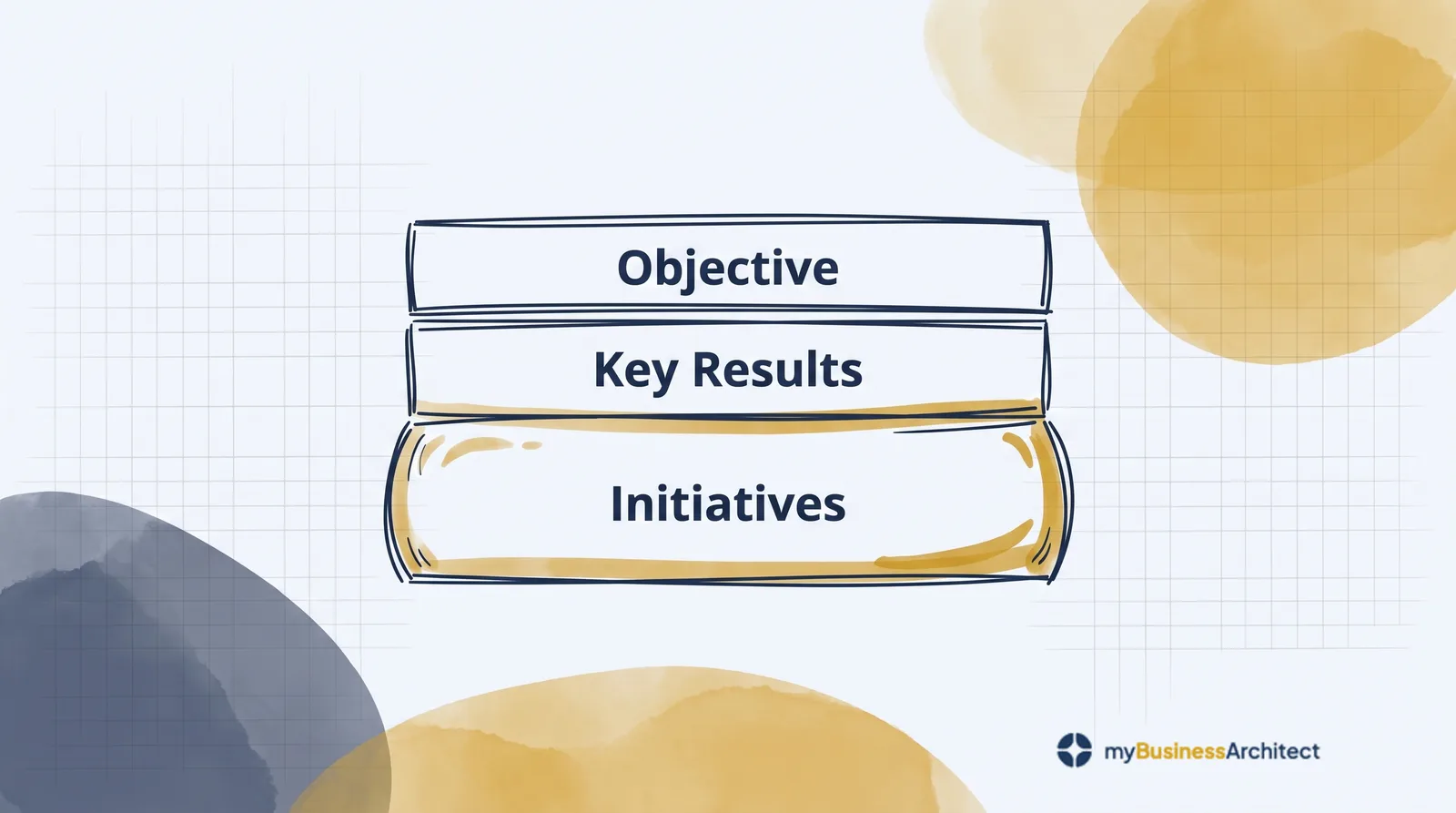
Objective: a qualitative, ambitious statement of what's changing. Not what you're doing, what becomes true once you've done it. Key Results: a small number of measurable outcomes, usually three, that would only be true if the Objective actually happened. Not activities. Not outputs. Changes in the world the Objective was about.
The third part nobody puts in the name
Most OKR templates carry a third layer beneath the two in the acronym: Initiatives, the specific projects and tasks that move the Key Results. This is where most of the actual work lives, and it's also where most OKRs quietly go wrong, because Initiatives are concrete and easy to write while Objectives and Key Results are hard. Under pressure, a team reaches for what it can name. The Initiatives creep upward, the Objective thins out to match them, and what started as an Objective, Key Results and a work plan ends up as a task list with a headline. Initiatives belong underneath the Objective, not inside it.
That's also the difference between an OKR and a KPI (a Key Performance Indicator): a KPI holds steady-state work to a standard, an OKR commits to changing something that isn't true yet. OKRs vs KPIs covers the distinction in full; that's the short version.
What makes each part good
A good Objective names a chosen future for a specific someone, not a task, and not a future so generic it could describe any year. "Make click and collect the shopper's default" is an Objective. "Deliver the digital roadmap" is a delivery mandate dressed up as an Objective. "Improve student success" sounds like a good Objective, but is closer to being dressed up, unless it says which students and why they're leaving.
A good Key Result measures a changed stakeholder, not a completed activity. "Repeat-purchase rate among click-and-collect shoppers climbs six points" is a Key Result. "Launch the new checkout flow" is an Initiative that snuck into the wrong section.
A good Initiative is honest about being a task. It doesn't need to sound strategic, because the Objective above it is already doing that work.
Three examples, diagnosed
The fastest way to learn the difference is to watch it get checked. Each of these is a real Objective and Key Results, lightly adapted, run through one question: does this Objective name a chosen future, and do these Key Results measure whether it arrived?
A retailer, rescued.
Objective. Make click and collect the shopper's default, because it wins the omnichannel customer we've chosen to compete for. Key Results. Click-and-collect share of eligible online orders rises from 12% to 30%. Stock shown as available online is on the shelf at collection 98% of the time. Repeat-purchase rate among click-and-collect shoppers climbs six points against store-only shoppers.
This one passes. The Objective names a customer the business chose to win, not a list of activities. Every Key Result would only be true if that bet actually worked, not if the team was merely busy. The full story, including the delivery-mandate version this replaced, is in When Your OKR Is Really a Task List.
A health system, working as intended.
Objective. Close the gap in chronic disease outcomes for the population we've chosen to serve. Key Result. Hypertension control rate rises from 55% to 70% among enrolled patients.
This one also passes, for a less obvious reason. The Key Result looks like a routine clinical metric, but it's only a legitimate commitment because someone already answered two questions behind it: which patients, and through what value stream. Without those answers, the same Key Result is a number with nothing holding it up. The full working, including the patient the number is actually about, is in the OKR pillar.
A university, failing quietly.
Objective. Improve student success and retention. Key Results. Launch a new advising platform by Q3. Increase advising touchpoints per student by 30%. Achieve 90% completion of the redesigned first-year seminar.
This one fails, and it fails in the way that's hardest to catch, because every Key Result is real, trackable, and will almost certainly go green. "Launch a new advising platform by Q3" isn't a Key Result at all, it's an Initiative that snuck into the wrong section. The other two aren't much better: touchpoints delivered and a seminar completed are things the institution does, not things that happen to a student. None of the three describes a student who is actually better off. And the Objective compounds it, exactly the generic-future problem flagged earlier: "Improve student success and retention" never says which students are leaving or why, so there's no population choice underneath it and no way to know if any of this moved retention at all. A dean could report three green Key Results at year end and still have no idea whether a single at-risk student stayed enrolled who otherwise would have left.
The tell, once you know it
All three examples above share one test, and it's the only one that matters: could every Key Result go green while the person the Objective was supposedly about is no better off? The retailer and the health system can't, because their Key Results are tied to a chosen customer or patient. The university can, easily, because its Key Results describe the institution's own activity instead.
Two smaller tells worth watching for, both explored at length in When Your OKR Is Really a Task List: an Objective that opens with a verb of delivery ("launch," "deliver," "roll out") is usually a task wearing an Objective's clothes, and a Key Result that reads like a project milestone rather than a changed number in the world almost always is a task.
This is the definitional half of the OKR pillar's argument: the shape of a real OKR, not yet the diagnosis of why so many aren't. For the deep dive on the failure mode, read When Your OKR Is Really a Task List. The Closing the Strategy-Execution Gap course teaches the full chain from choice to capability to Key Result.