Every argument for outcome reporting rests on an assumption that nobody tests: that outcome reporting improves what happens.
It's a reasonable assumption. Funders have a duty of care, boards have a fiduciary obligation, and giving money without any account of what it achieved is money given carelessly. The logic is so obvious that the sector has spent thirty years building infrastructure on top of it without ever running the experiment.
Then somebody ran the experiment, by accident, at enormous scale.
The natural experiment
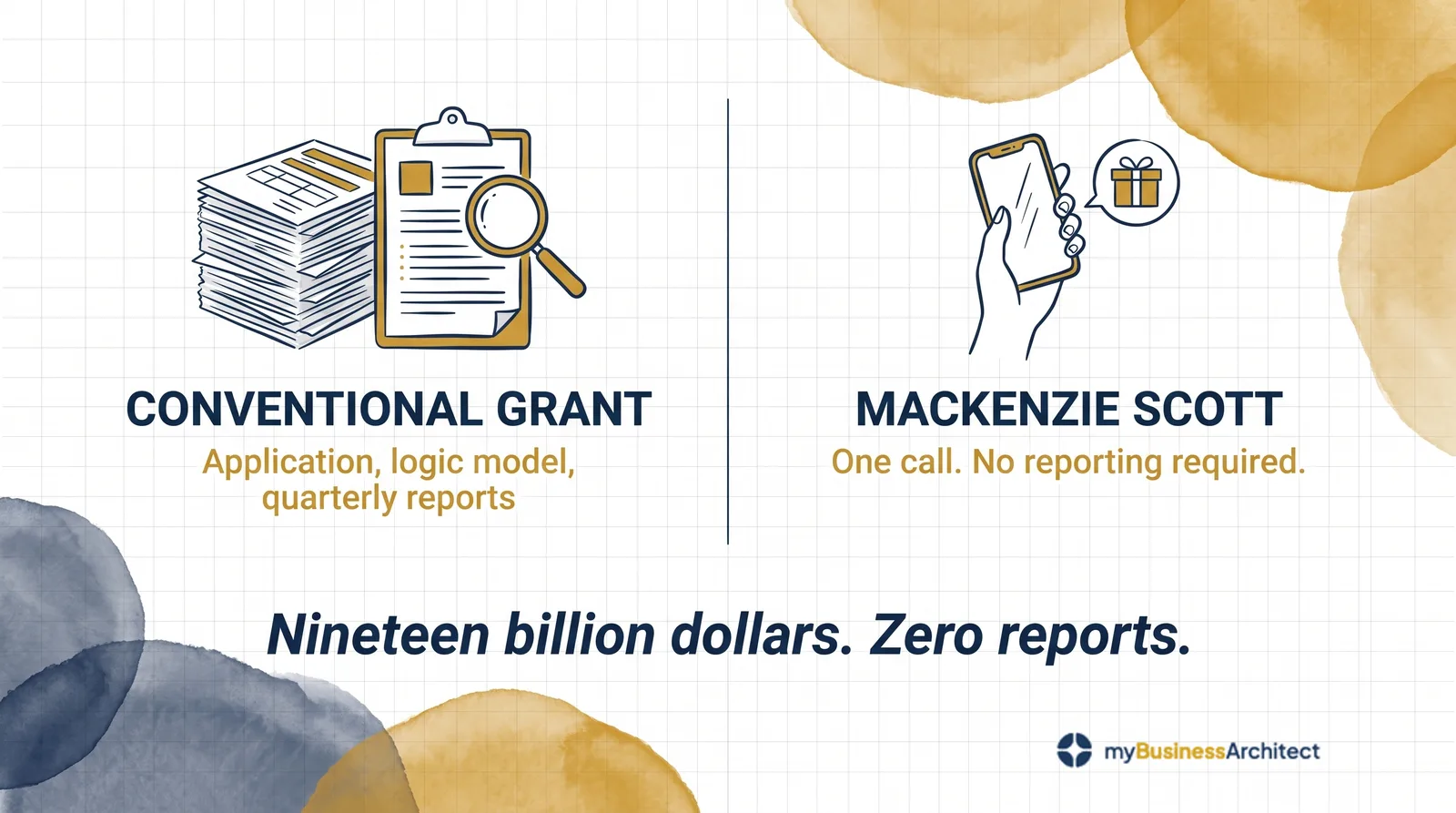
Since 2019, MacKenzie Scott has given away more than nineteen billion dollars in large, unrestricted grants. No application process. No logic model submitted in advance. No quarterly outcome reporting. In many cases, a phone call, due diligence conducted without the organisation's involvement, and then a transfer.
This is the opposite of every accountability convention in institutional philanthropy, and it was done at a scale that makes it impossible to dismiss as boutique.
The Center for Effective Philanthropy (CEP) spent three years on it, surveying 813 grantees and 243 foundation leaders and publishing Breaking the Mold in February 2025. It didn't rest on grantee self-report alone. It compared these recipients against similar organisations that received no gift, using 990 tax filings.
Recipients were able to strengthen their long-term financial position, expand their programs, and reduce staff burnout. The predicted harms didn't appear. So the study pushes back explicitly on the financial-cliff narrative: recipients were more sustainable after the money was spent, not less sustainable. They also produced documented program results, so removing the reporting requirement didn't remove the results.
The caveats are real, and the most significant isn't about method. Scott's recipients were pre-vetted, larger than average, and already performing well. They were selected, not randomly assigned, which limits how far the finding translates to organisations unlike them. The study's two halves aren't equally reliable either. The survey relies on self-reporting from people who have just received a large gift and have every reason to feel good about it. The tax-filing comparison uses public data that needs nobody's cooperation, and consequently it's the stronger half.
CEP has a stake in this. Its business is assessing funders, so it has an institutional interest in funders taking assessment seriously, and it studied this giving with the funder's cooperation. However, its methods are published and its findings are routinely unflattering to the funders who pay for its work. That's reassuring without being conclusive, and it's worth knowing before you weigh the result.
It's still the closest thing to a controlled test of whether funder reporting adds value that the sector has ever had, and the result didn't favour reporting.
What this does and does not mean
It doesn't mean measurement is worthless. The evidence that measurement can transform outcomes is strong, and the conditions under which it does are well documented.
It doesn't mean accountability is optional. Charitable fraud exists, incompetence exists, and an argument against reporting regimes cannot become an argument against scrutiny.
What it means is narrower and harder to dodge: the burden of proof has moved.
It used to sit with whoever questioned a reporting requirement, since requirements were assumed to be prudent. After nineteen billion dollars deployed without them, it sits with whoever imposes one. They now have to say what makes their situation different, and what specifically the reporting will improve.
Most can't answer. Not because they're careless, but because the requirement was inherited rather than designed, and nobody has asked before.
Why funders do it anyway
The uncomfortable finding underneath the headline is that foundation leaders kept worrying about unintended consequences after the data had stopped supporting the worry.
Institutional risk explains that better than evidence does. A program officer who reduces reporting requirements and later sees a grantee fail will be asked what controls were in place. A program officer who imposes burdensome reporting and achieves nothing will never be asked anything. The asymmetry is entirely about the funder's exposure, and has nothing to do with the grantee's outcomes.
So the reporting does serve a purpose. Just not the one it claims to.
The rule that resolves most of it
One change dissolves most of the burden critique without abandoning accountability, and it's already being done rather than just argued for.
If you require the measurement, you fund the capacity to do it.
Not as an allowable overhead line to be justified. As a designed, named part of the grant. The Listen4Good model does exactly this for beneficiary feedback: the funder pays for the organisation to build a feedback capability, rather than requiring feedback data as a condition of receiving money for something else.
Paying for it changes what the measurement is. Required and unfunded, it's a tax on delivery, and it gets met with the minimum that will pass. Required and funded, it's a capability the organisation keeps and uses for its own purposes long after the grant closes.
Everything in the evidence about when measurement works points the same way: it works when the people doing the work own it. Paying for it is how ownership starts.
Three questions to ask before the next reporting requirement
The first one is usually enough.
What decision will this data change, and whose? If nobody can name a decision on either side of the relationship, the requirement is producing paperwork.
What would we do differently if the answer came back bad? If the honest answer is nothing, or a conversation nobody intends to have, the requirement is theatre with a filing deadline.
Who is paying for the capacity to produce it? If the answer is the grantee, out of delivery, the requirement is a cost transfer in the language of accountability.
None of these questions is hostile to accountability. They're what accountability looks like when it's designed rather than inherited.
Part of the cluster around Is Anyone Better Off?, on why measurement systems report upward and never learn backward.