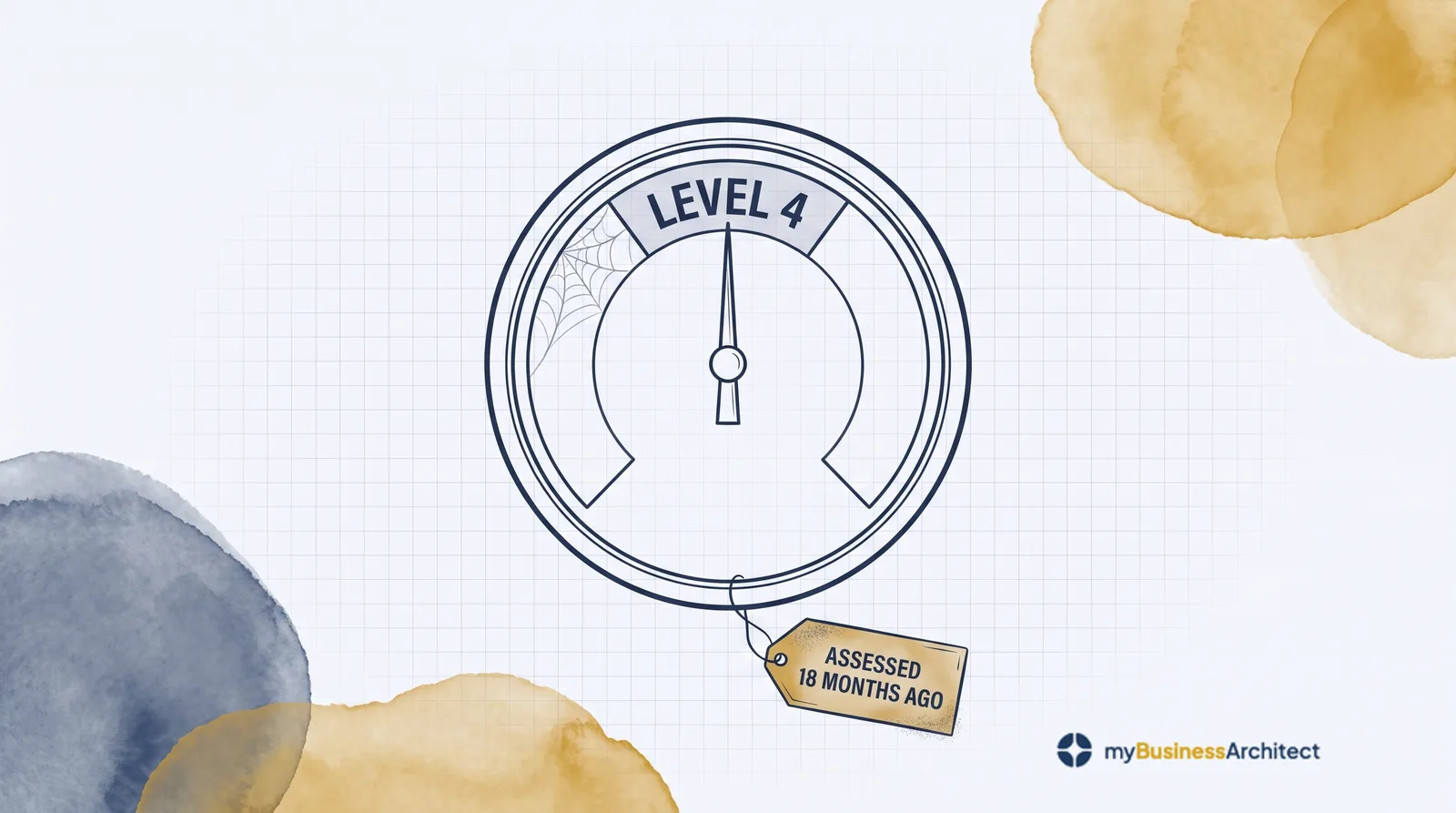
Two years after the uplift, the heat map for employer partnership management still reads Level 4. Peak level, above sector norm, exactly the target the strategy required. Nobody in governance questions it, because nobody has a reason to. The number on the map is the number from the assessment that produced it.
That assessment happened the week the uplift closed.
You've probably watched a capability get funded, fixed, and filed the same way. It's not naivety. The uplift was real: the target was correctly derived from the strategy, the funding landed, and the capability reached exactly the level it was supposed to. That work held up. What nobody built was a reason to check whether it still does.
Maturity isn't a ratchet
Here's what a maturity score actually is. A snapshot, taken once, of a capability's People, Process, Technology, and Information elements all performing at a stated level, at that moment. Most organisations treat it as something sturdier: an achievement that, once earned, stays earned.
It doesn't work that way.
When employer partnership management got uplifted, it wasn't a system installed once and left running. It was five formal partnerships, each with a named relationship manager, a quarterly touchpoint cadence, and a shared roadmap document per employer. The People element was a person doing the work of holding five relationships together on a schedule. The Process element was that schedule actually happening.
The relationship manager who built the program got promoted eighteen months in, a real success in its own right. Her replacement inherited five contact names and a set of files. Nobody handed over the cadence itself, because the cadence wasn't written down anywhere as a deliverable; it was just what she did. The quarterly touchpoints slipped to twice a year, then to whenever a partner happened to reach out first. Two of the five relationships are still exactly as designed. One has gone quiet entirely. Two have settled into a single annual call that both sides now treat as a formality rather than a partnership.
Nothing about this shows up anywhere. The capability isn't on any watch list, because it isn't struggling. It's finished. The next assessment cycle moved on to whichever capability scored badly this time. The gap between the number on the map and the number the capability is actually operating at has nowhere to surface, because nothing was ever built to go looking for it in a capability that already passed.
A different question from whether the target is right
This isn't the target going stale. The strategy that required Peak-level employer partnership management hasn't moved an inch; if anything, it needs that capability more than ever. The target was correct the day it was set and is still correct today.
What's gone isn't the target. It's whether the capability is still standing where the target says it should be, and that's a different question. Ask whether the target's still the right one, and you're asking about the strategy. Ask whether the capability still holds the level it was scored at, and you're asking about maintenance, and almost nothing in a standard assessment cycle is built to ask it twice.
Worth being plain about what actually broke here, because it isn't obvious. Nobody did anything wrong. The relationship manager did the work, then earned a promotion, exactly what should happen to someone good at their job. Her replacement inherited a role, not a documented practice. The failure isn't a person. It's that "reached Level 4" got treated as a finished sentence instead of a claim that has to keep being true.
Give a passed capability a reason to be checked again
The fix isn't re-running the whole assessment on a fixed clock. That's expensive, and mostly wasted on the capabilities that are genuinely fine. The highest-leverage place to start is the cheapest one to build: whenever a capability's champion changes role, that capability gets a light recheck before the handover is called complete, not just a contact list. Role changes are already a known process to hook into, which is why this trigger comes first. It isn't the only one a capability will ever need.
Concretely: the handover has to include the operating practice, not just the relationships: what the actual cadence is, what "on track" looks like week to week, who would notice first if it lapsed. If the incoming owner can't answer those, the capability hasn't actually been handed over, whatever the org chart says.
Pair that with one standing rule: a maturity score carries the date it was taken, visibly, wherever it's reported, not a bare "Level 4" but "Level 4, assessed eighteen months ago." The role-change trigger catches the handover failure specifically. The dated score catches everything else: cadence slipping under workload with the same person still in the seat, a step quietly skipped because nobody's checking. A stale date sitting next to a claimed number is a much smaller ask than a whole reassessment cycle, and it does the one thing that matters. It stops the number from reading as a permanent fact.
This is the same discipline Design4 runs at the strategy level, applied to the assessment cycle itself. A score is only as good as the cycle that keeps re-checking it.
A capability that earned its level once still has to keep earning it. The organisations that never lose the number are the ones that built a reason to look again, not a calendar nobody remembers to check.
A capability can reach its target, get scored, and still quietly stop being held there, with nobody the wiser. Now you know the second thing to check: not just whether a capability once reached its level, but whether anyone would actually notice if it stopped holding it.
This is maturing the deciding capability from the other direction: the sibling question asks whether the target's still right; this one asks whether the capability's still there.