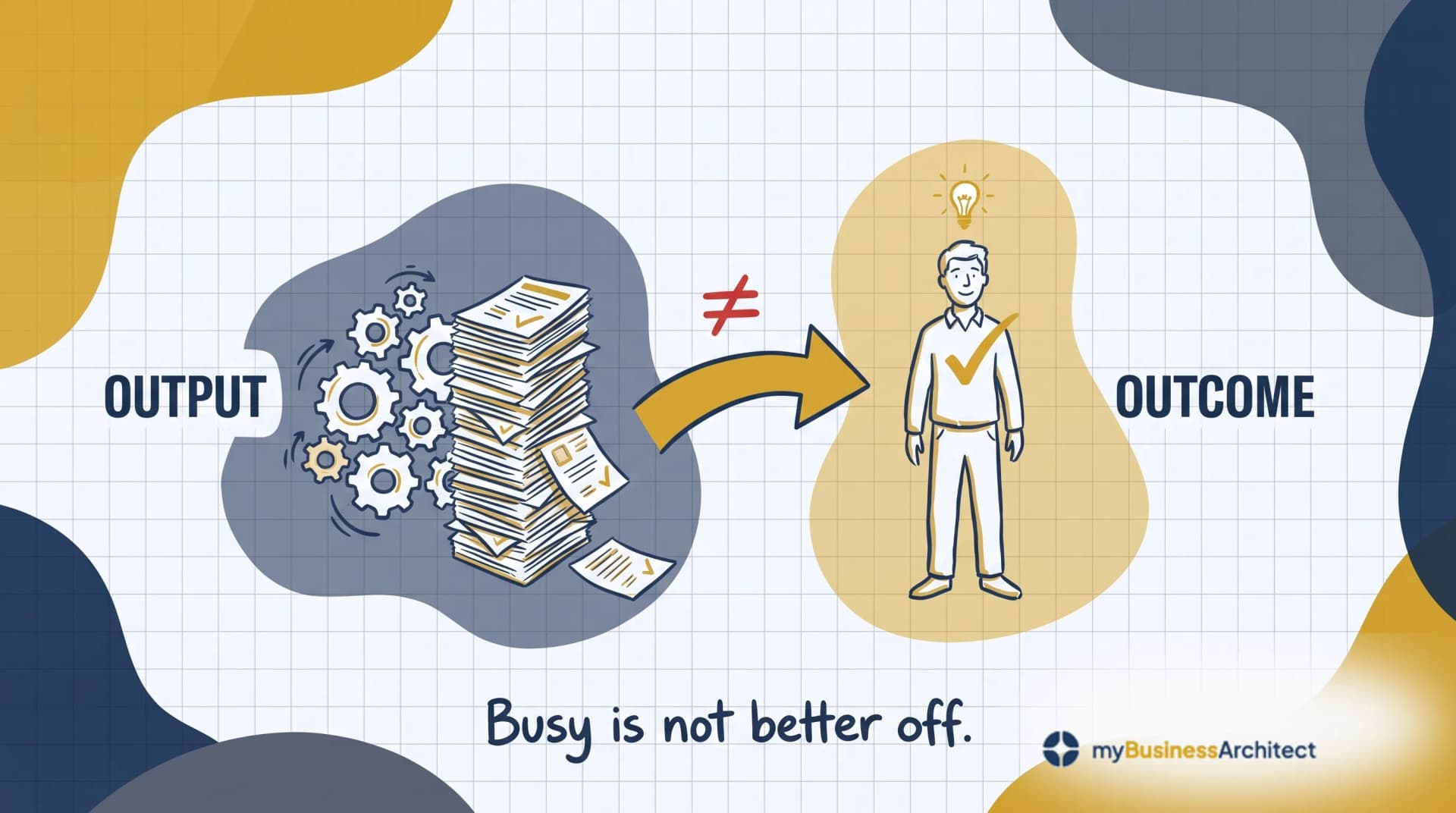
A training service produces a training encounter. Whether anyone can do their job better afterwards is a separate fact. The first is an output. The second is an outcome. Treating them as the same thing is how a transformation reports success while nothing actually improves, and it's one of the most expensive confusions in operating-model work.
The distinction sounds pedantic until you watch a program stand up in front of a board, report every output delivered on time, and get asked the one question it can't answer: so is anyone better off?
The short version: an output is what a service produces. An outcome is the change that output was supposed to cause in the stakeholder's world. Outputs are countable and belong to the service. Outcomes depend on the world outside it, and they're the only reason the service exists.
What each one is
An output is the unit of value a service produces. A subsidy paid. A permit issued. A training encounter delivered. A ticket resolved. Outputs are concrete, countable, and produced by the service itself. If the service ran, the output exists.
An outcome is the change in the stakeholder's world that the output was for. A family no longer needing assistance. A business able to open because the permit came through. An employee who can now do the thing the training was about. A customer whose problem is actually gone. Outcomes aren't produced by the service alone; they depend on the world outside it, and they're what the whole thing was supposed to achieve.
The relationship is directional and it doesn't reverse. Outputs contribute to outcomes. A subsidy paid contributes to a family's self-sufficiency. But the output isn't the outcome, because you can produce the output perfectly and still miss the outcome entirely. Pay the subsidy accurately, on time, at low cost, and the family can still end up no better off. The output was flawless. The outcome never moved.
Outputs vs outcomes: examples side by side
The same pattern shows up in every type of service. Simply listing outputs and outcomes side by side is usually enough to reveal that a program has only ever measured one of them.
| Service | Output | Outcome |
|---|---|---|
| Benefits assistance | Subsidy paid | Family no longer needs assistance |
| Licensing and permits | Permit issued | Business able to open and operate |
| Training | Training encounter delivered | Employee can do the job it was for |
| Service desk | Ticket resolved | Customer's problem is actually gone |
| Compliance review | Report filed, review completed | Risk is actually reduced, not just documented |
| Case management | Case closed | Client's situation genuinely improved |
In each row, the output is what dashboards already track: the service's own activity. The outcome is slower to appear and shaped by forces beyond the service, yet it's the only measure of whether the work mattered.
Where each one is measured
This maps straight onto how you measure a service. The output is where the service-level agreement attaches: cost, speed, accuracy, availability, the things that say the service produced its output well. That answers the Deliver question, are we getting it done well?
The outcome is measured somewhere else entirely. Effectiveness is the service's side of it: did the output do what it was for? That is the first evidence toward the Discover question, are we getting the benefits?, which is answered only when the outcome evidence comes back. Two measurement points, and they aren't interchangeable. The output tells you the service works. The outcome tells you the service matters.
Nearly every measurement failure makes the same error: it counts outputs and calls them outcomes. It is an understandable mistake, because the output is the easy number. It is right there, produced by the service, countable this quarter. The outcome is slower, depends on things outside the service's control, and sometimes takes a year to show. So the report defaults to outputs, and everyone treats "delivered" as "worked."
Services string into value chains
There is a second reason outputs get mistaken for outcomes, and it's structural. Outputs feed other outputs. One service's output is the next service's input, so the operating model is really a value chain of services connected by what they hand each other. A specialised assessment produces an output, an eligibility determination, that becomes the input to an enrolment service, whose output becomes the input to a benefit-administration service, and so on down the chain until, at the far end, an output finally contributes to the outcome the whole chain exists for.
That means an output near the end of a chain contributes to the outcome directly, while an output further back contributes indirectly, through everything it feeds. Both are real contributions, and both are traceable, but neither is the outcome itself. The trap is to measure a mid-chain output, see it green, and assume the outcome at the end of the chain is therefore fine. It might not be. The chain can deliver every intermediate output perfectly and still fail to move the outcome, because a single broken link downstream is enough.
The theatre this produces
When an operating model measures outputs and stops, it produces Measurement Theatre: the ceremonies of reporting performed with real rigour, the dashboards green, and the people the organisation exists to serve no better off. It is the same failure the OKR world calls out when Key Results track activity instead of impact, or when an OKR turns out to be a task list. Rigorous apparatus, wrong layer.
The tell is a report full of "delivered," "completed," "issued," "resolved," with nothing that describes a changed stakeholder. Everything in it is an output. The word that's missing is the outcome, and its absence is usually not an oversight. Outputs are what the service controls, and controlling the number you're judged on is comfortable. The outcome is exposed, because it can refuse to move no matter how well you delivered.
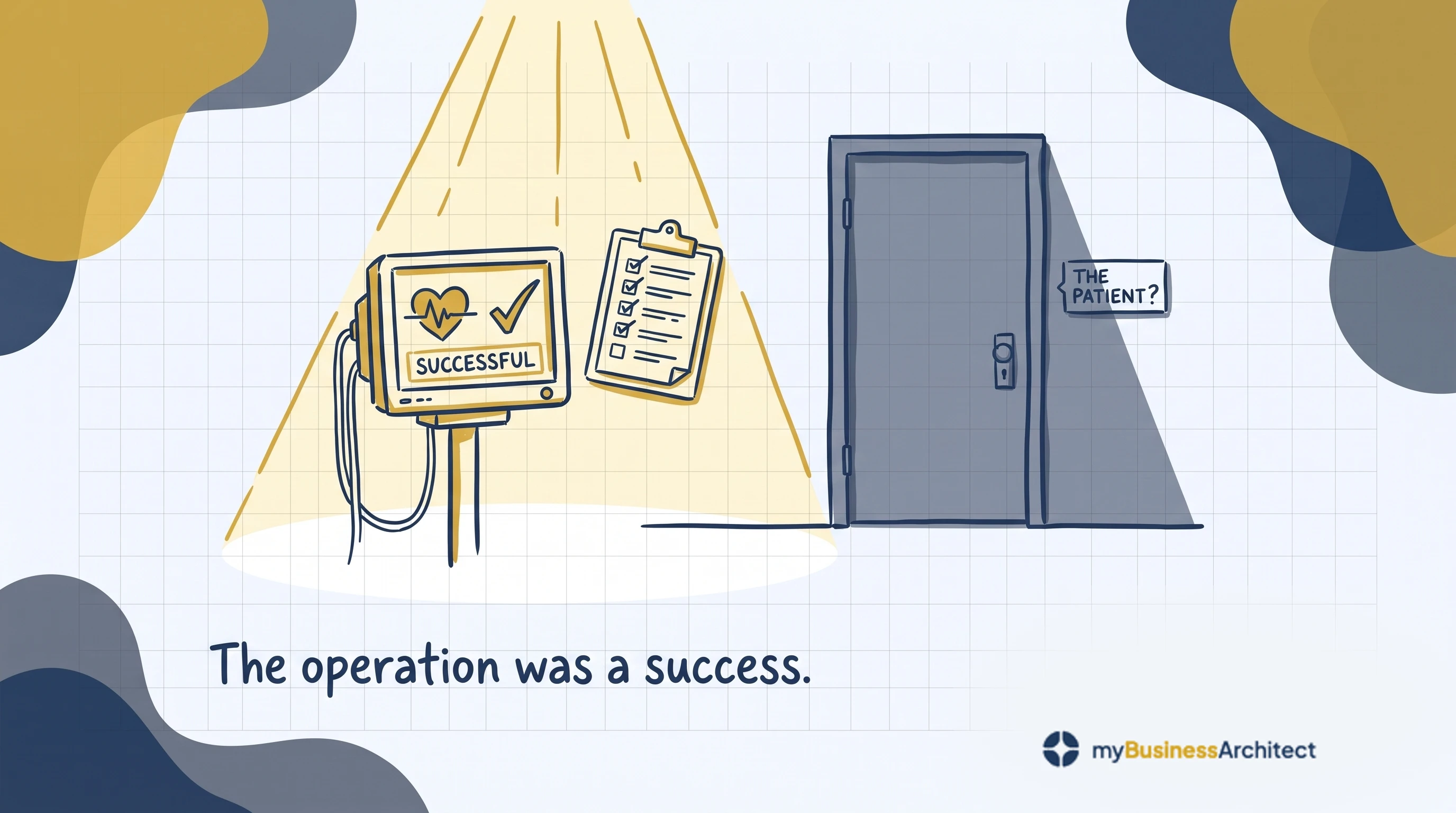
The operation was a success. Whether the patient recovered is a different question, from Measurement Theatre's own worked example.
How to use it
The discipline is simple to state and hard to hold: trace every output to an outcome, and measure both.
For each service, write down what it produces (the output) and what change that output is supposed to contribute to (the outcome). If you can't name the outcome, the service has no reason to exist that anyone has articulated, and that's worth discovering now rather than at the board. If you can name it but never measure it, you're one reporting quarter away from Measurement Theatre.
Then hold the two ends. The output gets a service level and is measured on efficiency and quality, day to day. The output gets an effectiveness measure too, its contribution to the outcome, and the outcome evidence is reported to the people who care whether the work was worth it. A service that delivers its output and can show its contribution to an outcome is doing its job. A service that only delivers its output is producing something, precisely and reliably, that no one has confirmed is worth producing.
Outputs vs outcomes: quick answers
What's the difference between outputs and outcomes? An output is what the service produces and controls directly. An outcome is the change in the stakeholder's world the output was meant to cause, and it depends on things the service doesn't control.
How do you measure outcomes versus outputs? Separately, and on different clocks. Outputs get a service-level measure (cost, speed, accuracy) tracked continuously. Outcomes get an effectiveness measure, checked less often, against whether the stakeholder is actually better off.
Can an output be perfect and the outcome still fail? Yes, routinely. A subsidy paid accurately and on time can still leave a family no better off. The output measures whether the service worked. Only the outcome measures whether it mattered.
Trace outputs to outcomes across your whole operating model with the free Service Operating Model Canvas, and see the argument in full in the operating model pillar. This is the benefits realization discipline seen from the service side; the Closing the Strategy-Execution Gap course teaches the full chain from output to outcome to purpose.