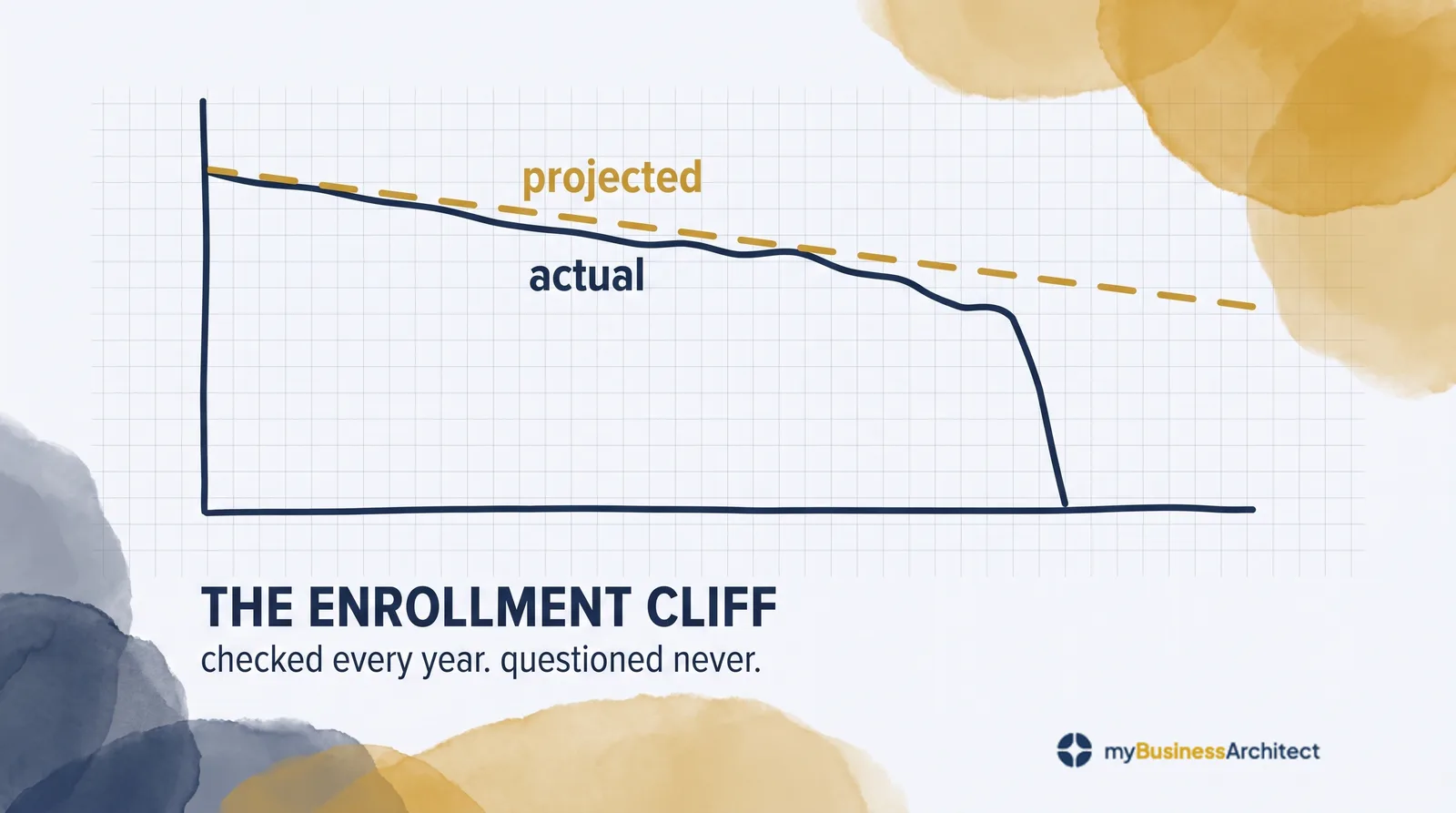
Every autumn for eleven years, the enrolment planning committee at a mid-sized regional university has opened the budget cycle with the same slide: a five-year projection showing a gentle, manageable decline, offset by growth in adult learners and international students. This is the third year running the actual number has landed below the projection, not by a rounding error, by nine percent. Nobody in the room is surprised by the shortfall anymore. What still catches people off guard is that the model didn't see it coming, again.
That's the enrolment cliff, and it is not actually a story about demographics.
The demographic decline itself was never a secret. The dip in births that followed the 2008 financial crisis has been public record for well over a decade, and institutional researchers across the sector have tracked the 2026 shortfall since roughly 2012. The cliff didn't arrive without warning. It arrived on a projection model that was built once, in a calmer decade, and checked every year against its own numbers, never once against whether it still deserved to be the model.
The gap wasn't information. It was a target nobody revisited.
Most explanations for institutional slowness reach for competence, as though someone simply failed to read the data. That's rarely what's actually happening. The people running enrolment planning at most institutions can quote the demographic numbers cold. They built the dashboards. What they didn't do is treat the projection model itself as something requiring the same scrutiny as the numbers flowing into it, because the model had worked for a decade and working models don't get questioned, they get run.
Donald Sull named this precisely in a 1999 Harvard Business Review piece studying companies like Firestone and Laura Ashley, both of which had every relevant fact available and still failed to act on it. His finding: the strategic frame that produces a company's early success tends to keep operating exactly as it did, in a market that has since moved. "In trying to dig themselves out of a hole," he wrote, "they just deepen it." The frame that let an institution correctly plan through a decade of stable demand is the same frame that keeps it planning the same way once demand stops being stable, because nothing about hitting the plan year after year ever forced anyone to ask whether the plan should still be the plan.
And the terrain underneath higher education specifically didn't just shift, it accelerated. IMD's Digital Vortex research, which surveys several hundred senior business leaders on where digital disruption will strike next, ranked education sixth among vulnerable sectors in 2021. In the 2023 edition, two years later, education had jumped to second. A strategic assessment that was reasonable in 2021 was dangerously out of date by 2023, and most institutions' planning cadence runs slower than two years.
The fix isn't a better model. It's a scheduled reason to distrust the current one.
The projection model is the thermostat. It reads accurately. The instinct, once this becomes visible, is to commission a better one: more variables, a sharper algorithm, a consultant. That's not a fix, it's the same mistake with a bigger budget. A more sophisticated model built once and then run unquestioned for the next decade fails exactly the same way the current one did, just harder to argue with.
What actually closes the gap is smaller and less satisfying: a standing, calendar-driven point where the model itself, not just the numbers it produces, gets checked against what's actually happened since the last check. Not "did we hit the plan," but "does the plan still deserve to be the plan." It's double-loop learning, applied here to forecasting instead of measurement: not whether this year's projection was accurate, but whether anyone's checked that the model producing it is still the right one to trust. It needs a named owner and a schedule that doesn't wait for a bad year to trigger it, because by the time a bad year triggers it, as this university's committee now knows, it's the third bad year in a row.
That is the discipline Design4 calls maturing the deciding capability, and it isn't a modelling skill, it's a governance one: the standing habit of asking whether the plan still deserves to be the plan, owned by someone whose job is exactly that question. Institutional research and enrolment management build the model well. Whether the model still deserves to be trusted is a different question, one nobody in the building is actually responsible for, which is precisely the gap a business architect exists to close.
The enrolment cliff isn't punishing institutions for not knowing. It's punishing them for building a deciding process that never had to prove it could still be trusted.
This is the practice How Mature Is the Process That Decides? names directly, applied to a sector living through it in real time: the deciding capability is a capability like any other, and part of maturing it is knowing that a target's maturity has an expiry date too. The Closing the Strategy-Execution Gap course teaches the discipline that keeps a plan honest long after the year it was written.