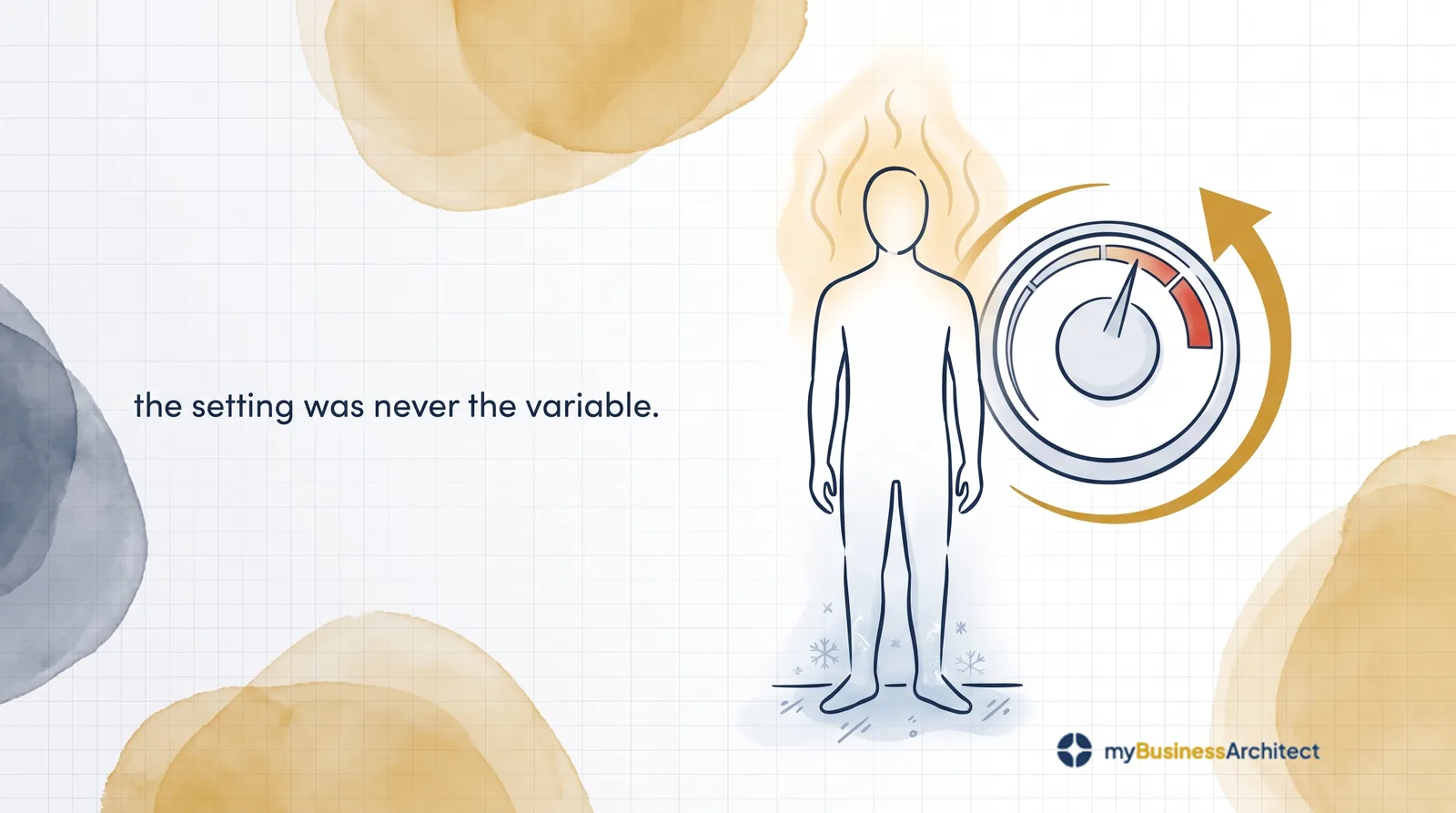
A tall room, a Canadian winter, and somebody who is cold.
They turn the thermostat up two degrees. Half an hour later their head is warm, their feet are still cold, and they are no more comfortable than before. So they turn it up again.
The thermostat is working. The furnace is working. The reading on the wall is accurate and the system is doing exactly what it was designed to do. Everyone involved is competent and the room is still uncomfortable.
The two loops
Chris Argyris and Donald Schön gave this a name in 1978. Single-loop learning is detecting an error and correcting it inside the existing assumptions. It is what the thermostat does, and what the person adjusting it is doing too: the room is off target, so move it back.
Double-loop learning is asking whether the assumptions are right. Not is the room at the set point, but is the set point the thing to be controlling at all.
Here it is not, and the reason is physical.
Human thermal comfort wants warm feet and a cooler head. Forced air supplies the inverse: warm air rises, so the heat collects at the ceiling and arrives last at the floor. Turning up the thermostat sends more heat to a head that was already warm enough, while the feet stay cold. The setting was never the variable that mattered. The delivery profile was.
It worsens with room height: barely detectable in a low room, the whole experience in a tall one. A radiant floor system inverts it, putting heat at the floor and letting it fall away with height, matching what a body actually wants regardless of how tall the room is.
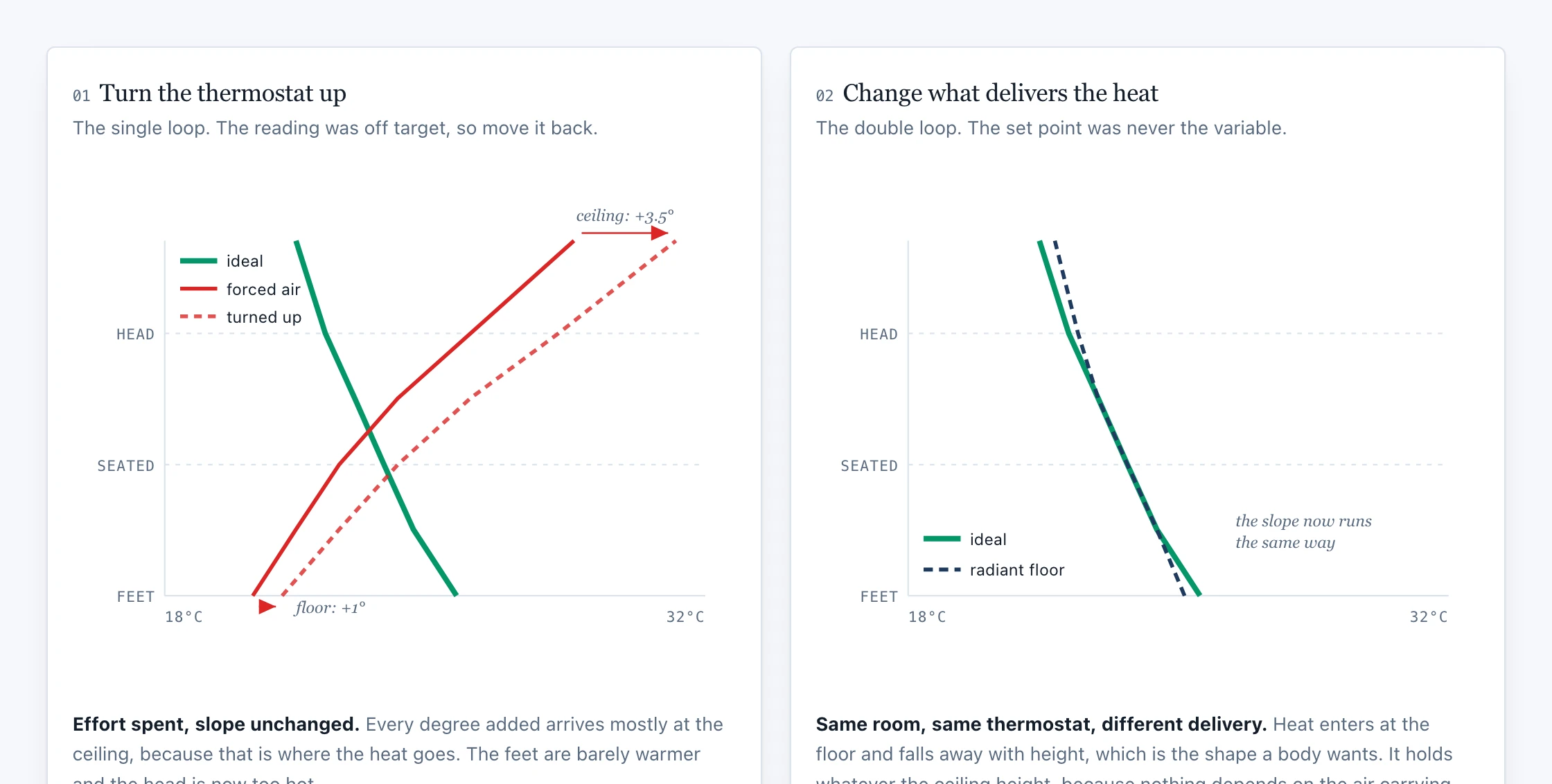
Read the slope, not the setting. Turning the thermostat up moves the whole profile right without changing its direction: the ceiling gains three and a half degrees and the floor gains one. Changing what delivers the heat changes the slope itself.
Which is a fair description of most performance measurement
The dashboard is the thermostat. It reads accurately. The recovery plan is turning it up two degrees.
And measurement built for accountability has the same delivery profile as forced air. It flows upward, because that is the direction with money behind it, and it arrives last, or not at all, at the floor where the work is done and at the people the work is for. Every reading is correct, the reports reconcile, and nobody is any better off.
Organisational stratification worsens with height too. In a small co-located team the gap between what leadership believes is understood and what is actually understood stays small. In a large distributed organisation it becomes the thing culture surveys pick up: leadership scores showing close to the top of the scale on "there is a clear strategy for the future", staff scores in contrast indicating "our strategic direction is unclear to me".
The heat never reached the floor.
Argyris had a second distinction for this, and it is the more uncomfortable one. What people say they believe is their espoused theory. What their behaviour reveals is their theory-in-use, and the two are routinely different without anybody lying. A leadership team scoring itself near the top on strategic clarity is reporting its espoused theory accurately. What staff can see is the theory-in-use. The gap between them is invisible from above by construction, because the person holding the espoused theory has no way to observe it failing to arrive.
And the single-loop response to that finding is to communicate the strategy harder. Restate it, run a roadshow. Which makes the top of the room hotter and does nothing whatsoever for the feet.
So why does nobody run the second loop?
The usual answer is that people do not question their assumptions, which is true and not very useful, because it suggests the fix is to think harder.
Here is a better answer, and it came from a woman I met who had bought a house off plan from a volume builder.
She worked for a hydronics manufacturer, so she had professional knowledge of radiant floor systems and ready access to the parts. Her house had not been built yet. She offered the builder the entire heating system, supplied at her expense, and offered to pay more than the contract price to have it installed instead of the forced air the plans specified.
The builder said no.
It wasn't cost; she had removed the cost. It wasn't supply; she had brought the parts. It wasn't customer preference; she was the customer, asking, in advance, with money.
They said no because every process they had was built around forced air heating systems.
What was actually being protected
It wasn't a heating philosophy. It was a repeatable build.
Radiant floor is not a component swap. It changes the concrete pour and its sequencing, which trades are on site and in what order, what gets inspected and when, the warranty exposure, and who on the payroll is competent to sign it off. A volume builder is an operating model optimised end to end for one way of delivering heat, and she was asking them to change the model for one house on one street.
From inside that model the refusal is not stupidity. It is arithmetic.
Which is the finding worth taking away: the second loop is not usually blocked by ignorance. It is blocked by an operating model that is very good at the first one. The people involved can often see the better answer perfectly well. What they cannot see is a version of it that does not require rebuilding how the work is organised, and nobody has budgeted for that.
The diagnostic this gives you
When you remove the stated obstacle and the answer is still no, the stated obstacle was never the reason.
That is a cheap and slightly ruthless test, and it works on almost any version of this conversation.
We cannot measure outcomes, we do not have the data. Fund the collection, as some funders now do, and see whether their answer changes. Often it does not.
We would review the claims quarterly but nobody has time. Take the preparation off them entirely and watch whether the meeting happens.
We would ask the people we serve, but we have no channel. Pay for the channel and see.
Where the answer stays no after the stated obstacle is gone, you have found the real constraint, and it is almost never informational. It is that acting on the answer would require changing who does what, in what order, answerable to whom, and that change has no owner and no budget line.
What to do about it
Don't think harder. Do three things instead.
Name the delivery profile before optimising the setting. Ask which direction your measurement travels and where it arrives last. If everything flows upward and nothing arrives at the front line or at the people served, no adjustment to the numbers fixes it, because the setting was never the variable.
Run the removal test before accepting a constraint. Take away the stated barrier, cheaply and temporarily if need be, and see whether the behaviour changes. The answer tells you whether you are dealing with a capacity problem or a structural one, and those need entirely different responses.
Cost the change to the operating model, not just the change to the measure. A new indicator is cheap. A new indicator that somebody has to act on requires the capability to act, and that is where the money and the resistance actually live. This is the condition most often skipped when frameworks are built, and it is why so many of them change nothing.
The room was never going to get comfortable by adjusting the thermostat. But knowing that does not warm anyone's feet either, and the builder was not wrong that a different system is a different build.
Somebody has to be willing to pour the floor differently. That is the whole of it, and it is a governance decision rather than a measurement one.
Part of the cluster around Is Anyone Better Off?, on why measurement systems report upward and never learn backward. The first loop closing early is also what happens to curiosity.