The job description says: bridge the gap between strategy and execution. Develop and maintain a holistic view of the enterprise. Translate strategic intent into capability models and value streams. Influence outcomes without holding direct authority. Communicate complex architecture to non-technical audiences.
All accurate, and an impressive mandate. But none of it tells you what the job actually feels like to do, or explains why many business architects spend most of their time as late-stage reviewers of decisions they weren't part of making. Nor does it say who actually pays when that keeps happening: not just the practitioner, but the customers, citizens, and communities the organisation exists to serve.
The gap between the job description and the lived reality of a business architect is structural. Understanding that is where you need to start.
What the Role Actually Exists to Do
The business architect's job is to hold a question that no individual team, project, or department can hold on its own: are the things we are building adding up to the outcomes we exist to produce?
That question operates at the portfolio level (the organisation's full set of programs, projects, and initiatives, not any one of them). It crosses organisational boundaries. It requires someone who can read the strategic intent, assess the capabilities that intent requires, observe what is actually being delivered, and clearly name the gap between what was promised and what is happening.
It's not about execution, it's about outcomes. The business architect is not responsible for ensuring the plan gets followed. They are responsible for the integrity of the chain from purpose through strategy through capability through operations. That chain exists to produce real value: the operational, financial, social, or regulatory outcomes that customers, citizens, or communities actually experience. The business architect's job is to ensure the chain is intact, and to clearly name where it is broken when it isn't.
This is what distinguishes the business architect role from project management (which asks: are we delivering on time and on budget?), from business analysis (which asks: are we building the right thing for this project?), and from enterprise architecture (which asks: do the technology and data layers cohere?). The business architect asks a different question: are the outcomes we exist to produce actually being achieved?
That question sounds simple. Holding it (continuously, across a portfolio, in the face of pressure to focus on delivery metrics and milestone completion) is the practice. What makes it genuinely hard is structural: the business architect carries accountability for a chain they do not control, with no direct authority over the teams, budgets, or decisions that compose it. The tension between that accountability and the absence of authority is the central condition the role operates within, and the reason the skills that matter most are not analytical.
Everything that follows draws on more than 100 recent Business Architect postings across 30 countries, individually read and coded: what employers actually write when hiring for the role, not an audit of how the work gets done once someone is in it. If you want to review the underlying data the rest of the argument builds on, the full findings are here.
The Three Confusions
Across four different business units, HSBC has posted for "Business Architect" roles that look almost nothing alike: an insurance-subsidiary role in Singapore built around target operating models and organisational design; a UK change-execution role in Leeds built around agile ways of working, epics, and OKRs; an alternatives-asset-management role in Hong Kong translating strategy into architectural roadmaps under the bank's own technology-governance standards; and a digital-platforms role, also in Hong Kong, shaping the bank's shift toward what it calls "agentic banking." Same employer, same job title, four genuinely different jobs. That's not a failure of definition. It's what happens when one title has to cover a role this structurally variable, and it's why three conflations about this role keep recurring.
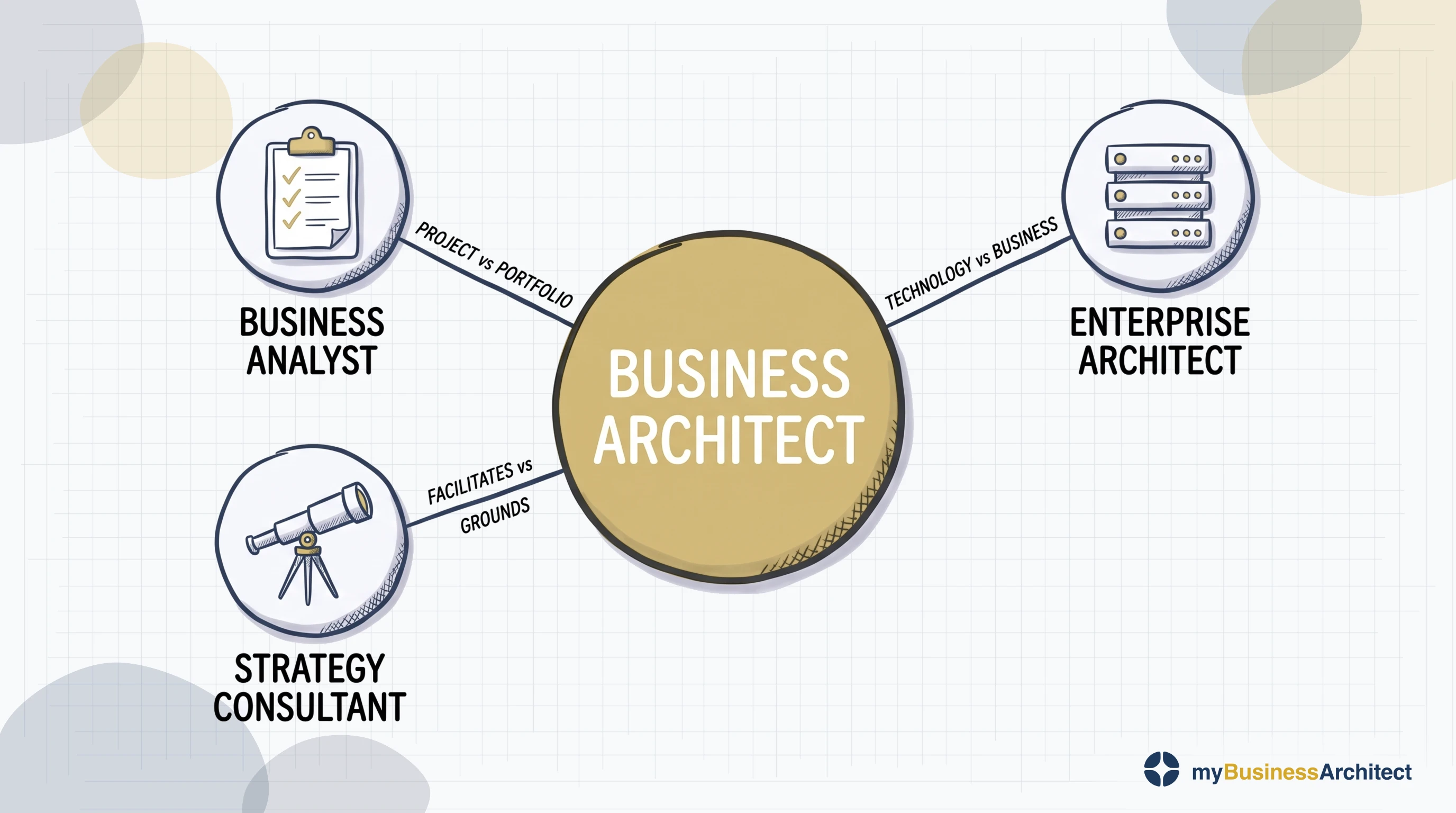 Same title. Three different jobs mistaken for it.
Business Architect vs Business Analyst
The business analyst is project-scoped. Their engagement is bounded by an initiative: what does this project need to do, what are the functional requirements, what does the solution need to include?
The business architect is portfolio-scoped. Their work doesn't end. They ask: does this initiative fit the strategy? Does it build a capability the organisation actually needs? Does it produce an outcome that advances the organisation's purpose? Will the data definitions it creates integrate with the rest of the portfolio, or accumulate as technical debt that costs three times as much to resolve later?
The business analyst defines the what for a specific case: the requirements, the scope, the functional specification. The business architect holds the why across all cases.
Some business architects came from BA backgrounds. The transition isn't primarily about learning new frameworks. It's about abandoning the project-specific perspective and learning to hold the portfolio view instead. This is a different discipline, not a larger version of the same one.
That distinction is measurable, not just conceptual. A review of more than 100 recent business architect postings across 30 countries found essentially no overlap between the fields that most define the discipline (capability modelling, operating-model design, value-stream design) and what a generic senior business analyst posting actually asks for. The career pathway between the two roles is nonetheless real: several employers explicitly accept business-analysis experience as a qualifying route into the role. The two findings aren't in tension. Who can enter the business architect role and what the role does once they're in it are different questions, and the review evidence answers them differently: the door is open. But the destination isn't the same job.
One persistent pressure exists. Business architects with business analysis experience are often the most capable person in the room for requirements-level analysis, and organisations with under-resourced projects will use that capability. The pull back into project-scoped work is real. Holding the portfolio perspective anyway is a discipline that the practicing business architect has to actively maintain.
Business Architect vs Enterprise Architect
The enterprise architect works across technology, data, and application layers, ensuring the technical estate coheres and supports the organisation's direction. The business architect works on the business side: the capabilities, value streams, operating model, and governance structures that the technology must enable.
In practice, the two roles work the same problem from different angles: continuously, not sequentially. The business architect asks what the organisation needs to be able to do and why. The enterprise architect asks how the technology estate can enable it, and at what cost and risk. Strong organisations have dismantled the assumption that business architecture ends and technical architecture begins. The boundary is a perspective, not a handoff. Both roles are in scope for the life of the portfolio.
The evidence bears this out in a specific, textured way, not a blanket one. Measured across job postings, enterprise architect content actually runs ahead of business architect's own benchmark on governance and roadmapping, generic senior-planning vocabulary shared across every architecture-adjacent role, not specific to the business architect. But the two roles diverge sharply on the fields that give business architecture its own name: capability modelling and value-stream design show up consistently in business architect postings and almost never in enterprise architect ones. Solution architect content tells a similar story from a different angle: it matches business architect closely on general architecture and planning language while asking for almost none of the capability or value-stream work that defines this discipline specifically. The overlap between these roles is real. It lives entirely on the planning and governance half of the job. (Solution Architect content follows the same pattern but isn't a fourth confusion tracked here in full.)
Business Architect vs Strategy Consultant
This conflation is less commonly named but equally real. The strategy consultant facilitates the formulation of strategy, helping leaders orient to the landscape, identify the choices available, and make the decisions about what to pursue and what to set aside. Those choices belong to the leaders. The consultant's job is to create the conditions for good ones.
The business architect's job is to ensure those choices are grounded in organisational reality. The strategy choice cascade (Martin and Lafley, Playing to Win) runs from winning aspiration through where to play, how to win, capabilities required, and management systems. It is not a one-way descent. It is iterative. "How to win" must be tested against what the organisation can actually build. If the required capabilities cannot be put in place, the "how to win" has to change. That logic applies at every level of the cascade: a capability gap can force revision of "where to play," and management systems must be tested for whether they reinforce the strategic choices above them or quietly undermine them. The business architect holds the capability intelligence that makes that testing possible. Without it, the cascade writes commitments the capability underneath can't cash. Most job postings, it turns out, don't even ask the role to check.
The business architect who only appears after strategic choices are locked is already too late. The reason isn't a gap in the consultant's own scope: a top-tier strategy consultancy often does real capability and organisation-design work too. The difference is duration. The consultant's understanding is only as current as their engagement; the business architect holds the capability intelligence permanently and stays accountable for it long after the deck is delivered. The strategy consultant brings external strategic intelligence for the life of an engagement; the business architect brings internal capability intelligence that persists. Both are complementary inputs to the same iterative process. Without both, the strategy work produces commitments no one can execute. That is precisely the failure mode named at the start: showing up after the decision is already made, with nothing left to do but review it.
Related: Strategy Choice Cascade: Making Strategy Real: how the five choices work as an iterative system, and why capability assessment is not a downstream step.
Not every title mismatch is like these three, though. Some postings carry the title without the job: one AI-platform startup's "Business Architect" opening turned out to be pure account management, no capability map or architecture vocabulary anywhere in it. That's title dilution, not title variance, and the two look identical on a job board. But confusing them is how a hiring manager ends up interviewing the wrong candidate.
| Business Architect | Business Analyst | Enterprise Architect | Strategy Consultant | |
|---|---|---|---|---|
| Scope | Portfolio | Project-specific | Technology estate | Organisation or business unit |
| Primary question | Are we achieving the outcomes we exist to produce? | What does this initiative need to do? | Does the technical estate cohere? | What should we pursue, and what should we set aside? |
| Horizon | Strategic and continuous | Project lifecycle | Program and platform cycles | Strategy formulation, iterative with capability testing |
| Primary audience | Portfolio leadership, domain owners, program sponsors | Project teams | Technology leadership | Executive and board |
| Gap if missing | Nobody holds the portfolio question, so the mismatch surfaces at delivery, not before | This initiative ships against the wrong requirements | Point solutions multiply, each optimised locally, none of them talking to each other | Strategic choices go untested against what can actually be built |
Where Each Role Actually Sits in the Cycle
The confusions above are easier to see laid against the Design4 cycle, a four-phase model connecting purpose to operations: Discover, Define, Develop, Deliver. The figure below adds three more roles from the same review: Transformation Lead, who runs major change programs; Process Architect, who designs and governs business processes; and Product Manager, who owns a product's roadmap and build.
The Business Architect · Where Each Role Actually Sits in the Cycle
The only role present in all four phases
Business Architect is the only role in this comparison present in all four phases continuously; every other role, including Strategy Consultant, owns a segment. This table is reasoned from each role's own scope and the review's own content patterns, not an independent measurement, with one exception noted below.
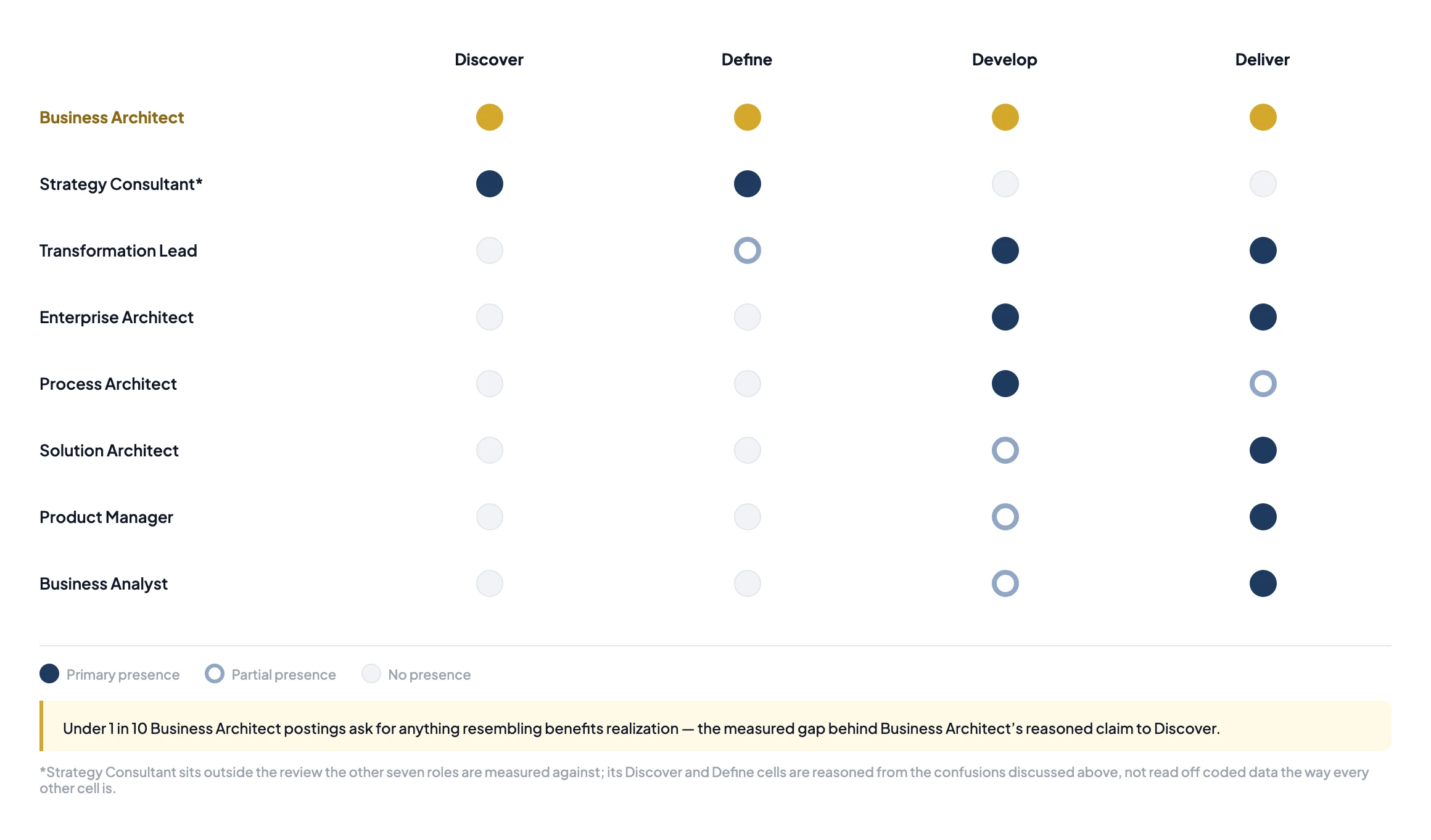
Strategy Consultant sits outside the review the other seven roles are measured against; its two Discover and Define cells are reasoned from the confusion discussed above, not read off coded data the way every other cell is.
One cell deserves a second look. Business Architect's presence in Discover is structurally real but thin in practice: of the more than 100 postings in the review, under one in ten ask for anything resembling benefits realization, connecting delivered value back to purpose. That confirms the gap named earlier: the role exists partly to catch commitments the capability underneath can't cash, and most job postings still don't ask it to check. That's the measured part. The reasoned part, per the figure above, is that verifying delivered value, closing the loop rather than just setting the aspiration, is a piece of Discover no other role in this comparison is positioned to own continuously: Strategy Consultant helps formulate what to aim for, then the engagement ends; Business Architect is the one still there to find out whether it arrived. That distinction makes the low rate a market gap rather than just a data point: the market's own hiring language is under-asking for the one thing that would most clearly earn the role's structural claim to that phase.
How the Role Has Evolved
A decade ago, the business architect's primary deliverable was the model: capability maps, value stream diagrams, process architectures, each one plotting current state, target state, and the gap between them. The discipline's value was in making the implicit explicit: creating a shared picture of how the organisation worked that executives could use for planning and investment decisions.
That work is still real. The models still matter.
What distinguishes senior practice now is not the quality of the capability map. It's what happens in the room after the capability map is presented. The leadership team nods at the heat map and funds something else anyway. The initiative gets approved before the capability assessment is complete. The strategy stays in the document and never reaches the teams who have to build something different.
The practitioner who changes that outcome is not a better modeller. They are someone who understands precisely why correct structural diagnoses keep getting set aside, and who has developed the capacity to change it.
That requires doing something the frameworks don't teach. Hold that diagnosis. Convert it into a governance decision with two real options, each with visible consequences. Take it to the level of leadership that can act on it. Call this the Governance Fork.
Most decision briefs ask a decision-maker to select from a menu of options. A Governance Fork does something narrower and sharper: it makes the organisation choose, on the record, between its stated intent and its current behaviour. This is the cascade's own test, forced into the open: does this management system reinforce the strategy above it, or quietly undermine it. "Here are two delivery models. One is consistent with your stated strategic intent. The other is what you are currently doing. Which one are you choosing?" It is not "here is what is broken," and it is not "we recommend X." A recommendation leaves the practitioner holding the answer, and it can be received, thanked, and shelved without anyone having decided anything. The Fork moves ownership across the table instead: once leadership picks a branch, drift stops being available as a defence, because someone selected it. For it to actually work, the status quo has to be one of the two branches, described for what it actually is rather than a straw version built to lose, and both options have to be genuinely choosable. Sometimes the right answer is to change what the organisation says it wants, not what it's doing; a Fork that always resolves the same way isn't testing anything. An engineered loser isn't a Fork. It's a recommendation pretending to be a choice.
This is not a hypothetical script. A government health portfolio's data and standards function used exactly this move once working-level negotiation for earlier engagement had already failed. The figure below shows the actual choice put to leadership, and what they picked. The full case is here.
The Business Architect · The Governance Fork
Two branches, one choice on the record
A Governance Fork puts two real branches in front of leadership: one consistent with the organisation's stated intent, one its current behaviour, continued. Both have to be genuinely choosable and actually costed, not a diagnosis dressed as a choice. Once leadership picks a branch, ownership moves across the table: drift stops being available as a defence.
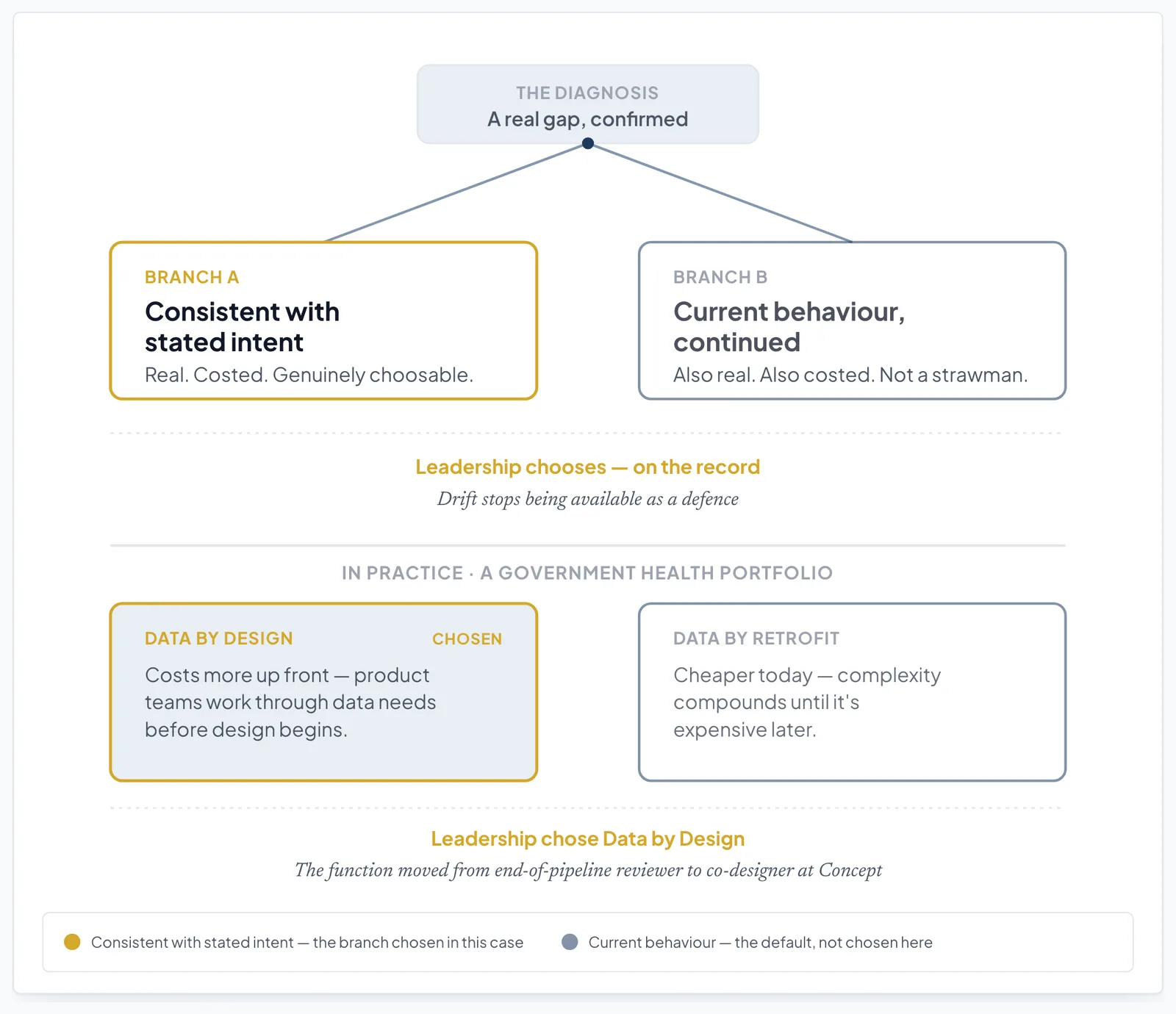
Saying it out loud is a real professional risk, not a formula. The person putting the choice on the table usually has no formal authority over the people hearing it. The Fork only works in front of leadership with actual decision rights, not just visibility, and getting in front of that room is frequently the harder half of the job to secure. None of that makes it optional. It is a structural intervention, not a communications technique: it converts analysis into a decision the organisation has to make, and makes the business architect the person who put the choice on the table.
The Governance Fork forces the decision the Four Ares depend on: are we doing the right things, are we doing them the right way, are we getting them done well, and are we getting the benefits, the four governance questions Design4 asks at each phase of the cycle. Get the first one wrong and the other three are never reachable, however well the rest of the work goes. Naming the choice doesn't deliver the benefit. It makes delivering the benefit possible. The four questions are explained fully here.
The same review suggests why the business conversation, not the model, is usually where this gets decided, and why the Fork is the exception rather than the default move. Collaboration and facilitation are the two most commonly named soft skills in the review; direct-advocacy influence trails well behind Enterprise Architect and Solution Architect postings. Read against the case above, that isn't evidence against the Fork. It's the reason the Fork works when it's needed: the collaborative register is the default, and it's usually right, but the health-portfolio Fork only got used once working-level negotiation had already failed. The Fork isn't an alternative to facilitation. It's the move a facilitator has left once facilitation has been genuinely exhausted and the decision is still drifting. A handful of Australian postings in the review gesture at the same idea in softer language, stakeholder credibility, the ability to "respectfully contest ideas," without ever naming the Fork directly.
The frameworks are the prerequisite. The conversation gets you in the room. The choice is the practice.
What the Role Is Becoming
Two forces are reshaping the business architect's position in organisations. One is structural. One is technological.
The Coordination Problem
As organisations scale complexity (more products, more vendors, more regulatory pressure, more stakeholder expectations), the portfolio-level coordination problem grows. Individual teams making rational local decisions produce aggregate outcomes nobody designed. Data that was supposed to be interoperable isn't. Capabilities that were supposed to be shared are duplicated across multiple product lines. The strategy that was supposed to connect purpose to operations has become a document nobody references when real decisions are being made.
Related: Three Forces That Make Strategy Fail (and None of Them Are Effort): speed, complexity, and purpose are reshaping how every organisation operates, and none of them are a matter of trying harder.
In this environment, the business architect's role is not advisory. It is structural. Holding the portfolio-level question, naming the accumulating cost of uncoordinated local decisions, and framing the governance choice for leadership: this is the work organisations need most and find hardest to fill.
The function that is called in too late to influence the decisions that matter will always appear to create friction rather than remove it. Changing that requires a governance decision, not a better pitch. Most organisations will not make this governance decision unless someone forces the question. The business architect who can do that (not just frame the choice, but ensure it lands as a real governance decision with named consequences) is doing something most practitioners cannot do.
See it in practice: When the Data Function Can't Prove Its Value: the same portfolio referenced above, and how Design4, a governance-cycle framework, diagnosed the structural failure.
The AI Dimension
The most significant technical shift in 2025 and 2026 is the emergence of AI-first architecture. The direction of travel is clear: systems where AI agents perform complex, multi-step tasks with increasing autonomy, reducing human involvement at each intermediate step. That requires business architects who can define business domains with precision, structure semantic models that AI systems can operate within, and design capability frameworks that remain auditable and aligned with purpose as intelligent systems scale.
This is not a call to become an AI specialist. It is a recognition that the foundational skills of business architecture (semantic clarity, capability design, value stream definition, stakeholder orchestration) are exactly what AI-era organisations need to govern intelligent systems well.
But in the same review, adjacent roles like solution architect and product manager mention AI more often than business architect postings do, not less. That's not the discipline lagging so much as what those roles are for: solution architect and product manager postings are often about building AI-enabled systems directly, where AI is the subject of the work, not a market-trend line in a job posting. We should ask whether the practitioners doing business architecture work treat AI governance as an extension of a mandate they already hold (semantic clarity, capability design, accountability without direct authority), or wait for it to be assigned to someone else.
That mandate is now more concrete than it used to be, not fundamentally different. As AI agents take on consequential tasks autonomously, the question of whether those agents remain aligned with business purpose (whether their outputs are traceable to the value streams they serve, whether accountability is clear when something goes wrong) becomes an architectural responsibility. That is not a technology problem. It is a business architecture problem.
There is also a strategic dimension that sits above governance. If AI changes what capabilities are possible (and it is), it also changes which capabilities are strategically necessary. A capability that used to require a scale advantage, deep in-house actuarial or legal expertise, for instance, is now available to a much smaller competitor through an AI system trained on the same domain knowledge. An organisation's "how to win" formulated before this shift may no longer be the right bet: one built on that expertise staying scarce needs a different bet now, not a faster version of the old one. The business architect who holds the capability intelligence can see that. The question of whether the cascade needs to be ascended and revised is an architectural view, not a technology implementation question.
The honest picture: for practitioners who hold the portfolio question, frame governance choices, and translate intent into governed capability, the AI shift increases the value of the work. For practitioners who define themselves primarily by their modelling deliverables, that work is increasingly replicable by AI tooling. The business architect role is not uniformly made more necessary. The practitioner who has built the practice is.
What that split actually looks like is worth its own read.
What It Actually Takes
The business architect job postings are consistent: 5 to 10 years of experience (senior and lead-level roles cite 10 to 15), frameworks fluency, senior stakeholder engagement, cross-portfolio perspective. All accurate. None of it names what the practice actually requires to develop.
The credentials themselves are a good illustration of how misleading the postings can be if read literally. TOGAF alone is named in roughly half of them; BIZBOK and the mixed business-analysis/business-architecture certification family trail well behind. Whichever framework, it's actually required, not just preferred, in a small minority. The market currently treats demonstrated experience as the real qualifying signal and the certificate as secondary confirmation of it, not the other way round.
Stakeholder management is the single most commonly named field among those that actually discriminate between roles in the same review, ahead of governance, roadmapping, or any named certification. Here are the four things senior business architects actually do, all of them versions of managing stakeholders well: three have to be true before the Governance Fork can actually work, and a fourth only comes with experience.
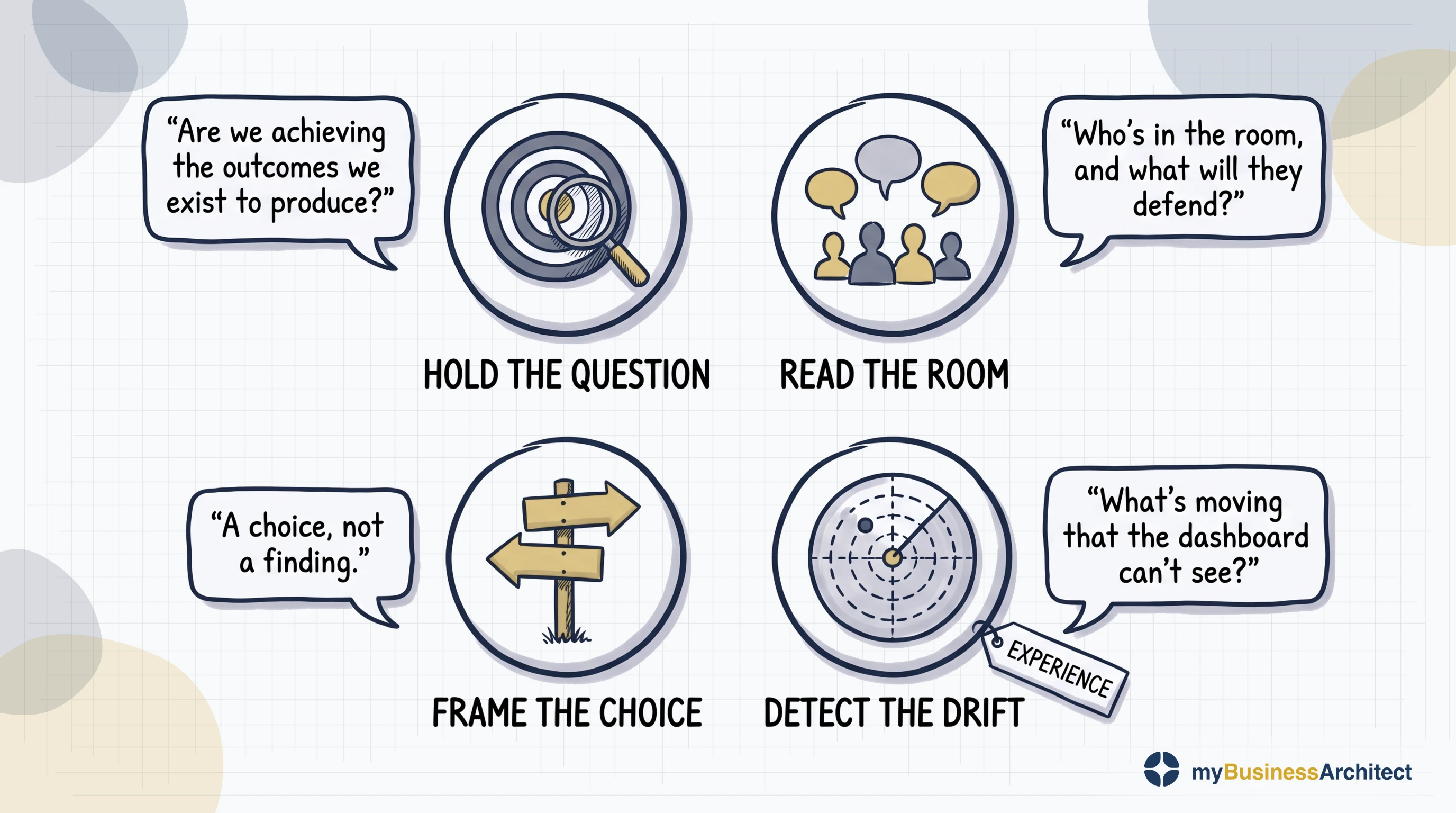 The first three are prerequisites. The fourth comes with time.
They hold the portfolio-level question continuously, not project by project, across the portfolio, through cycles, against the ongoing pressure to focus on what is immediate and measurable. The question is always the same: are the outcomes we exist to produce actually being achieved? If they are, the chain from purpose to operations is intact. If they aren't, something upstream is broken, and the business architect's job is to find it.
They read the political structure before presenting the analysis. A capability heat map is an analytical document. When the person responsible for that capability is in the room, it becomes a political one. The same finding can produce a productive governance conversation or an entrenched defensive response, depending entirely on who framed it, for whom, and when. Senior business architects read that dynamic in advance. They know which findings will generate resistance, who the sponsor needs to be, and what the first cycle of productive engagement looks like before any diagnostic work begins.
They frame choices for leadership, not findings. This is the Governance Fork again, and it's what separates practitioners whose work lands from practitioners whose work gets deferred: a presentation of findings is something leadership can defer; a Fork isn't. It is not confrontational. It is precise. And it is what closes the gap between correct analysis and funded action.
Timing matters as much as framing. A governance choice presented before the sponsor is ready, or before the cost of the current trajectory is visible to the people in the room, will be deferred just as readily as a findings presentation. Reading when the moment is right is part of the capability.
A fourth capability develops with experience: detecting the drift that doesn't trigger a dashboard alert. Operations can move quietly away from mission while every metric insists things are on track. Capabilities get built but never reach the front line. Strategy documents exist that nobody ever references in real decisions. The organisation is busy, KPIs are met, and it has quietly stopped delivering on its reason for existing. The business architect who can sense that drift and call it out, before the crisis makes it undeniable, is doing the work at its most valuable and its hardest to justify. It's the Governance Fork again, this time aimed at drift instead of a single bad decision.
Related: Strategy to Execution: How to Close the Gap: its Operations-to-Purpose gap covers this pattern in depth, how operations drift from mission while dashboards stay green, and what it takes to close it.
These are not natural skills. They are developed through practice, through pattern recognition, and through the accumulated experience of being in rooms where the analysis was right and the organisation funded something else anyway, and eventually learning to change that.
The Practitioner's Question
Go back to the opening business architect job description: develop a holistic view, translate strategic intent into capability models, influence outcomes without direct authority. Every line of it is accurate, and for the right candidate, clearing that bar isn't the hard part. Succeeding at the job is a different task, and almost nothing in the postings names it: a few hint at it, most don't mention it at all. What's missing is the capability that actually separates the two: verifying that the value promised showed up, and forcing the choice when it hasn't. That's not something a posting can screen for. It's something you build. It's the difference between getting the job and building the practice.
The role is not a modelling function, a documentation service, or a framework application role. It is the practitioner who holds the question no individual team can hold, whether the work the organisation is doing is producing the outcomes it exists to deliver, and who combines the structural diagnosis, the governance framing, and the political read to act on the answer when it's no.
What takes longer, and matters more, is developing the capacity to keep asking that question when the organisation would rather you focus on delivery metrics, and to change the answer when it's wrong.
The practitioner's own positioning problem has an answer, but it arrives in a sequence, not all at once. The Governance Fork is the move you make before you have any standing in the room: a structural diagnosis converted into a choice leadership has to make, put there by someone who usually has no formal claim to be there at all. Organisations can and do decide without that person in the room. They just decide worse: the leadership team nods at the heat map and funds something else anyway, exactly the pattern named earlier. Put enough real choices on the table, and that changes. Leadership starts wanting the practitioner there before the next decision, not after it. That's not a seat negotiated. It's a seat that accrues, one Fork at a time, until testing "how to win" against "what we can actually build" is something leadership does with this person in the room by default.
That's the other side of the opening problem. The practitioner who has built this practice is no longer the late-stage reviewer, finding out about the decision after it's already been made. They are the reason the decision goes the other way: the one where the organisation chooses what it says it wants, not what it's already doing by default. That shift, from being right and overruled to being the person the room cannot move without, is what a career of Governance Forks actually builds toward.
Frequently Asked Questions
What does a business architect do?
Keeps asking the question no single project or department can hold on its own: are the things the organisation is building actually producing the outcomes it exists to deliver? In practice that means translating strategy into capability, operating-model, and process work, tracking it across the whole portfolio rather than one initiative, and converting what's found into a Governance Fork, a choice with two real options that leadership has to make on the record. Across recent job postings, a "translate strategy into capabilities, operating models, and transformation roadmaps" mandate recurs in employer language independently, worldwide.
Do I need formal authority to use the Governance Fork?
No, and that's the point. The Fork works precisely because it doesn't require the practitioner to hold power over the room, it converts a diagnosis into a choice leadership has to make, on the record, which is a different kind of move than persuading people to agree with you. What it does require is standing: access to a room with people who actually have decision rights, not just visibility into the decision. That access isn't given up front. It's built the same way capability intelligence is, one real choice put on the table at a time, until leadership starts wanting you there before the next one comes up.
How do I become a business architect?
There's no single path, but the market's own pattern is consistent: most postings ask for 5 to 10 years of experience (senior and lead-level roles cite 10 to 15), a degree in "business, commerce, technology, engineering, or a related discipline" (deliberately broad, not a computer-science gate), and demonstrated experience over any named framework. A background in business analysis is a genuine, commonly accepted entry route, even though the two roles do different work once you're in. Learn the frameworks. Build the practice on top of them.
Is business architect in demand?
Job-board search volume for the phrase itself is thin, which is a market-visibility quirk, not a demand signal. The actual demand shows up differently: postings for the role exist across at least 30 countries and a wide range of sectors, most commonly reporting into transformation, enterprise-strategy, or technology functions at large, multi-line-of-business employers, with financial services the best-represented single sector. The harder gap to fill isn't the modeller. It's the practitioner who can convert a correct diagnosis into a Governance Fork, a real choice leadership has to make, not just a finding to file away.
Will AI replace business architects the way it might replace business analysts?
The evidence shows almost no content overlap between business architect and generic business-analyst work already, so "AI replaces one, therefore it replaces the other" doesn't hold up. Within business architecture itself, the honest split is by practice, not by title: for practitioners who define themselves by modelling deliverables alone, that work is increasingly replicable by AI tooling. For practitioners who hold the portfolio question, frame governance choices, and translate intent into governed capability, the AI shift increases the value of the work, and adds a genuinely new mandate (AI governance) on top of it.
Continue Learning
Research and going deeper
- What the Business Architect Role Actually Is: the full findings behind every comparison above, more than 100 postings across 30 countries, individually read and coded
Pillar pages
- What Is Business Architecture?: the discipline, the models, and how it connects purpose to delivery
- Strategy to Execution: How to Close the Gap: the four gaps where the chain from strategy to outcomes breaks
- Business Architecture Framework: The Design4 Approach: the four-phase governance cycle in depth
Case studies
- When the Data Function Can't Prove Its Value: Design4 applied to a real portfolio positioning problem in government health
Courses
- Closing the Strategy-Execution Gap, the foundational course: purpose, strategy, capability, operations, and where each connection breaks
- Building the Common Language: standardised models for naming what you see across the portfolio
- Communicating Business Architecture: making the work land in the room
- Shaping What Gets Built: the governance and solution oversight skills that distinguish senior practice